
7 Small Block Muscle Cars That Prove There Is a Replacement For Displacement
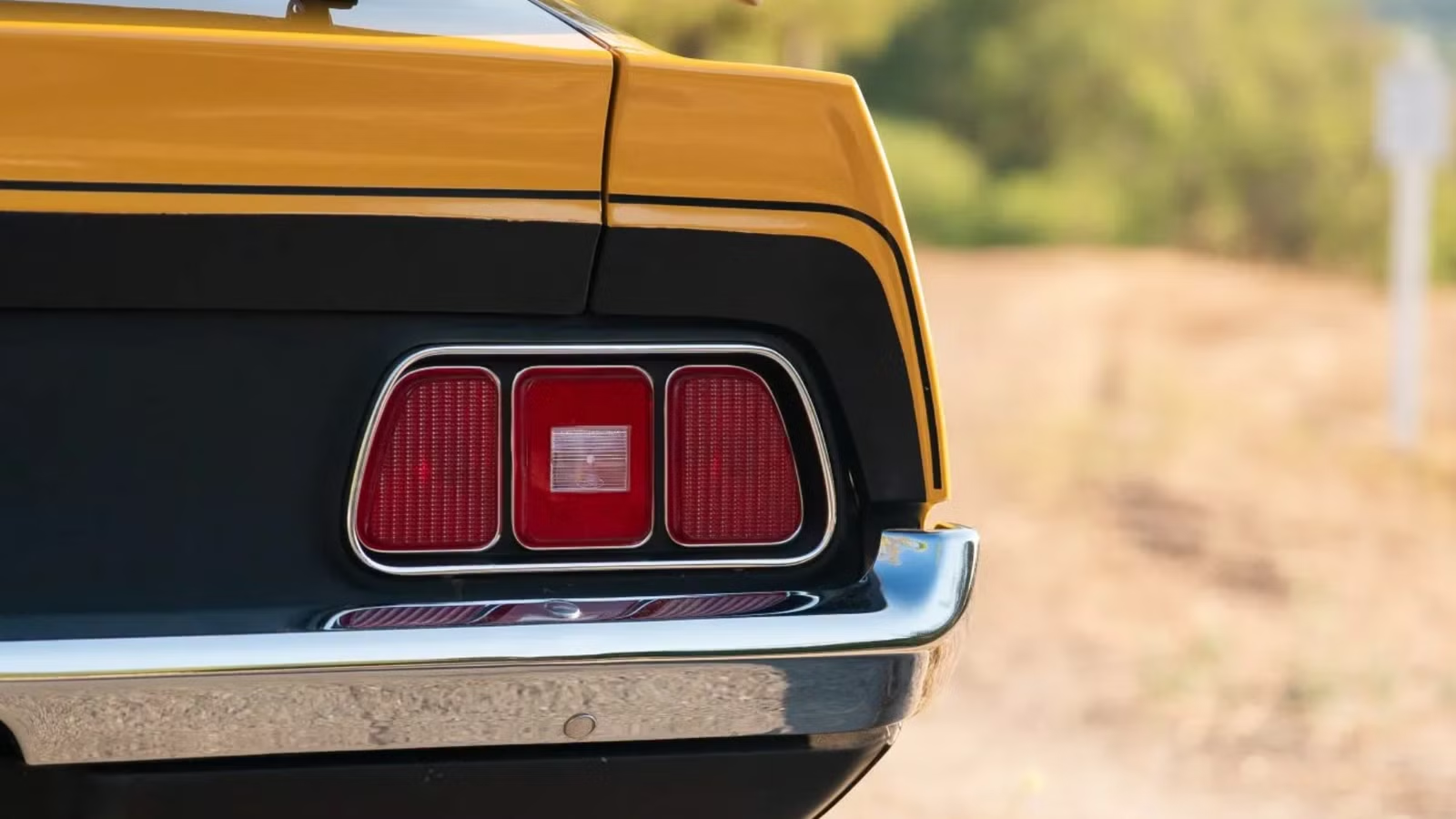
When people talk about classic American Muscle Cars, the top billing always goes to the big-block monsters. That’s absolutely understandable. Those were the muscle cars that had the most power, and in some cases were so fast that they could genuinely worry the first proper supercars. But the saying that “there’s no replacement for displacement” isn’t always true. There were plenty of small-block models during the muscle car heyday that were powerful enough to be an attractive alternative to those big-block monsters.
7
Dodge Dart GTS 340
Power Output: 275 hp

The Dodge Dart GTS 340 is a sporty compact car that can genuinely take the fight to the big boys in terms of its performance. It wasn’t the only high-performance Dart Dodge offered, but it is certainly one of the finest. As you’d expect from the name, it has a 340 cubic inch V8 under the hood. This engine was rated at 275 horsepower and 340 lb-ft of torque.
That 275 hp rating is impressive for a compact American car. But, this is known to be a significant under-rating. People who have done independent dyno tests on Dart GTS 340s have claimed readings of 300 hp or more. That, along with it feeling lighter than bigger-engined Darts due to its smaller and lighter engine, puts this classic muscle car squarely into the performance monster category.
6
Ford Mustang Boss 302
Power Output: 290 hp


When people talk about the Boss Mustangs from the golden age of American muscle cars, they’ll typically wax lyrical over the Boss 429. While that’s a brilliant homologation special muscle car, people are missing out on the other small-block Boss made at the same time. The Boss 302 is also a homologation special, but it wasn’t intended for the super speedways of NASCAR. It was designed to be Ford’s competitor in the Trans Am series, racing alongside cars like the Chevrolet Camaro Z/28 and the AMC Javelin.
As the name suggests, it has a 302 cubic inch V8. This V8 is slightly unusual: it uses the engine block from the Windsor V8, but has some components from the bigger 351 cubic inch Cleveland V8. Those Cleveland V8 components helped to make its engine both more powerful and more durable. This engine became known as the G-Code, and it was rated at 290 hp and 290 lb-ft of torque from the factory.
The Boss 302 was quite successful in the short time it spent in the Trans Am series. Parnelli Jones even won the championship driving one in 1970. But after that point, Ford pulled factory support from the Trans Am teams using its cars, and the Boss 302 disappeared from competition.
5
Plymouth AAR ‘Cuda
Power Output: 290 hp

When people talk about the Plymouth ‘Cuda, the monstrous big-block Hemi ‘Cuda is the one that usually comes to mind. But, Plymouth had a small-block performance monster up its sleeve as well, in the form of the AAR ‘Cuda. Instead of the 426 Hemi V8 the Hemi ‘Cuda got, the AAR ‘Cuda got a 340 unit with three 2-barrel Holley carburetors. This made it a “Six-Barrel” engine in Mopar parlance. The result of that was an output rated at 290 hp and up to 350 lb-ft of torque.
Like the Ford Mustang Boss 302, the Plymouth AAR ‘Cuda was a homologation special designed for the Trans Am series. That made it more of a driver’s car in some ways than the Hemi ‘Cuda. The small-block AAR ‘Cuda was designed for handling on a twisty road course, rather than being blisteringly fast in a straight line like the all-muscle Hemi ‘Cuda. But, it was nowhere near as successful as the cars it competed with (including the aforementioned Boss 302 Mustang). It is not surprising, then, that the AAR ‘Cuda has become somewhat forgotten.
4
Oldsmobile Cutlass W-31
Power Output: 325 hp
Of all the classic muscle cars covered on this list, the Oldsmobile Cutlass W-31 is one that perhaps gets the least airtime. That means that people forget about how much of a dark horse this car really is. The W-31 package added the 350 cubic inch version of the Rocket V8 to the Cutlass, which was rated at 325 hp and 360 lb-ft of torque.
There’s an argument to be made that the Oldsmobile Cutlass W-31 is the most underrated small-block muscle car ever. Considering how powerful it is relative to the size of its engine and how little people talk about it, that’s not a bad argument to make. This car really could hold a candle to some of the big-block monsters it was sold alongside.
3
Ford Mustang Boss 351
Power Output: 330 hp

The second Boss Mustang to be featured on this list, the Boss 351 is a direct successor to the Boss 302 in many ways. Scrapping the G-Code V8, the Boss 351 uses the 351 cubic inch (hence the name) Cleveland V8 instead. This bigger, more conventional V8 was rated at 330 hp and 370 lb-ft of torque from the factory. That makes it both more powerful and more torquey than the Boss 302, particularly in terms of torque.
Judging it on its own merits, the Boss 351 has to easily be one of the best small-block muscle cars ever. But it rarely gets talked about. That’s been great for collectors, as it’s kept values relatively low. But it’s meant that this car barely gets a mention in the enthusiast circles that should absolutely adore it.
2
Chevrolet Malibu SS
Power Output: 350 hp

There aren’t many cars as emblematic of what a classic American car should be as the Chevrolet Malibu. Examples from that ’60s-’70s golden era have the classic American car styling that people love, and they were available with a good selection of V8s. This includes the fantastic L79 V8 that was put into the Malibu SS.
The 327 L79 is one of the smaller engines that we’ll come across in this list. But it packs quite a punch, being rated at 350 hp and 360 lb-ft of torque. That makes the Malibu SS (with this engine) one of the most powerful cars on this list. The power from this relatively small V8 was enough to square up to big-block monsters of the era, while not feeling too overpowered.
1
Chevrolet Yenko Nova Deuce
Power Output: 360 hp

There aren’t many names that have more of an aura among muscle car enthusiasts than Yenko. Don Yenko was an entrepreneurial dealer who took full advantage of General Motors’ COPO system to create absolutely unhinged muscle car specials. One of them is the Yenko Nova Deuce. Named after the Beach Boys song “Little Deuce Coupe,” only 175 of these remarkable COPO specials were ever built.
In a rare turn of events for a Yenko Chevrolet, the Nova Deuce isn’t powered by a big-block monster engine. It’s actually got a 350 cubic inch small-block V8. This engine in particular is the LT-1, which was rated at 360 hp and 380 lb-ft of torque. Those are numbers that can easily challenge a conventional big-block muscle car.
Sources: Chevrolet, Dodge, Ford, Plymouth, Yenko

Related posts

Latest Post


No Comments