
7 Hemi Variants Even Serious Mopar Guys Rarely Discuss
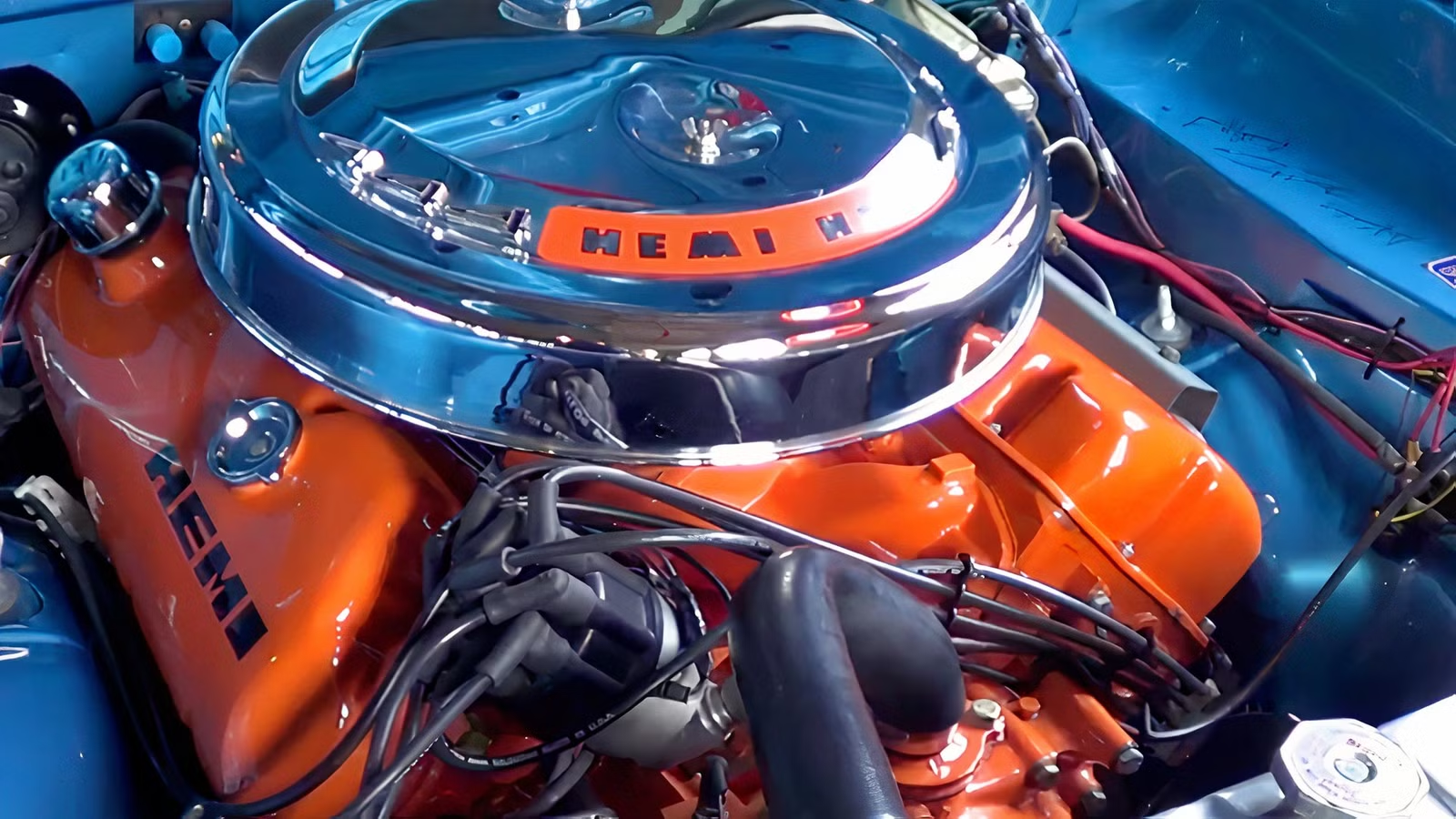
The Chrysler Hemi V-8 is the most iconic engine in automotive history and, for generations, has made Mopar muscle cars the fastest things on the streets. The 425-horsepower, 490 pound-feet of torque 426ci Street Hemi bestowed dominance on Dodge and Plymouth muscle cars during the Golden Age, while the 808-horsepower 6.2-liter supercharged Hemi Hellcat empowered Challengers and Chargers with soul-crushing performance in the Modern Age. Even non-car people, who we call “normies,” have heard of the Hemi engine and, for enthusiasts, it’s all they can talk about.
There are, however, some pretty amazing Hemi engines that have been forgotten, which need to be a part of the conversation. Long before the 426 Street Hemi debuted in 1966, there were kick-ass Hemis, even if they weren’t marketed as such yet. Here are some important Hemi engines that even hardcore Mopar nuts might not be aware of or rarely talk about but should.
7
Chrysler FirePower 331
Maximum Power: 300 HP
Chrysler first developed the hemispherical combustion chamber engine for use in fighter aircraft and tanks during WWII, and eventually brought that radical technology to passenger vehicles in 1951 with the FirePower series V-8s. These engines are now retroactively referred to as the first-gen Hemis, and they were, but wouldn’t be called that until the 1966 reboot, when Chrysler marketing figured out what a cool selling point it was. The first of the proto-Hemis was the 1951 331ci FirePower V-8 that produced 180 horsepower and 312 pound-feet of torque with a single two-barrel carburetor. Most cars equipped with the 331 had that power rating, but in 1955, Chrysler built a dual-quad version that roared with 300 horsepower and 345 pound-feet of torque, which was insane for the day.
Engine Specifications And Applications


The 331 FirePower literally defined the 1955 Chrysler C-300, which stood for “Coupe” with 300 horsepower. This car could go 0-60 in 10.0 seconds and had a quarter-mile time of 17.5 seconds, which sounds super-slow to us today, but was blistering for the time. Tim Flock was the 1955 NASCAR Grand National Champion with 18 checkered flags and 18 pole positions behind the wheel of a 331-equipped ’55 Chrysler C-300. This speedster was advertised as “America’s Most Powerful Car” which it most certainly was, but was also dubbed the “The Banker’s Hot Rod” because it was expensive. Starting at $4,100, which is the equivalent of $51,268 in today’s bucks, and with a production run of 1,725, this was an exclusive luxury vehicle that the people who would have enjoyed it the most couldn’t afford.
- Production Years: 1951-1955
- Displacement: 331ci
- Power: 300 HP
- Torque: 312 LB-FT
- Noteworthy Applications: 1955 Chrysler C-300
6
Aussie Valiant Hemi-6 – 302 HP
Maximum Power: 302 HP

A lot of people probably don’t know that back in the day, Australia had Mopar muscle cars with Hemi engines, but not in the same way they ruled the American streets. The engine in question was the 265 Hemi Six-Pack Inline-Six, produced by Chrysler Australia, and like its name would suggest, it was a 265ci Hemi I-6 with a trio of two-barrel carburetors. Rated at 302 horsepower and 320 pound-feet of torque, it was a far cry from the 426 Street Hemi, but in its application, was quite effective. One of the most notable features about the Hemi from Down Under was the side-mounted carbs and air cleaners that made it look like whoever installed it was drunk. It also used high-performance parts like a hotter cam, upgraded pistons and rods, as well as tuned heads to get power beyond its displacement.
Engine Specifications And Applications

The Aussie Hemi-6 dynamo was made for the 1972 Chrysler VH Valiant Charger R/T E49, which is way too much name, but was surprisingly badass. The compact muscle car was capable of 5.6-second 0-60 acceleration and a 14.1-second quarter-mile ET which, again, ain’t nothing compared to a 426 Hemi V-8, but was actually quicker than American Mopars that year. 1972 was the beginning of the Malaise Era of detuned engines, plus both the 426 Hemi and 440 Six Pack were discontinued, so Dodge and Plymouth muscle cars were absolutely neutered. A ’72 Charger or Road Runner with a 440 ran a quarter-mile in 15.0-seconds, which was almost two seconds slower than a 426-eqipped ’71 and nearly a full second worse than that crazy Aussie Hemi-6 Valiant Charger.
- Production Years: 1972
- Displacement: 265ci
- Power: 302 HP
- Torque: 320 LB-FT
- Noteworthy Applications: 1972 Chrysler VH Valiant Charger R/T E49
5
Dodge Super Red Ram 325 D-500
Maximum Power: 310 HP

When Chrysler introduced the FirePower Hemi engines in 1951, all of its divisions except Plymouth got their own versions, but it was utter chaos. None of the Hemi variants had interchangeable parts and all had different blocks and bore spacings. Dodge’s Hemi engines were called the Red Rams, which isn’t the coolest name, but as you will soon see, also wasn’t the lamest. The best of these Red Rams was the 325ci D-500 dual-quad Hemi-headed V-8 that cranked out 310 horsepower and 340 pound-feet of torque. There is a bit of confusion with this particular displacement because there was also a “Poly” head 325 that wasn’t exactly a Hemi and also, a completely different engine. The 325 D-500 was the real-deal Hemi and one of the baddest V-8s of the year.
Engine Specifications And Applications

People tend to remember the Dodge Coronet as the boxy, aggressive bruiser of the Golden Age of American Muscle, but it used to be a stylish near-luxury ride. It was still a street machine though, as the ’57 Coronet Super D500, and its 325ci D-500 V-8 proved. Hitting 0-60 in 8 seconds, burning up the quarter-mile in 16.5 seconds, and hitting a top speed of 120 MPH, there weren’t any non-Mopars that could touch it. Just 399 D-500 V-8s were installed across all of Dodge’s lineup in ’57, but no actual records of how many found a home in the Coronet. Suffice it to say, this is one rare Hemi but, unlike Golden Age rides, it is surprisingly affordable. That super-clean D-500 drop-top pictured above sold for just $82,500 at Mecum Glendale 2026, which is an astonishingly low price for a Hemi convertible that may be one of only a handful left in existence.
- Production Years: 1957
- Displacement: 325ci
- Power: 310 HP
- Torque: 340 LB-FT
- Noteworthy Applications: 1957 Dodge Coronet Super D500
4
DeSoto FireDome 345
Maximum Power: 345 HP

While “FireDome” sounds like a post-apocalyptic battel arena, it’s actually DeSoto’s version of the Chrysler FirePower Hemi engine. Firedome (with a little D) was also a DeSoto model produced from 1952-1959 with various FireDome engines ranging from 276ci to 361ci. In 1957, DeSoto came out with the 345ci FireDome, it’s most powerful Hemi engine, but none were equipped with the Firedome, go figure. In any case, the 345 FireDome featured twin Carter WCFB four-barrel carburetors and produced 345 horsepower, one of the first to jam out one pony per cubic inch, and 355 pound-feet of torque. As great of a performance engine as this was, it was only around for a single model year.
Engine Specifications And Applications

The reason why the Firedome never got a 345 FireDome is because it was exclusive to the 1957 DeSoto Adventurer. Right about now, it might have just hit some folks that this car was in fact a Mopar, as before going belly up in 1961, DeSoto was a Chrysler division. The luxury Adventurer was a total land yacht weighing 4,300 pounds, but the 345 FireDome got it moving pretty well with an 8,0-second 0-60 time and a 125 MPH top speed. They only made 1,950 Adventurers in ’57 and 300 of them were convertibles, which are the most expensive Mopars nobody has ever heard of. That gold drop-top pictured above literally struck gold for the seller, crossing the auction block for $247,500 in 2023.
- Production Years: 1957
- Displacement: 345ci
- Power: 345 HP
- Torque: 355 LB-FT
- Noteworthy Applications: 1957 DeSoto Adventurer Convertible
3
Chrysler FirePower 392
Maximum Power: 375 HP

The Chrysler 392ci FirePower V-8 was the ultimate first-gen Hemi engine and such an icon that Dodge would pay tribute to it in 2011 with the Challenger SRT 392. The modern muscle car’s 6.4-liter Hemi engine converts to 392 cubic inches, and that was no coincidence. The OG 392ci FirePower came in several configurations, from a 325-horsepower four-barrel base to the raging dual-quad 375-horsepower version. There was also a 390-horespower fuel-injected variant offered in 1958, but it was wonky as hell and 15 of the 16 cars optioned with it were recalled and fitted with carburetors, so we’re not counting it as the top output of this killer early Hemi. Even though the 392 FirePower was only produced in 1957 and 1957, drag racers would later discover, and it proved to be unbeatable until the second-gen Hemi came along in the early 1960s.
Engine Specifications And Applications

The 1957 Chrysler 300C with the 392 ForePower V-8 was the baddest ride of the entire 1950s and that some consider the first muscle car, but it wasn’t for a couple of reasons. First, the 300C was a full-size ride and muscle cars are intermediates, and second, it was an expensive luxury car with a MSRP of $4,929 ($58,783 adjustd for inflation) and muscle cars are inexpensive, so knuckleheads and speed junkies can afford them. It was, however, a muscular ride with an 8.0-second 0-60 time, a quarter-mile ET in the 15s, and a 140 MPH top speed, all of which were bests for 1957. Chrysler made 2,402, so this is a Mopar rarity, but only the 484 convertibles ever made are unicorns. A hardtop in great condition can be had for under $50,000, but a drop-top will run in the six-figures with a top sale of $214,500.
- Production Years: 1957-1958
- Displacement: 392ci
- Power: 375 HP
- Torque:
- Noteworthy Applications: 1957 Chrsler 300C
2
Chrysler Ball-Stud Hemi
Maximum Power: 375-425 HP

The Chrysler Ball-Stud Hemi, named for its ball-stud-style rocker arms, is a genuine Mopar urban legend that turned out to be real. Chrysler had the baddest engines of the Golden Age with 383, 400, 440, and 426 big-blocks, as well as the 340 small-block, but they were all different and didn’t have interchangable parts, plus the Hemi was very expensive to produce. They sought to replace them all with a unified block now known as the Ball-Stud Hemi in 1972. There was going to be a 400ci V-8 and a 444ci V-8 that were said to produce more than a 440 but less than a 426, so somewhere in the 375-425 horsepower range. As amazing as this engine seemed, it never went into production and the Malaise Era of detuned engines is why. Emissions standards and consumer demand for fuel economy ripped the heart and soul out of the Golden Age muscle cars, and Chrysler didn’t see any reason to go forward with a new performance V-8 at that point.
Engine Specifications And Applications

It is believed that between 3 and 12 Ball-Stud Hemi prototypes were built, but only one still exists today, and it’s under the hood of a 1969 Plymouth Barracuda. How it got there is a weird and wild journey that started with legendary drag Racer Dick Landy somehow getting his hands on it. From there, it was sold to another person who bored it out, replaced the rotating assembly, and modded the intake manifold, which seems like an insane thing to do to a one-of-one Hemi V-8. The car did reportedly blast out 500 ponies, but still, you can get that kind of juice out of any engine, so why defile the only Ball-Stud Hemi in existence? The car was raced for many years and changed hands quite frequently, including a stint in drag racer Tom Hoover’s garage, and eventually ended up at the National Auto and Truck Museum of the United States in Auburn, Indiana, where something this historically significant belongs.
- Production Years: N/A
- Displacement: 400-444ci
- Power: 375-425 HP
- Torque: 480-490
- Noteworthy Applications: 1969 Plymouth Barracuda
1
Chrysler 426 Race Hemi
Maximum Power: 425+ HP

When most people think about the 426ci Hemi V-8, they probably don’t realize it’s actually two distinct engines with both a Race and Street version. The 426 Race Hemi was developed as, you guessed it, a race-only engine in 1964, and more specifically to go under the hood of Richard Petty’s Belvedere, so he could unleash hell. He did just that, which sent Ford crying to NASCAR that the Hemi was too fast, and it got temporarily banned until it could be homologated. Chrysler could have done a limited edition special to meet the requirements, but instead, made the 426 available to all Dodge and Plymouth intermediates in 1966, which is how the Street Hemi came about. Both engines are rated at the same 425-horsepower and 490 pound-feet of torque, and quite frankly, both were underrated. The Race Hemi had a more aggressive cam, thirstier carbs, and used high-octane racing fuel, so it was probably pumping out 550 ponies at a minimum.
Engine Specifications And Applications

There was a grand total of 10,495 426 Hemi engines made for production vehicles from 1964 to 1971, with 9,761 Street Hemis and 734 Race Hemis. Chrysler also sold 426 blocks, Hemi heads, and even mostly complete engines through their Direct Connection parts network, so there are more 426 Street Hemis out there, but nobody kept track of how many. As for the Race Hemis, they were obviously used for racing and were utterly destroyed in the process, so they are a lot rarer on the collector’s scene. The 80 units of the ’68 Hemi Dart LO23 and the 50 units of the ’68 Hemi Barracuda BO29 are not included in the Street Hemi totals, so presumably they are Race Hemis, which regularly sell in the multi-hundreds of thousands. That 1970 Plymouth Super Bird pictured above is Richard Petty’s actual race car, that was completely restored by Petty Enterprises to exact specs using original parts, which is too damn cool. It was put up for auction at Mecum Harrisburg 2019, reaching a high bid of $3.5 million but didn’t hit the reserve, so a 426 Race Hemi with some provenance is a valuable car indeed.
- Production Years: 1964-1971
- Displacement: 426ci
- Power: 425+ HP
- Torque: 490+ LB-FT
- Noteworthy Applications: 1970 Plymouth Superbird
Sources:Chrysler, Mecum

Related posts





Latest Post


No Comments