
7 Forgotten Muscle Car Engines Worth Restoring
Muscle car restoration has a funny way of making familiar engines look a lot less interesting. Cubic inches will always grab attention, but restoration shops know an engine isn’t valuable just because it has a big number cast into the block. The real finds are the factory performance engines that combine serious output, real rarity, and enough parts support to make rebuilding one worthwhile. These are the engines that turn a dusty core into the centerpiece of a build, provided you know exactly what you’re looking at. Here are seven of them.
7
Mopar 340 Six-Pack

290 hp, 345 lb-ft
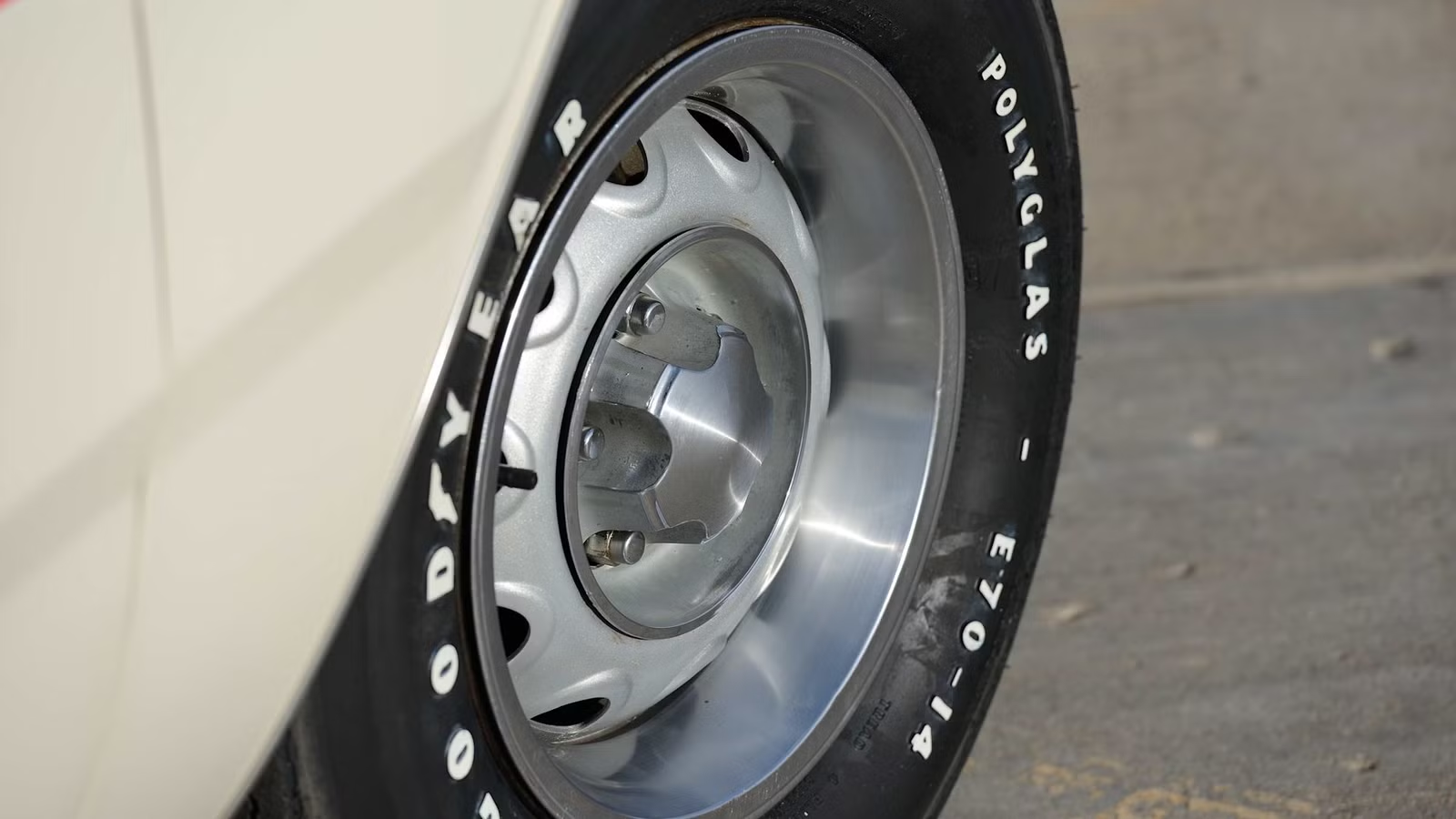
The Mopar 340 Six-Pack is the oddball of this group. It didn’t need big displacement to hang in with the big dogs. Standard in the 1970 Dodge Challenger T/A and Plymouth AAR ‘Cuda, it paired three two-barrel Holley carburetors with a specialized aluminum intake, and Chrysler built only 2,399 T/As and 2,724 AAR ‘Cudas to put it in. Factory output was 290 horsepower and 345 lb-ft of torque at a 10.5:1 compression ratio. Real Mopar nuts also understand that the special DNA goes beyond simply the intake, with a high-nickel block and unique internals. If you have an original, it’s worth sinking the money into.
6
Ford 428 Cobra Jet

335 hp, 440 lb-ft

The Ford 428 Cobra Jet is where the story runs deeper than the displacement. Built around a 427-style cylinder head and a Holley four-barrel, Ford’s FE-family big-block was rated at 335 hp and 440 lb-ft of torque. Quarter-mile times said otherwise almost immediately. Here is the confusing part of the story: Ford never cast a block unique to the 428 Cobra Jet. It used the same reinforced 428 block across every FE application, and the casting numbers on that block, C6ME, C7ME, and C8ME among them, show up on ordinary FE blocks too.
Those casting numbers prove nothing on their own. Real verification comes from the rear of the block, where a scratched “C” mark separates the reinforced casting used in CJ and SCJ applications from the standard “A” blocks that went into Thunderbirds and LTDs. Add a matching casting date code and, on many blocks, a partial VIN stamp, and that’s what actually turns a common FE core into a documented 428 Cobra Jet. FE parts support is deep enough that verifying a core beats swapping it for a crate engine.
5
Buick 455 Stage 1
360 hp, 510 lb-ft

Forget the biggest or most famous engine on the shelf. The Buick 455 Stage 1 is the argument against that instinct. The standard 455 already hit like a freight train; Stage 1 added higher-performance heads, bigger valves, stiffer springs, and a more aggressive cam on top of that. Buick rated the result at 360 hp in 1970. The number that actually mattered was torque. 510 lb-ft. That combination is why the Stage 1 makes a serious restoration core, but only with the correct hardware attached. Stage 1 identity lives in specific factory parts, and the cylinder heads are the telling detail. In short, a Stage 1 badge doesn’t mean much if the heads aren’t a match. But a combo with the right block and heads are worth chasing for a correct restoration, even if the parts hunt is its own headache.
4
Oldsmobile 455 W-30
370 hp, 500 lb-ft

Oldsmobile ran the same playbook. Instead of just leaning on cubic inches, the 1970 W-30 stacked forced-air induction, a free-flow air cleaner, and an aluminum intake on top of the 455, then backed it up with a 370 hp rating. Completeness is what matters here. A W-30 with the correct induction hardware is a different animal from a 455 wearing a W-30-style air cleaner and nothing else. Oldsmobile built just 1,542 442 W-30s with automatic transmissions in 1970. That’s a specific enough number that a seller claiming a bigger production run should raise an eyebrow. Values back up the hunt. A 1970 442 W-30 Holiday Coupe sold at Mecum’s auction for $126,500 in January 2026, and that was an automatic, not even the more coveted four-speed. The right heads, intake, and induction hardware turn a common-looking 455 into something worth that kind of money.
3
Pontiac Ram Air IV
370 hp, 445 lb-ft

Pontiac’s Ram Air IV is the engine that made the division’s performance reputation a lot more serious. Round-port cylinder heads, a longer-duration camshaft, and an aluminum intake sat on top of the 400-cubic-inch block, and the factory rated the whole package at 370 hp and 445 lb-ft of torque. Pontiac only built the Ram Air IV for 1969 and 1970.
Just 759 GTOs got the Ram Air IV in 1969, split between manual and automatic transmissions, and that scarcity is why an untouched or correctly identified core outweighs a beautifully rebuilt generic Pontiac 400. The block, heads, intake, and date codes all matter because performance parts can be reproduced. The original factory-correct pieces can’t be. A concours-grade 1970 Ram Air IV GTO convertible carries a price guide value of $562,000, and that gap between a real one and a convincing clone is the whole reason to find the right core first instead of recreating one from expensive parts.
2
Chevrolet L78 396
375 hp, 415 lb-ft

Chevrolet’s L78 396 proves a smaller engine can be more interesting than its displacement suggests. The Mark IV big-block ran rectangular-port heads, a mechanical-lifter cam, forged internals, four-bolt mains, and an aluminum intake under a Holley four-barrel. Chevrolet rated it at 375 hp and 415 lb-ft of torque for 1969. A later Hot Rod dyno test of a stone-stock L78 produced 425 horsepower and 445.4 lb-ft. The hardware underneath those numbers is what makes the L78 worth chasing. Forged pistons, a forged steel crankshaft, and forged connecting rods sat under heads and an intake that Chevrolet didn’t bother installing on a lesser 396. Casting numbers, date codes, and intake all need to agree before a core is actually useful for a factory-correct build.
1
Chrysler 440 Six Pack
390 hp / 490 lb-ft

The Chrysler 440 Six-Pack is hard to ignore once you see the induction system. Instead of one four-barrel carburetor, Chrysler ran three Holley two-barrels. For 1970, that setup was good for 390 hp and 490 lb-ft of torque, matching the 426 Hemi’s torque output to the pound. The center carburetor handled everyday driving. The two outboard carbs only opened under real throttle, which is part of why the Six-Pack felt so different from a straight four-barrel big-block.
The intake manifold changed too, from an early aluminum piece to a later cast-iron version, so matching the right manifold to the right year matters as much as matching carbs. This is one of the few engines on this list where reproduction support is genuinely strong. Six-Pack intakes and carburetor components are widely reproduced, so a missing piece does not derail a restoration the way it would on rarer engines. It just means the buyer needs to know a 440 wearing three aftermarket carburetors isn’t automatically a real Six-Pack car.
Sources: Mecum, Bring A Trailer, Classic.com

Related posts



Latest Post


No Comments