
500,000 Battery Health Checks Just Made This The Most Important Used EV Buying Guide Of The Year
Half a million real-world battery tests just settled one of the biggest questions in used EV shopping: how much range will actually be left? Aviloo, an independent EV battery diagnostics firm, published its Certified EV Battery Report this week after analyzing 500,000 health checks performed between 2022 and 2026 across 20 popular EV models in North America, South America, Europe, Asia, and Australia. The headline finding is mostly reassuring — most EVs hold the vast majority of their original range even past 90,000 miles. But the rankings between models, and the variance within them, are exactly what used buyers need to understand before signing anything.

Aviloo measures state of health (SoH) — the percentage of a battery’s original usable capacity that’s still available. A car at 95% SoH delivers roughly 95% of its original range on a full charge. For each model, Aviloo calculated the median SoH at three milestones: 50,000 km (about 31,000 miles), 100,000 km (about 62,000 miles), and 150,000 km (about 93,000 miles). Critically, these numbers come from physical battery measurement via an OBD-port diagnostic tool — not from the dashboard readout, which varies by manufacturer and doesn’t always reflect true battery condition.
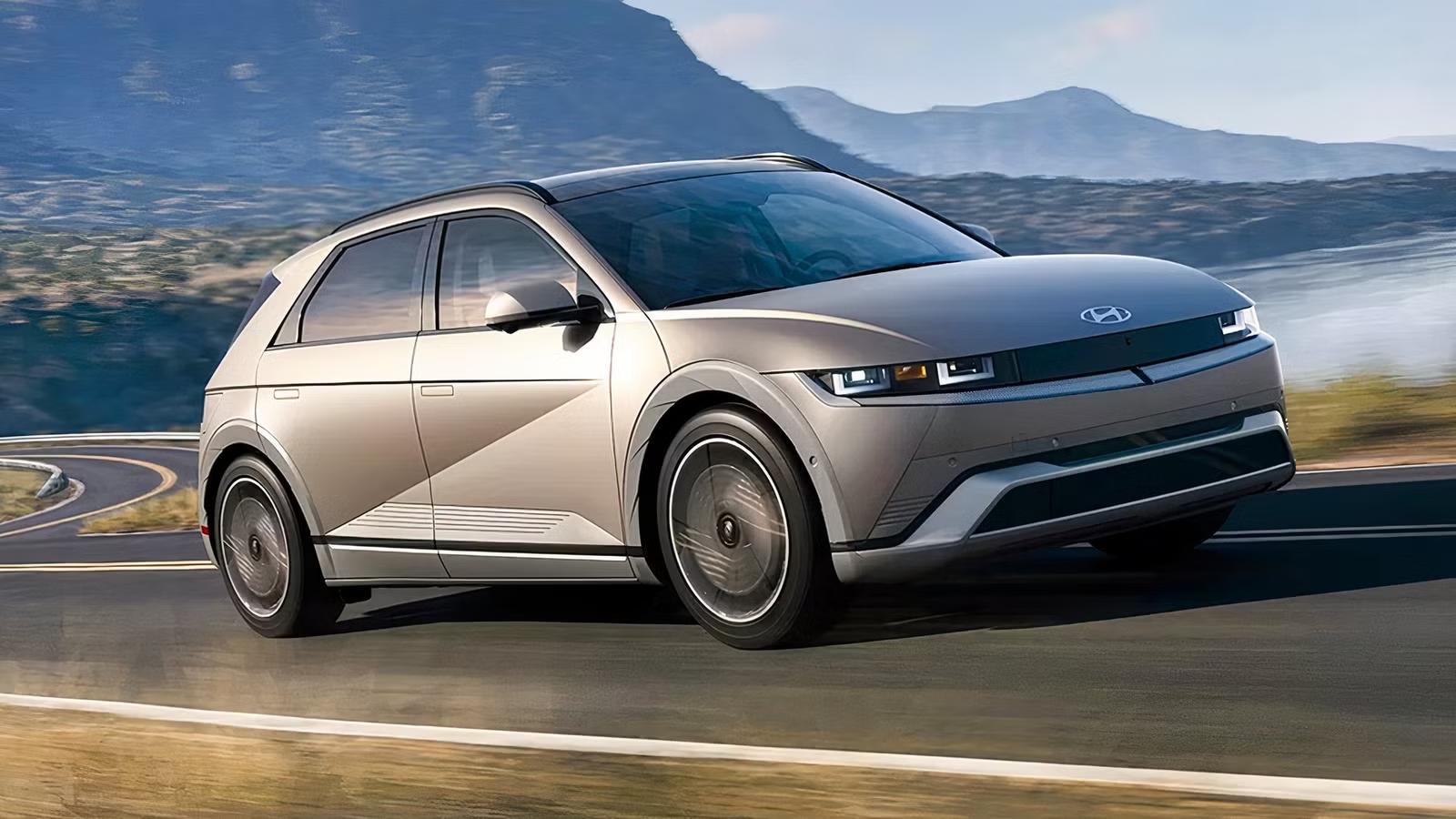
The Ioniq 5 Leads Every Milestone, and It’s Not Particularly Close
The Hyundai Ioniq 5 topped the rankings at all three mileage checkpoints. At 50,000 km it posted a median SoH of 97.2%, at 100,000 km it held above 95%, and at 150,000 km it came in at 92.8% — still delivering roughly 319 km of real-world range per charge on its 72.6 kWh battery. The Mercedes-Benz EQA ran a close second across the board, finishing at 93.97% at the 150,000 km mark and essentially tying the Ioniq 5 at the top of the final standings.

Other strong performers at the 150,000 km milestone included the BMW i4 (93.62%), Hyundai Kona Electric (92.95%), Volvo XC40 Recharge (92.79%), and Ford Mustang Mach-E (which cleared 93% at 100,000 km). The Volkswagen ID.4 tracked similarly to the Model Y, running from 95.3% at 50,000 km down to 90.6% at 150,000 km. For most mainstream liquid-cooled EVs, the 150,000 km picture clusters between 90% and 94% — a solid outcome by any reasonable measure.
Tesla Lands in the Middle, Which May Surprise Some Shoppers

The two Teslas in the study finished in the middle-to-lower end of the pack — a result that runs counter to the brand’s reputation for software-driven battery management. After 150,000 km, the Model Y showed a median SoH of 90.3% and the Model 3 came in at 88.94%. Both numbers still represent the majority of original range intact, but they trail the Ioniq 5 by roughly three to four percentage points at the same mileage.
For context, the Model Y’s 90.3% median at 150,000 km translates to roughly 362 km of real-world range per charge — down from around 379 km at 50,000 km. That’s a workable outcome for most buyers. The issue isn’t the median, though. It’s what sits on either side of it.
The Variance Problem: Model Averages Only Tell Half the Story

This is the section every used EV shopper needs to read carefully. Aviloo’s data shows that outcomes vary dramatically within the same model, and that spread widens as mileage climbs. For the Model Y at 150,000 km, the range covering 99% of tested vehicles runs from 82.9% to 94.9% — a 12-point spread worth roughly 46 km of real-world range. The Model 3’s spread at the same milestone runs from 80.28% to 94.53%. The BMW i4 spans 87.5% to 96.9%.
What drives that spread? Aviloo points to climate (hotter regions accelerate degradation), charging habits (frequent fast charging, regularly topping up to 100% and leaving it there), and calendar age independent of mileage. Battery chemistry differences between models also mean that identical charging behavior can produce very different results across makes. The practical takeaway: a 60,000-mile Model Y from Phoenix that lived on Superchargers could be in meaningfully worse shape than a 90,000-mile example from Seattle that charged mostly at home overnight. Mileage alone doesn’t tell you which one you’re looking at.
Air-Cooled Batteries Are the Clear Outliers — and Why Smaller Packs Degrade Faster

The Nissan Leaf and Renault Zoe stand apart from the rest of the study’s field, and for a specific reason: both use air-cooled battery systems rather than the liquid thermal management found in most modern EVs. The Leaf posted a median SoH of 86.67% at 150,000 km, the Zoe came in at 87.33%, and the Mini Cooper SE landed at 87.11% — all noticeably below the liquid-cooled pack.
Smaller batteries compound the problem. A 40 kWh Leaf needs to charge far more often than a 77 kWh ID.4 to cover the same distance, and each charge cycle adds incremental wear. Aviloo’s data for the Leaf shows the widest spread of any model in the study — up to 13.5 percentage points between the best and worst examples at 150,000 km, worth about 29 km of real-world range. For buyers considering an older Leaf or Zoe, an independent battery health test isn’t optional — it’s essential.

The broad picture is genuinely good news. Across 500,000 tests, the worst median result in the study still showed 86–87% of original capacity remaining after 93,000 miles of use. Batteries are not turning into bricks. A reasonable baseline expectation for a high-mileage liquid-cooled EV is around a 10% range reduction — and many examples do better than that.
But the variance data makes clear that model averages are a starting point, not a guarantee. Aviloo recommends — and the data supports — getting an independent battery health test on any specific used EV before purchase. The company’s own three-minute FLASH Test connects via the OBD port and calculates SoH from multiple diagnostic signals rather than relying on the car’s own dashboard reading. For buyers weighing models, the Ioniq 5 and EQA offer the strongest median performance across all three mileage milestones. The Teslas are competitive but not the leaders the brand’s reputation might suggest — and the wide variance within those models makes individual car history more important, not less.

Related posts



Latest Post


No Comments