The Mainstream Crossover That Quietly Makes The Audi Q3 Look Overpriced
8 minutes reading
Sunday, 30 Aug 2026 23:00 0 41 autotech
A profound shift is currently redefining the automotive market around the $40,000 threshold. Mainstream mass-market compact SUVs and crossovers are aggressively advancing into traditional luxury territory, creating a direct value conflict with entry-level European offerings. By packaging top-tier interior materials into fully optioned upper trims, non-luxury manufacturers present a compelling proposition.
Meanwhile, entry-level luxury vehicles at identical price points strip out basic features to protect baseline margins. This intentional dynamic narrowing of the value gap creates a functional substitute scenario, forcing pragmatic buyers to weigh the functional superiority of loaded mainstream offerings against the diminishing value of a basic badge.
Mazda maintains a distinct identity in the U.S. automobile market, positioning itself between mainstream high-volume brands and traditional luxury automakers. The Japanese brand focuses heavily on driver engagement, refined vehicle dynamics, and upscale cabin design. That strategy guides its current product roadmap, which prioritizes a steady transition toward premium market tiers.
Central to Mazda’s strategy is the ongoing expansion of its crossover lineup alongside targeted electrification efforts. The brand leverages strategic partnerships to introduce flexible hybrid architectures while developing its own proprietary platforms to support mild-hybrid and plug-in hybrid options. By emphasizing premium interior materials, elegant exterior styling, and standard all-wheel-drive configurations across most utility offerings, Mazda targets buyers seeking an elevated driving experience without luxury-brand price tags.
Balancing Reliability With Build Quality
Mazda
Simultaneously, the Japanese brand continues to elevate upper-trim feature density, equipping high-tier specifications with premium cabin acoustic insulation, sophisticated driver-assistance technology, and upscale interior upholstery to retain value-focused buyers.
In 2026, this strategy yields strong financial results. The automaker recorded sales gains in the U.S. market through the first half of the year, outperforming broader industry slumps. Consumer demand for fuel-efficient hybrid powertrains drives double-digit monthly growth, pushing year-to-date sales figures past key historic milestones. The brand remains an industry leader in light truck and passenger car volume, proving the enduring strength of balanced product offerings.
How The CX-50 Outprices Its Rivals
2025 Mazda CX-50 Hybrid Side ProfileWilliam Clavey | TopSpeed
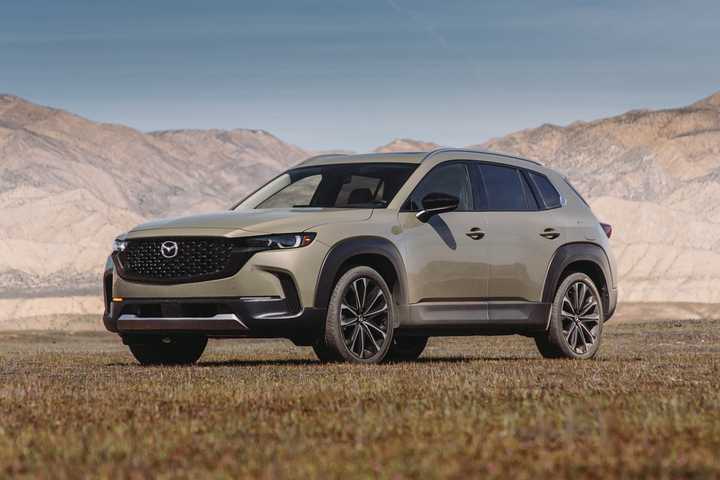
The real story in the compact crossover segment does not involve deciding which mainstream vehicle wins a head-to-head comparison. The true shift happens at the $40,000 threshold. A fully loaded Mazda CX-50 Turbo Premium Plus sells between $42,900 and $44,675, depending on destination fees and option packages. That exact price point places it in direct conflict with entry-level German luxury SUVs. The base Audi Q3 starts at $39,800. The BMW X1 xDrive28i begins at $40,500. The Mercedes-Benz GLA 250 4MATIC opens at $41,850. The mainstream Mazda CX-50 quietly makes the entry-level Audi Q3 look overpriced. The German near-luxury segment loses buyers because of this price collision.
Mainstream manufacturers run an intentional entry-luxury squeeze play. Competitors often review the Mazda CX-50, Honda CR-V, Kia Sportage, and Hyundai Tucson in total isolation. They miss the broader strategy across the market. Japanese and Korean brands systematically package luxury-grade interiors, advanced technology, and aggressive styling into their highest trim levels. They cap these top-tier models right where European luxury brands begin their order sheets. Mainstream brands convert functional utility vehicles into genuine luxury alternatives. They target buyers who want high-end amenities without paying traditional luxury ownership costs.
No Compromising On Interior Features
Interior shot of a 2026 Mazda CX-50 showing driver’s side cabinMazda
The equipment disparity between these two groups reveals a stark reality. A top-tier Mazda CX-50 Turbo Premium Plus comes standard with a panoramic sunroof, ventilated front seats, position memory settings, and a 12-speaker Bose audio system. Hyundai and Kia offer dual 12.3-inch display screens, rear heated seats, and advanced highway driving assistance on upper Tucson and Sportage trims. Honda equips the CR-V Sport Touring with leather upholstery, a heated steering wheel, and premium acoustic glass. Mainstream buyers receive every available comfort and technological convenience standard at the peak of the price structure.
The entry-level German SUVs tell a very different story. Base versions of the Audi Q3, BMW X1, and Mercedes-Benz GLA feature premium badges, but they strip away basic convenience features. German automakers hide ventilated seats, premium sound systems, adaptive cruise control, and leather seating behind expensive standalone options or bundled equipment packages. Adding these necessary options to a base Audi Q3 or BMW X1 quickly drives the final transaction price toward $50,000. The advertised $40,000 entry point serves as a phantom price point for a basic vehicle.
The Difference Is Seen In Interior Quality
Interior shot of the 2026 Mazda CX-50’s front seatsMazda
Interior execution closes the remaining gap between mainstream and traditional luxury badges. The upper trims of the 2026 Mazda CX-50 deliver cabins that genuinely rival luxury competitors. Mazda uses real leather upholstery with distinctive terracotta stitching, solid metal switchgear, and clean dashboard layouts. Kia and Hyundai utilize ambient lighting, soft-touch material surfaces, and frameless digital displays. The interior ambiance in a top-spec mainstream crossover matches the material quality of a base German vehicle. The entry-level German SUVs feature hard plastics, synthetic leather seating, and empty switch blanks on their lower dashboards.
Driving dynamics no longer separate these segments either. The Mazda CX-50 Turbo uses a 2.5-liter turbocharged engine that generates up to 256 horsepower and 320 pound-feet of torque on premium fuel. Standard all-wheel drive and responsive steering give the CX-50 sports-car agility across winding roads. The vehicle handles curves with total composure. The base Audi Q3 uses a 2.0-liter turbocharged engine producing just 184 horsepower in its standard form. The Mazda accelerates faster, offers sharper handling, and delivers superior engine output compared to its base European competition.
The CX-50’s Polish Changes Value Proposition Mindsets
Interior shot of a 2026 Mazda CX-50’s rear seatsMazda
The value proposition for near-luxury German SUVs erodes under this competitive pressure. Buyers traditionally paid a premium for German engineering, advanced technology, and elevated brand status. Today, mainstream automakers match German engineering precision and exceed their technology packages at identical price points. The value gap narrows to a simple decision between a fully optioned mainstream crossover or a stripped-down luxury badge. Rational buyers increasingly choose feature-rich utility over basic brand prestige.
Ownership costs accelerate this buyer migration. Mainstream crossovers run on regular unleaded gasoline, though models like the CX-50 Turbo unlock maximum power on premium fuel. Japanese and Korean brands offer longer powertrain warranties and significantly lower routine maintenance costs. European luxury dealerships charge substantially higher fees for basic service items, brake replacements, and out-of-warranty repairs. The long-term cost of ownership widens the financial divide between these vehicles even further.
Premium Mainstream SUVs Are Rapidly Gaining Popularity
Mazda CX-50 interiorMazda
Market data supports this shift in consumer behavior. Mainstream compact crossovers capture higher market share by capturing buyers who previously shopped at entry-luxury showrooms. The upper trims of the CX-50, CR-V, Sportage, and Tucson account for a growing percentage of total model sales. Buyers willingly spend $40,000 or more on a mainstream vehicle when that vehicle includes every available premium feature. Automobile manufacturers recognize this trend and invest heavily in their top-tier interior trims.
The sub-$45,000 price band represents a new battleground in the automotive industry. Japanese and Korean automakers build superior value into their top models, while European manufacturers rely heavily on badge recognition to justify high entry prices. A buyer spending $44,000 on a loaded Mazda CX-50 Turbo Premium Plus drives home a complete luxury package with superior horsepower, advanced cabin technology, and premium acoustic comfort.
Ownership Costs Are An Important Factor
side shot of a red 2026 Mazda CX-50 parked in lotMazda
The CX-50 Hybrid’s overall five-year ownership costs come in at $40,493 for the base Preferred trim. Included in this figure is $4,092 on insurance, $4,918 on maintenance, $754 on repairs, $2,342 on taxes and fees, $7,302 on financing, $14,374 on depreciation, and $6,711 on fuel.
The base Preferred model increases this figure to $41,306. This includes $4,092 on insurance, $4,827 on maintenance, $754 on repairs, $2,148 on taxes and fees, $6,862 on financing, $12,820 on depreciation, and $9,803 on fuel.
CarEdge reveals the average five-year ownership costs for the entire CX-50 range to be $42,429. These costs include $14,944 on depreciation, $10,465 on insurance, $8,250 on fuel, $6,241 on financing, and $2,529 on maintenance.
The CX-50’s Trusted Reputation Among Owners
Front 3/4 shot of an orange 2026 Mazda CX-50 Hybrid parked in front of housesMazda
According to J.D. Power, the Mazda CX-50 is a highly accomplished semi-premium hybrid SUV offering, benefiting from a 78/100 consumer-verified overall score. This consists of 72/100 for quality and reliability, 78/100 for the driving experience, 83/100 for resale, and 83/100 for the dealership experience. iSeeCars doesn’t issue the model with a comprehensive rating system, but it does award it 8.2/10 for retained value and 10/10 for safety.
The 2026 Mazda CX-50 Hybrid earns high praise across consumer review platforms, maintaining a strong average rating of 4.5 out of 5 stars. Owners and test drivers highlight the vehicle’s dynamic handling, elevated cabin materials, and striking exterior styling as primary selling points. Standard all-wheel drive, supportive front seats, and an intuitive interior layout featuring physical climate controls add everyday usability. Combining Mazda’s sharp steering feel and upscale design with Toyota’s proven hybrid setup allows the crossover to offer responsive driving dynamics alongside serious real-world efficiency.













No Comments