
The Japanese Luxury Sedan Built To Humiliate The Mercedes S-Class
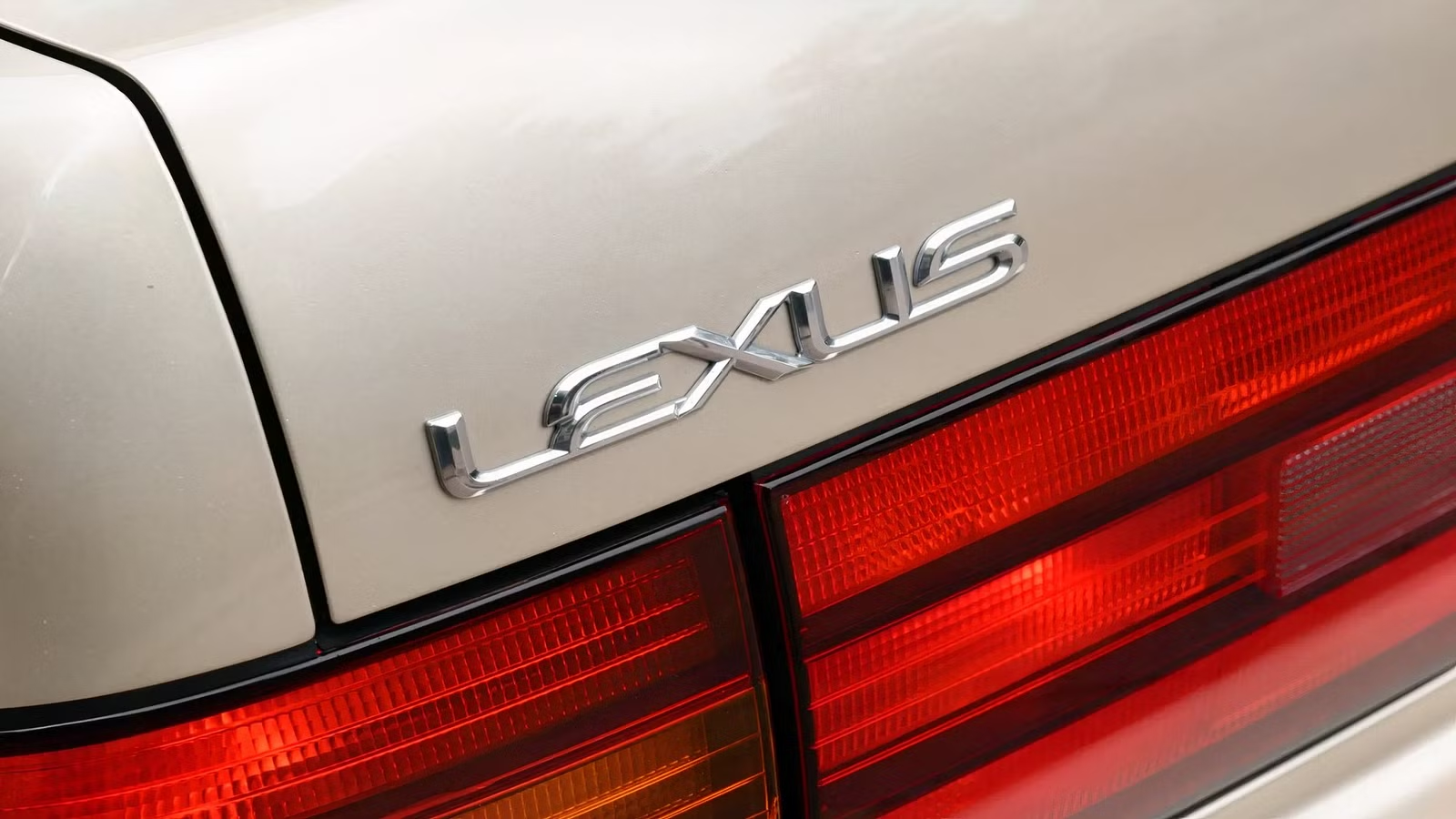
It’s hard to beat the Germans when it comes to that sweet combo of luxury, comfort and performance, which has been the case for several decades now. And among Germany’s finest luxury sedans, the Mercedes-Benz S-Class stands out as a perfect example of automotive opulence over its many generations. The Teutonic luxobarge debuted as the W116 all the way back in 1972, remaining in production to this very day and currently in its seventh generation (codenamed W223). It consistently ranks as the world’s best-selling full-size luxury sedan, only really challenged for that top spot by the BMW 7 Series. Additionally, there is also the upscale Mercedes-Maybach S-Class for those who want something even more prestigious.
What Makes The S-Class Formula So Appealing?

The Three-Pointed Star’s flagship sedan lineup was never just about luxury and comfort, but also a fantastic contender in terms of performance. Safety innovations have been at the forefront from the very beginning, too, with the W116 famously becoming the world’s first production car to receive fully-electronic, multi-channel ABS back in ‘78. But for the purposes of our discussion today, we’ll be focusing more specifically on the model’s second generation, introduced in 1979 and known as the W126. Well, this article’s focal point will actually be the car built to give it a good run for its money, but it’s worth seeing what the classic Benz had to offer before bringing its rival into the spotlight. Let’s dive right in for a closer look.
One could get the W126 with an array of engines ranging from inline-sixes to V8s, as either a short- or long-wheelbase sedan (SE or SEL) or a coupe (SEC). Until 1985, the top engine option was a five-liter V8 with 228 horses, but a larger 5.5-liter powerhouse became available thereafter. It was tuned to 238 hp on U.S. variants, whereas European versions produced just under 300 hp. Beyond the engine bay, the car boasted an abundance of premium features tailored toward safety and comfort, even becoming one of the first production vehicles you could get with optional airbags and seatbelt pretensioners. The suspension offered an incredibly plush ride, so much so that it was often compared to a magic carpet. And we could go on, but the S-Class — as great as it might’ve been — was about to get a good run for its money at the tail end of the eighties.
Mercedes Wasn’t The Only Automaker With Big Aspirations For Its Flagship Sedan


You’d think the biggest threat to the model’s dominance in the luxury sedan segment would come from BMW, and that’s entirely correct if you’re talking about the present day. However, things were a little different during its second generation, just as Toyota was preparing to launch its luxury division Lexus in 1989. Development on the brand’s first car started much earlier, though, all the way back in 1983 and with attention to detail that was borderline obsessive. The whole process was led by Toyota’s head of engineering Ichiro Suzuki and codenamed the F1 (Flagship One) project, with no time or budget constraints imposed by the company’s then-CEO Eiji Toyoda. Thus, a ton of resources were poured into the car’s six-year development phase to take it as close to perfection as possible — 1,400 engineers, 2,300 technicians and about 200 support staff. Countless prototypes and 1.7 million miles of testing later, the very first Lexus model came in guns-blazing.
The Original Lexus LS 400 Was Nothing Short Of A Masterpiece

The LS 400 debuted at the North American International Auto Show of 1989 in Detroit, and it went on sale in the U.S. as a 1990 model in September of that year. Under the hood, it came with a four-liter V8 dubbed 1UZ-FE and a four-speed automatic transmission which fed its power to the rear wheels. Originally, the 32-valve engine was capable of delivering 250 hp and 260 lb-ft of torque, while the gearbox prioritized durability and smooth, unobtrusive shifts above all else. But despite the LS being remarkably well-mannered, it was still pretty quick for a vehicle in its class with a zero-to-60 time of just under eight seconds. Top speed was electronically limited at 155 mph, and Toyota’s engineers went to great lengths in order to keep you comfy on the way there.
Hydraulic engine mounts were used to isolate vibration, while the cabin featured extensive sound-proofing to remain nice and quiet at all times. Speaking of which, the LS 400’s interior could go toe-to-toe with just about any German luxury brand, featuring things like premium leather upholstery, genuine wood trim and incredibly comfortable memory seats. Controls were intuitive and offered great tactile feel, whereas the steering wheel was power-adjustable for extra convenience. Generous leg and shoulder room for all occupants made the interior even more pleasant, but the car’s suspension was also engineered with comfort in mind. It comprised independent double-wishbone arrangements at both ends, tailored toward smoothness rather than outright performance.

And although the exterior looked rather conventional and somewhat understated, a ton of work went into keeping the drag coefficient as low as possible. Compared to the W126’s rating of 0.36, the LS 400 managed just 0.29 thanks to the development team’s attention to every little detail. Wind noise was thus maintained nice and low for an even quieter cabin, showcasing Toyota’s determination to create one of the most refined vehicles in existence at all costs. But the Japanese automaker didn’t stop at the original LS, instead continuing to update and improve it along the way. The second generation arrived for the model-year 1995 — lighter, faster and more comfortable than the first. Some of the most notable improvements came a bit later on in ‘98, though.
That year, the Lexus LS 400 received a mid-cycle facelift and was thereafter able to hit 60 mph from a standing start in a little over six seconds. Its V8 gained variable valve timing and a peak output of 290 hp, now channeled to the rear wheels by a five-speed automatic. Torque grew to 300 lb-ft, less than a contemporary flagship S-Class but more than enough to get the job done. Besides all that, Toyota placed great emphasis on customer service for an exceptional ownership experience from the get-go, but the LS 400’s main German rival had also evolved considerably during the nineties. The W126 made room for the W140 in 1991 and then the W220 in 1998, with power output figures growing significantly along the way. As such, it eventually came time for the LS 400 to also be replaced, bowing out gracefully in favor of the LS 430 starting with the model-year 2001. The legacy left behind by that original LS was there to stay, though.
The LS 400 Is Still A Great Buy After All These Years

Overengineered and characterized by that sweet Toyota reliability, the Lexus LS 400 makes for an excellent pick on the used car market even today. Prices vary considerably depending on factors like mileage and model year, with first-generation variants regularly changing hands for around $15,000 in good condition. However, you might be spending a fair bit more on later models released after the 1998 facelift, even upward of 30 grand in the case of a 3,300-mile example sold on Bring a Trailer last year.
Nevertheless, you will still be able to find a bargain on these Japanese luxobarges here and there, so keep an eye out for them if dependable retro luxury appeals to you. Because the car that dared to challenge the S-Class so boldly is much more than just another fancy sedan. It represents automotive refinement at its very best, as well as a fascinating underdog story of a new brand boldly challenging an industry leader and forcing it to evolve.
Sources: Lexus, Mercedes-Benz, Bring a Trailer

Related posts


Latest Post


No Comments