
2018 Dodge Challenger SRT Demon: First Factory Wheelie Car
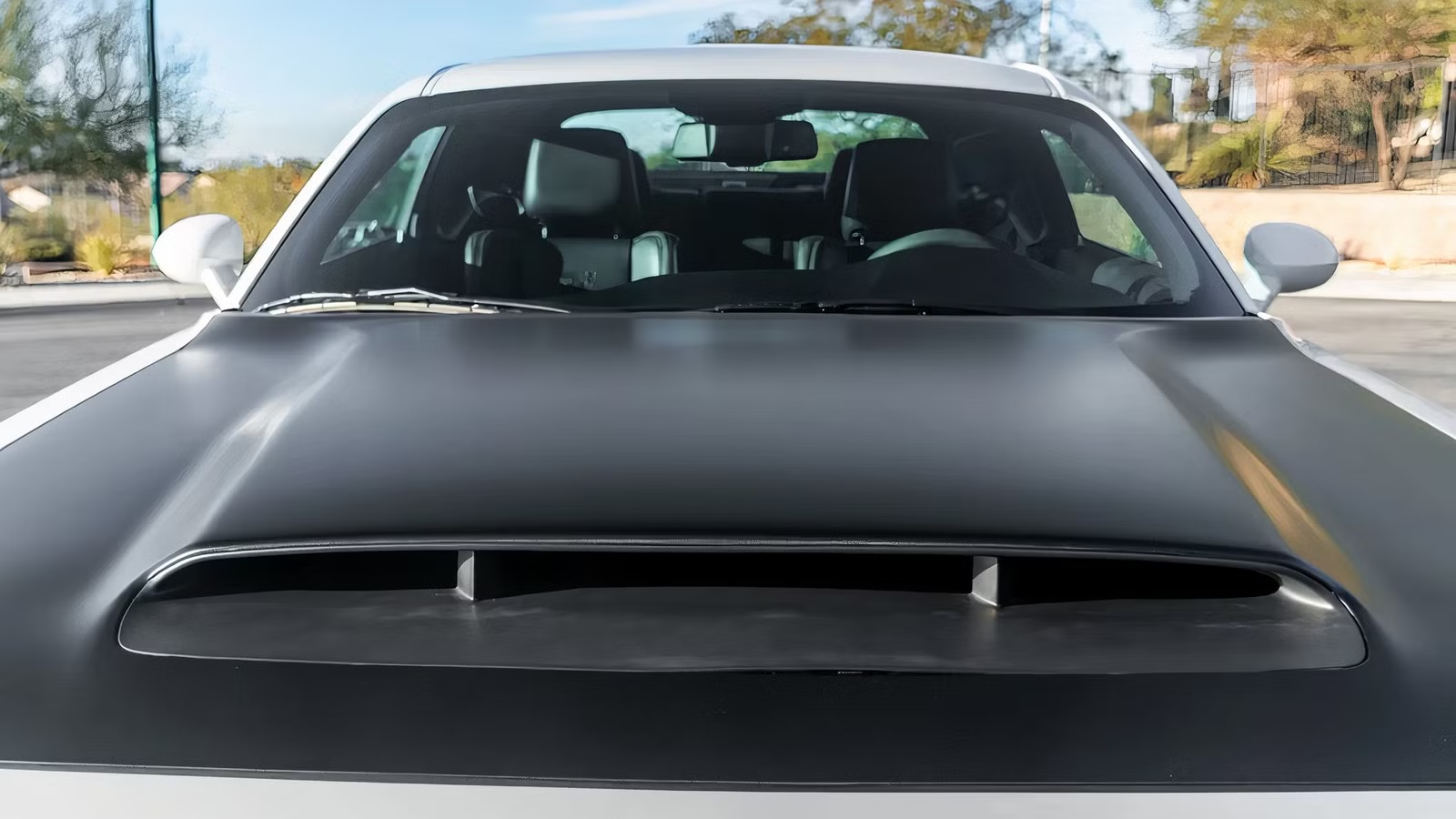
A muscle car pulling a wheelie off the starting line once told you a couple of things. Its owner had probably spent years modifying it, and it had almost certainly arrived at the drag strip on a trailer. Then a Detroit automaker put the same trick in a car with air conditioning and a factory warranty. The result was less a muscle car with a drag-racing package than a dragster wearing just enough street-car clothing to sneak past your local HOA patrols.
The Horsepower War Was Running Out Of Road

It was a big deal when Detroit muscle cars cracked 450 horsepower. It was huge when they crossed 500 horsepower. The supercharged 707-horsepower Dodge SRT Hellcat broke the mold for 2015. The horsepower war kept escalating. The 2017 Chevy Camaro ZL1 made 650 horsepower, while the 2020 Mustang Shelby GT500 arrived with 760.
The first Challenger Hellcat advertised an 11.2-second quarter-mile at 125 mph on street tires. Swap on drag radials to keep the launch from becoming a cloud of expensive tire smoke, and that dropped to 10.8 seconds at 126 mph. Four-tenths from a tire swap revealed exactly where the next breakthrough had to happen. Detroit no longer had trouble making power. Its latest, greatest muscle cars had trouble putting all of it through two rear contact patches.

More horsepower had become the easy headline. One company stopped asking how to build a few more horsepower and started asking how close a showroom muscle car could get to a purpose-built dragster.

707 Horsepower Was Just The Beginning

The Challenger and Charger Hellcats were genuine dual-purpose street-and-strip cars. They could carry a family across the country with the A/C blasting, then swing by a drag strip and run in the tens. Dodge could have sat back, basked in that glow, and raked in extra cash from special-edition badges. Instead, it decided to swing for the fences again.
A secret two-year project began simply as the Challenger “Special Edition.” Its data was stored separately with access tightly limited. Engineers ran dyno tests at night and on weekends, then recalibrated the test cells to display ordinary Hellcat output numbers.

They increased the engine’s output, improved its cooling for repeated drag-strip runs, and strengthened the drivetrain. The engine program even took its nickname, “Benny,” from the goofy, rotund Benny the Ball character in Top Cat.
But none of that mattered unless the car could transfer its weight and keep the rear tires hooked up. The team scrapped every side project that didn’t move it toward one wonderfully blunt target: “9s with light,” meaning a nine-second pass with daylight beneath the front tires.
Dodge Stuffed A Drag Strip’s Worth Of Tricks Into One Car

The result was the 2018 Challenger SRT Demon. It made 808 horsepower at 6,300 rpm and 717 lb-ft at 4,500 rpm on 91-octane premium fuel. With 100-plus-octane fuel and the high-octane calibration, those figures climbed to 840 horsepower and 770 lb-ft.
Everything about the Demon was calibrated for the drag strip, from its 2.7-liter supercharger running 14.5 psi to the shift points of its TorqueFlite 8HP90 eight-speed automatic. But it wasn’t merely a tuned Hellcat. Sixty-two percent of the V8’s bill of materials was new, including dual fuel pumps, strengthened pistons, connecting rods and crankshaft, and a revised lubrication system.

Torque Reserve built supercharger boost while the car stood still. The SRT Power Chiller used air-conditioning refrigerant to chill the intercooler circuit before a run, reducing charge-air temperature by 18 degrees Fahrenheit after the air left the supercharger. The Demon was also the first factory-production car equipped with a TransBrake, which held it at the starting line until the driver released the launch.
Factory-installed 315/40R18 Nitto drag radials delivered 40 percent more launch force than standard Hellcat performance tires. Dodge also removed more than 200 pounds by deleting the passenger and rear seats, spare tire, trunk trim, sound insulation, speakers, and other nonessential equipment. That is the equivalent of offloading a full-size passenger who was riding along unnoticed.
The real wizardry was the drag-tuned adaptive damping. Before launch, the system switched to a calibration that let the nose rise and rear squat once the car moved. Acceleration caused the weight transfer, while the suspension helped the Demon use the extra load on its rear tires to generate 11 percent more grip. But this system had a byproduct.

Dodge invited Guinness World Records to Gainesville, Florida, on November 21, 2016. Guinness diplomatically certified the Demon for the longest wheelie from a standing start in a production car: 0.89 meter, or 2 feet 11 inches, which Dodge published as 2.92 feet. No earlier production-car record appears in Guinness’s public database. Dodge said the quiet part out loud, calling the Demon the first production car to lift its front wheels at launch.
The Demon’s wheelstand wasn’t a circus trick. It was the visible consequence of extraordinary launch force. Think about how hard it would be to lift a car’s front end, then imagine trying to rock it up from the rear axle with no leverage.

Dodge claimed the Demon could reach 30 mph in one second, 60 mph in 2.3 seconds, and subject the driver to 1.8 g. At launch, acceleration transferred 2,576 pounds of load rearward while the driveline saw 11,164 lb-ft of torque. The Demon also recorded an NHRA-certified 9.65-second quarter-mile at 140 mph.
Dodge Made The Absurd A Factory-Backed Feature

Raw speed was nothing new by the Demon’s time. And it certainly didn’t invent drag racing. Reigning national champion Calvin Rice opened the 1956 NHRA Nationals with a 9.99-second pass. What was new was a street-legal car with a factory warranty running even quicker. Dodge covered the Demon with a three-year/36,000-mile limited vehicle warranty and a five-year/60,000-mile limited powertrain warranty.
Dodge built only 3,300 serialized 2018 Demons, with 3,000 allocated to the United States and 300 to Canada. Base MSRP was $84,995, including the $1,700 gas-guzzler tax but excluding destination.

The absurdity continued with Dodge’s $1 “Demon Crate,” a package Dodge valued at $6,140. Check the box and Mopar sent front-runner wheels, a high-octane PCM and switch, a drag-racing air filter, a jack, tools, and personalized identification. Only the driver’s seat was standard. The passenger and rear seats cost another dollar each. Dodge desperately wanted buyers to race this car.
The most absurd aspect of the Demon may be how the entire idea was hobbled from the start by its own success. Sure, it was a drag racer that set an official 9.650-second quarter-mile pass as equipped from the factory. But you didn’t want to try the same stunt at your local track. The NHRA rulebook requires additional safety equipment, protective clothing, and a competition license for any sub-10-second car. So, after your first run with your shiny new Demon, the NHRA would send you home for a certified roll cage, window net, restraints, driveshaft loop, master cutoff, and the other mandated equipment. Maybe Dodge should have offered a bigger $1 Demon Crate.
Sources: Stellantis, Mopar, PR Newswire, Guinness World Records, and NHRA

Related posts




Latest Post


No Comments