
2029 Chevy Camaro Delayed — Four-Door Sedan Confirmed
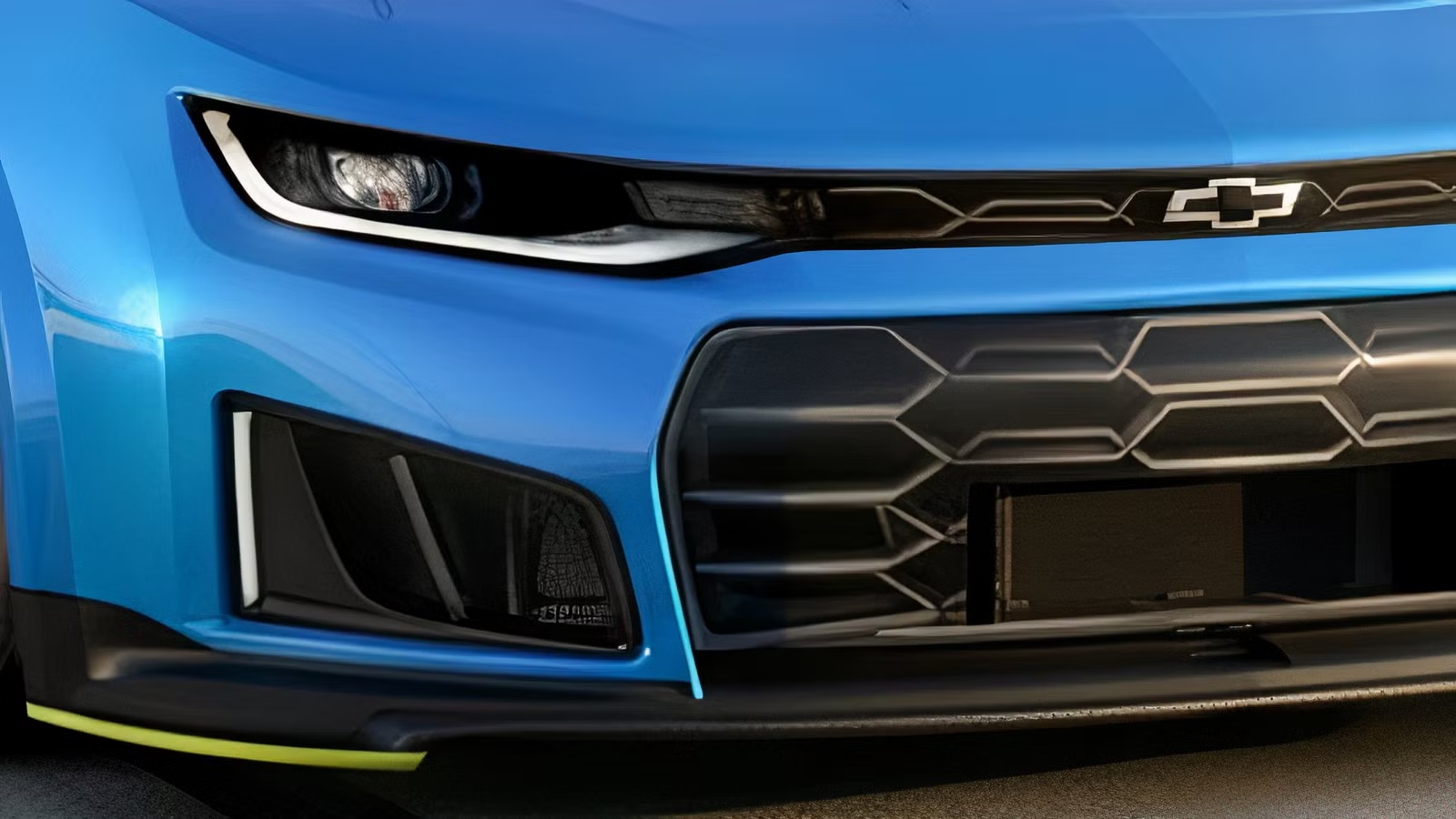
The Camaro is coming back — just not when anyone expected, and not in the shape anyone expected. Chevrolet has pushed the next-generation Camaro to the 2029 model year, slipping past the previously anticipated 2028 target and stretching the nameplate’s absence to at least five years after the sixth-generation coupe was discontinued following the 2024 model year. The delay alone would be enough to frustrate gearheads who’ve been watching the clock since the last coupe rolled off the line at Lansing Grand River Assembly.

But the timeline isn’t even the real story. The 2029 Camaro is reportedly coming back with four doors — a departure so fundamental it forces the question of whether this is a Camaro revival or a Camaro replacement. The badge that built its legend on two-door coupes and convertibles, from the first-gen Z28 to the sixth-gen ZL1 1LE, is now headed toward sedan territory. For Camaro loyalists, that’s either an exciting expansion of the nameplate or the beginning of its dilution. There isn’t much middle ground.
What’s Actually Been Confirmed — And What’s Still Rumor
The core details come from GM Authority, which has been tracking the revival closely. According to their report, the 2029 Camaro will ride on GM’s Alpha 2 platform — an updated version of the same rear-wheel-drive architecture that underpinned the sixth-generation Camaro and currently serves the Cadillac CT4 and CT5. That platform lineage matters: it confirms the new car will stay rear-wheel drive, which is at least one pillar of Camaro tradition still standing.

Powertrain specifics haven’t been locked down publicly, but the picture being sketched is promising. A turbocharged four-cylinder is expected to serve as the entry point — the CT5 already pairs one with the Alpha platform — while a confirmed high-performance variant points toward a V8, likely derived from the small-block family currently found in the Corvette . Critically, a manual transmission is reportedly in the mix alongside an automatic, which will matter enormously to the crowd that rows gears as a point of principle. Production is expected at Lansing Grand River Assembly in Michigan, the same plant that built the sixth-gen car.
Four Doors and a Badge with a Two-Door Soul

The Camaro has never had four doors. Not once in nearly six decades. That’s not a trivial detail — it’s the entire visual grammar of the nameplate. The long hood, the chopped roofline, the two-door stance: that’s what separates a Camaro from a Malibu in the minds of the people who’ve been buying them since 1967. Stretching the body to accommodate rear doors doesn’t just change the silhouette; it repositions the car entirely.
The dimensions being discussed — reportedly comparable to the Chevy Malibu or the short-lived Chevrolet SS sedan — suggest something closer to a performance sedan than a muscle car in the traditional sense. That’s not automatically a bad thing. The Chevrolet SS, which ran from 2014 to 2017 on a Holden Commodore platform with a 415-horsepower 6.2-liter V8 and a six-speed manual, was a genuine driver’s car that the market largely ignored because it looked too plain. A Camaro-badged successor with actual nameplate recognition could avoid that fate. But it also raises the uncomfortable question of whether the Camaro name is being used to sell a car that the Camaro’s core audience never asked for.
The Dodge Charger Precedent — And Why It’s Not a Perfect Parallel

Dodge already walked this path. The current Charger is offered in both two- and four-door configurations, with the Hurricane inline-six replacing the Hemi that defined the nameplate for a generation. The four-door Charger hasn’t collapsed the brand — but it also hasn’t fully satisfied the Hemi faithful, and the absence of a V8 option in a standard production Charger remains a sore point in Mopar circles.
The Camaro’s situation is different in one key respect: the nameplate has been dark for years before its four-door debut. Dodge kept the Charger in continuous production and pivoted the body style gradually. Chevrolet is asking enthusiasts to accept a fundamental format change as the price of getting the Camaro back at all. Whether that trade-off lands well depends almost entirely on how the high-performance variant is executed. A four-door Camaro with a V8, a manual, and real performance credentials is a defensible proposition. A four-door Camaro with a turbo-four and a CVT is a different conversation entirely.
Meanwhile, the Cadillac CT5-V Blackwing — the closest thing the Alpha 2 platform currently produces to what the top-spec Camaro could become — ends production after the 2026 model year. Its supercharged 6.2-liter LT4 producing 668 horsepower and 659 lb-ft of torque, paired with a six-speed manual, represents exactly the kind of hardware the new Camaro will need if it’s going to carry the badge credibly. Whether GM routes that recipe into the Camaro, or lets it quietly retire with the Blackwing, is the most important unanswered question in this story.
What Enthusiasts Are Actually Waiting For

The sixth-gen Camaro’s sales collapse — from around 31,000 units in 2023 to reportedly fewer than 6,000 in its final production year — told GM something real about the two-door muscle car market. The audience for a pure coupe with a big V8 and a manual has been shrinking for years, and no amount of ZL1 track-day heroics changes the retail math. The four-door format is almost certainly GM’s attempt to broaden the Camaro’s appeal without abandoning performance entirely.
That’s a reasonable business decision. It doesn’t have to be a betrayal. But the delay to 2029 means Camaro loyalists are now being asked to wait five-plus years for a car that may not look or feel like the one they remember — and to do so without any confirmed specs, pricing, or production images. The Alpha 2 platform, the manual transmission option, and the promised high-performance variant are the right ingredients. Whether GM actually commits to them, or hedges toward a softer product as the launch approaches, is what enthusiasts should be watching. The nameplate deserves better than a rebadged sedan. Let’s hope the people building it agree.

Related posts




Latest Post


No Comments