
2028 Tesla Roadster Concept Ditches Rocket Thrusters For Mustang V8s
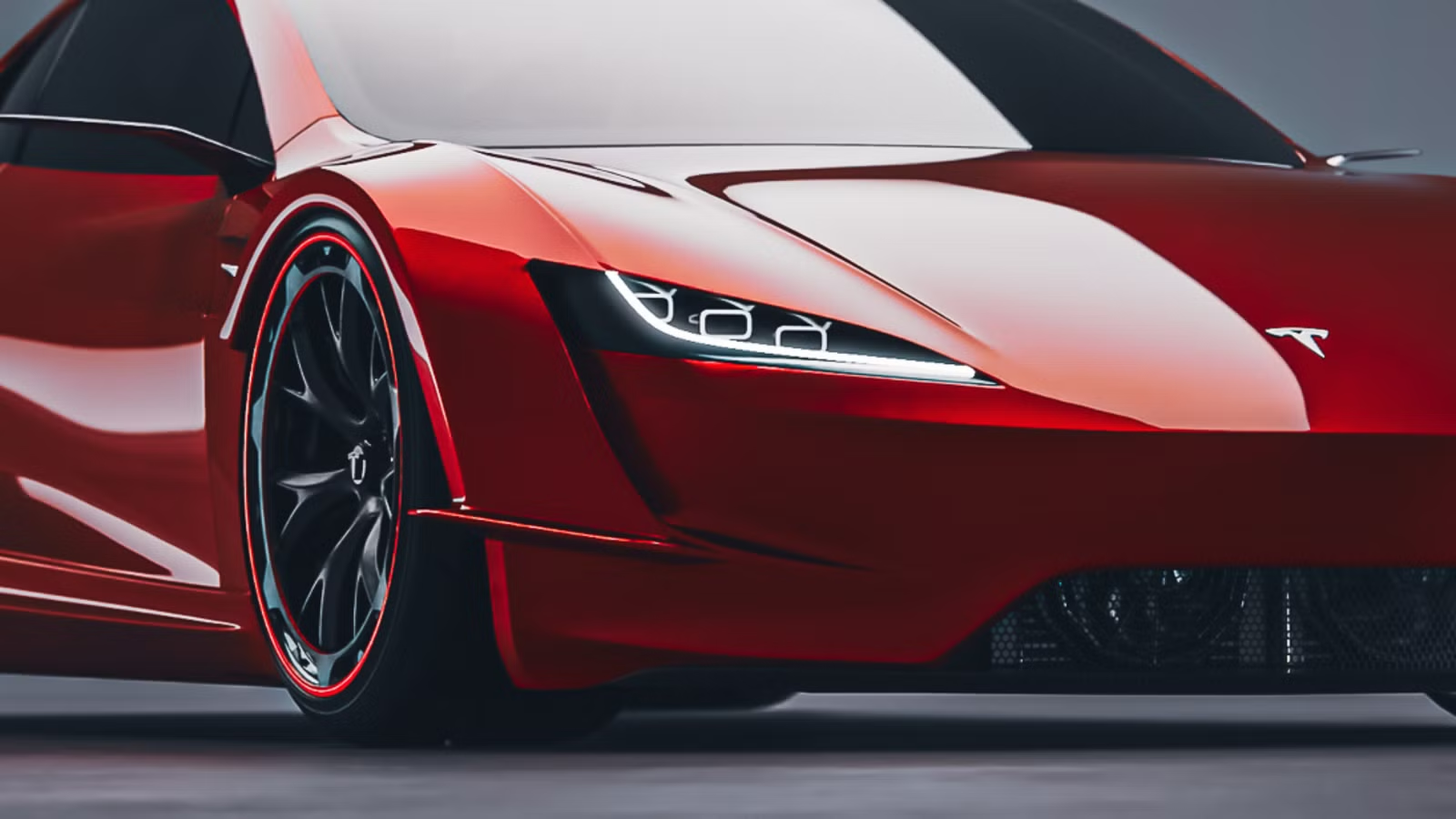
Tesla’s new Roadster drove up a curved ramp, hung upside down using fan-powered suction, and flew off on SpaceX-developed cold-gas thrusters. The only thing it didn’t do, is reach a single customer’s driveway in nine years. Elon Musk staged the stunt at SpaceX’s test site in McGregor, Texas, and declared the future does have flying cars.

That spectacle arrived nearly a decade after Tesla first showed the Roadster in November 2017 with a 2020 launch date, and production is now slated for 2028. Plenty of fans never asked for wings, though, just a supercar that won’t drive them up the wall.
Tesla’s Flying Roadster Is Spectacular, But Barely A Road Car
The second Roadster concept promises three trims called Performance, Thrust, and Rocket. The Performance is the two-seat plausible road car, the Thrust adds GMA T.50 style fan for the track, and the single-seat Rocket is claimed to fly. Tesla claims 0-60 mph times of under 1.6, 0.9, and 0.59 seconds.

Tesla’s Roadster page says the Rocket isn’t approved for public road use, and flying any version on the street isn’t allowed. There’s no price yet, though reservations cost $50,000 for the Performance and $250,000 for the Thrust, while the Rocket is invite-only. Interesting the deposit does not promise you will ever receive the Roadster. With fans that literally drive it up the wall, it’s fair to wonder what a Roadster built just for the road would look like.
The V8 Roadster Concept Keeps Its Wheels On The Ground

This HotCars Exclusive concept sticks to the 2017 prototype’s shape, but trades thrusters for a roof scoop, a towering rear wing, and a centered exhaust tip in an aggressive diffuser. Those additions hint at what sits under the carbon fiber intake: a Ford V8 instead of a battery pack.
Like the 2008 original, which was built on a Lotus Elise chassis, this concept borrows its bones from Lotus. The Elise is long gone, so the donor here is the Emira, the last gas-powered Lotus, with its bonded aluminum chassis.
The concept reimagines Tesla’s three trims with Mustang power, starting with the Dark Horse’s 500 hp, 5.0-liter Coyote V8 in the Performance. The Thrust steps up to the Dark Horse SC’s supercharged 5.2-liter Predator V8, making 795 hp and 660 lb-ft.
At the top, the Rocket borrows the Mustang GTD’s 815 hp supercharged V8, along with its dry-sump oiling and rear-mounted eight-speed transaxle. That’s only 20 hp more than the Thrust, but the dry sump lets it rev to 7,650 rpm, and the transaxle helps balance the weight.
Why Off-The-Shelf Parts Would Finally Get It Built

A Ford V8 won’t drop straight into a Lotus chassis, but it’s far from impossible. People have shoehorned V8s into their Miatas, and Hennessey squeezed a twin-turbo 7.0-liter V8 into the Lotus Exige-based Venom GT. So which sounds more plausible, a V8 in a Lotus or a car that flies, sucks itself to the ground, and drives up walls?
Every engine already powers a road-legal Mustang, sidestepping the red tape that keeps Tesla’s Rocket off public roads. The Lotus deal sped up the original Roadster’s production and type approval. After nine years, a V8 might be the quickest way to put a second-gen Roadster on the street.

Related posts



Latest Post


No Comments