
The Dodge Pickup That Outran A Ferrari 308 In The 1/4-Mile
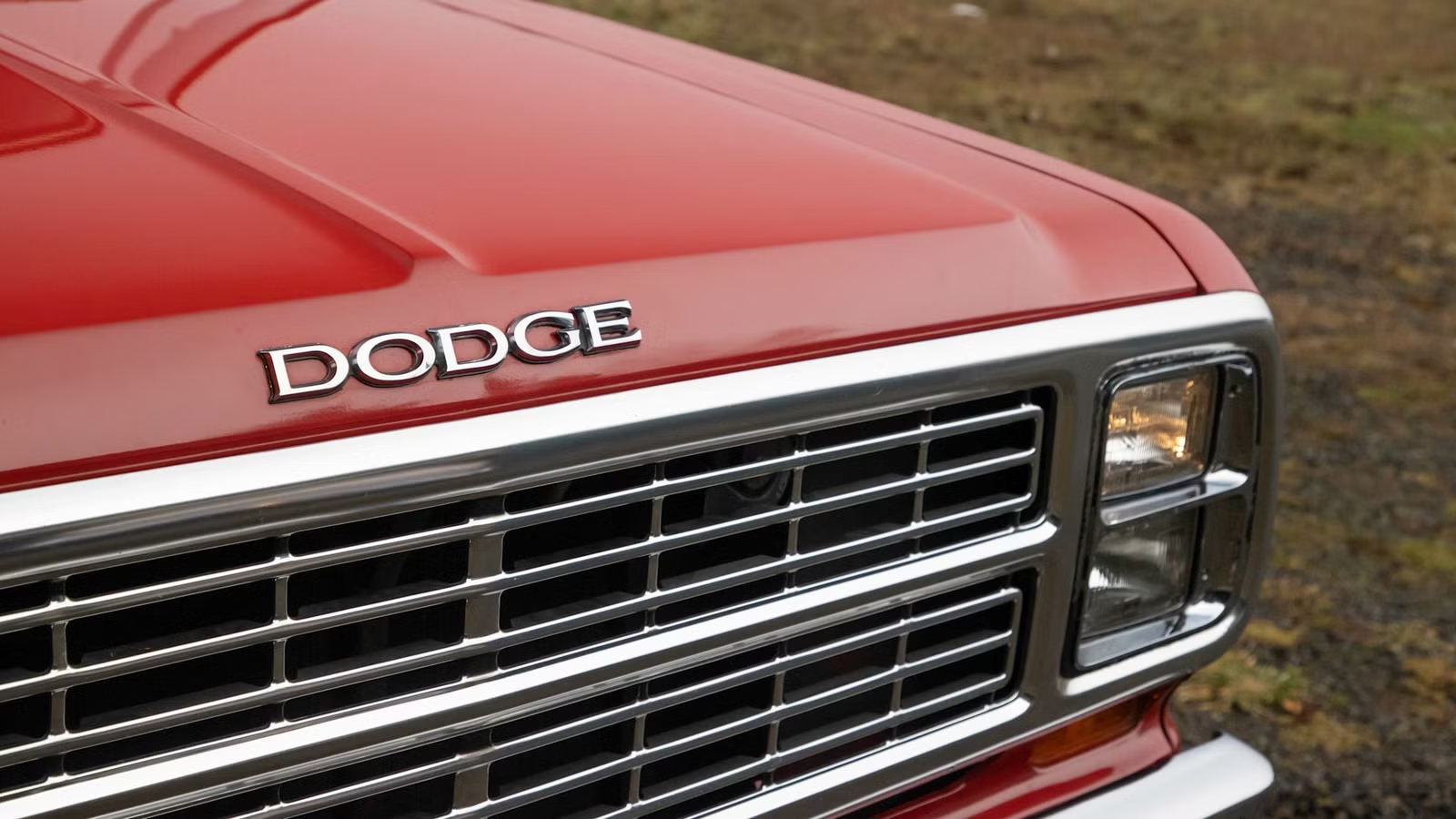
Imagine: You’re a government pencil pusher who’s been fighting those pesky muscle cars for years. By the mid 1970s, emissions regulations, insurance premiums, and the swap to unleaded gasoline forced Detroit to detune every V8. So in 1978, you open your office window, recline in your chair, and listen to the blissful silence of traffic sliding by on the street below. Then you hear a rumble, a roar, and squealing tires as a V8 launches from a stoplight. You rush to the window, looking for the muscle car. Instead, you see a little red truck tearing down the street.
Emissions Ended The Muscle Car Party Early

By the late 1970s, Detroit’s muscle cars had become shadows of their former selves. Horsepower figures tell part of the story, but they’re difficult to compare because the industry switched from optimistic SAE Gross ratings to more realistic SAE Net ratings beginning in 1972. The stopwatch paints a much clearer picture.
In 1970, Pontiac’s new Trans Am recorded a blistering 5.7-second sprint to 60 mph and a 14.1-second quarter mile. A year later, Chevrolet’s mighty LS6-powered Corvette, reaching 60 mph in just 5.3 seconds and covering the quarter mile in 13.8 seconds.

Fast-forward to 1978. Using the same testing methods, the quickest Corvette now needed 7.1 seconds to reach 60 mph and 15.3 seconds to clear the quarter mile. Pontiac’s best Trans Am was nearly identical at 7.1 seconds and 15.6 seconds. In less than a decade, America’s fastest performance cars had become one-and-a-half to two seconds slower in the quarter mile.

By the late 1970s, even America’s most famous performance badges had devolved into appearance packages. The Corvette lived on, but not as the tire-shredding monster of the early 1970s. The GTO was gone entirely, the Charger had become a personal luxury coupe, and the Trans Am’s reputation depended more on Hollywood than horsepower. Detroit had spent nearly a decade learning how to make cars cleaner and quieter. Dodge wanted to know if it could make one loud again.
Dodge Discovered A 6,000-Pound Loophole

Beginning in 1975, every new car needed a catalytic converter, further throttling its output. Then someone at Dodge read the fine print. The Clean Air Act exempted light trucks with a GVWR (the combined weight of vehicle and potential payload) over 6,000 pounds. The crew at Dodge started to ask: What if we threw a muscle car powertrain into…a pickup truck?
The automaker still tuned high-output V8s, though mostly for police use. So it took a police-spec 360 cu-in “E58” small block. Then it upped the cam and slapped a Carter Thermoquad four-barrel carb on the top, resulting in a new engine (code EH1). It attached the whole thing to a free-flow dual exhaust system.

The engine made 225 net horsepower at 3,800 rpm and 295 lb-ft of torque at 3,200 rpm. The team then found a built A-727 “LoadFlite” version of the TorqueFlite three-speed automatic that could handle this output. They settled on a 3.55:1 rear end ratio and limited slip differential. The only thing left was to drop the powertrain in a truck, and see what it could do.
Dodge’s 1978 Li’l Red Express

Mopar built some of the zaniest, gutsiest muscle cars of the early 1970s. Its 1978 Li’l Red Express proved that it still had all that personality, it had just been waiting for an outlet.
Every Li’l red express started its life as a D-150 Adventurer Utiline (stepside). This meant it head the lightest possible body and bed on the shortest wheelbase (115-inches). They were all finished in Bright Canyon Red (paint code PY3442), before receiving gold pin striping.
Dodge didn’t try to make these things look like late-1960s Chargers. To its credit, the automaker leaned into the truck’s personality. It got clear-coated oak wood bed planks for a true down-on-the-farm look. The finishing touch was not one, but two “stacks” style exhaust pipes that could have been borrowed from a semi-truck.

Other touches were more reminiscent of the golden age of muscle cars. The Li’l Red Express came with unique 5-spoke chrome wheels, and big chrome front and rear bumpers. Buyers could choose between a black bench seat, red bench seat, or red bucket seats which came with a center console.
The result is one of the most iconic special editions in automotive history. Dodge had already introduced the “Warlock” and “W100 Macho Power Wagon” editions. But history remembers the brightly colored Li’l Red Express. Perhaps because of its most famous battle.
Battle Of The Reds: Beating A Ferrari In The 1/4-Mile

Car and Driver wanted to test the Li’l Red Express when the truck first came out. The problem was that in 1978, there weren’t other muscle trucks that could keep up with it. Luckily, it had already tested the fastest exotics of the day on the drag strip. So it published a head-to-head. The results were staggering.
The Li’l Red Express sprinted to 100 mph in 19.9 seconds. That made it the fastest American-built production vehicle of 1978. In any segment.
The 1/4-mile was just as impressive. Car and Driver found the Porsche 928 could do the 1/4-mile in 15.31 seconds. The Ferrari 308/GTS came in at 15.08 seconds. The 911/SC: 14.81 seconds.

The Li’l Red Express embarrassed them all. It’s 1/4-mile time was 14.71 seconds at 93 mph.
Not every review agreed with the precise times. Others claimed a quarter mile peaked at 15.7 seconds at 88 mph. But everyone agreed this was one fast pickup truck.
The Feds Finally Catch On

Dodge built 2,188 Li’l Red Express trucks in 1978. But then the powers that be got wise to the gig. The government immediately changed the Clean Air Act, closing the 6,000-pond GVWR catalytic converter loophole.
Dodge did build a Li’l Red Express for the 1979 model year. It even sold 5,118 of them. But they had catalytic converters and detuned engines with a milder cam. Even the speedometer was limited to 85 mph. After making 7,306 Li’l Red Express trucks, Dodge pulled the plug on the entire project.
Today, the market is full of muscle trucks. But the Li’l Red Express started it all. GMC had its own Ferrari-racing moment in 1991 when its AWD compact “Syclone” pickup truck beat the Ferrari 348 to 60 mph in its own Car & Driver showdown. Ford dropped the SVT Lightning for the 1993 model year. The second, supercharged generation of the Lightning appeared in 1999. Dodge answered the Lightning by shoehorning the Viper’s V10 engine into the 2004 Ram SRT-10.

These muscle trucks of yesteryear paved the way for today’s lineup. The desert racing-inspired Ford Raptor made waves in 2010. Then Ram’s Hellcat-powered TRX took things to the next level in 2021. Ford answered yet again with the supercharged Raptor R. Now, the battle returns to the street with Ram’s new muscle truck lineup, featuring the Hellcat-powered Rumble Bee SRT. But none of this would be possible without the industry’s first muscle truck.
The Li’l Red Express was just one vehicle in Dodge’s daring late-1970s “Adult Toys” lineup. The automaker also built the 4WD “Macho Power Wagon” a customizable “Street Van,” and a dealer-assembled “Midnight Express” muscle truck with a big block V8. But the Li’l Red Express is the one people remember, because in the battle of the reds, this Detroit truck beat a Ferrari in the quarter mile. And the world hasn’t been the same since.
Sources: Car and Driver magazine: November 1977, Dodge, Dodge Connection

Related posts
Latest Post


No Comments