
2027 Honda CBR500R Four First Look: The Small-Bore Four Is Back

The middleweight sportbike segment continues to capture that market’s attention, and today we’re met with an all-new small-bore inline-four-powered entry: The 2027 Honda CBR500R Four. While the long-teased CBR500R Four has been announced in European markets, American Honda has not confirmed whether it will make its way to the United States, and we will update this story accordingly.

But wait, isn’t there already a CBR500R in Honda’s lineup? Yes, the longstanding CBR500R is an entry-level sportbike featuring a 471cc parallel-twin engine making roughly 47 horsepower. The CBR500R Four is a horse of a different color, entirely. The “Four” suffix is what matters most here, as it means we’re seeing a far more potent near 70 horsepower out of the all-new 502cc inline four powerplant, along with an all-new chassis.
Honda’s latest small-bore sportbike harkens back to a class that prioritized handling agility over massive peak power figures, recently reopened by the Kawasaki Ninja ZX-4R platform. Speaking specifically to Honda’s history, the new CBR500R Four grew out of the CB400 Super Four, a mid-sized I4 naked bike that has had a three-decade run in Japan and recently returned to the brand’s domestic lineup after a four-year hiatus. Enough fluff, let’s dig into everything we know about Honda’s new middleweight sportbike.
Engine: Sixteen Valves, Half a Liter
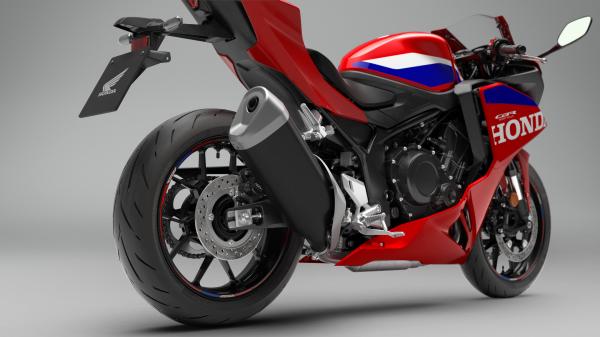
Powering the CBR500R Four is a liquid-cooled DOHC 502cc inline four-cylinder engine using four valves per cylinder, along with a rev-happy short-stroke design that sees the redline reaching 12,500 rpm. Healthy performance figures line up with class rivals, offering a claimed 69.5 horsepower at a lofty 11,000 rpm and 34.1 lb-ft of torque at 10,500 rpm, placing the meat of its power high in the top third of the tachometer, for a classic I4 riding experience.

Honda incorporated several upgrades in growing the engine from 400cc to 500cc. The cylinder bores are Ni-SiC plated rather than sleeved, which trims weight and friction, and the valve lifters carry a Diamond-Like Carbon (DLC) coating. A revised shaft layout shortens the engine front to rear, helping centralize mass.

Intake air arrives through two ram-air ducts beneath the headlights and feeds a 5.8-liter airbox mounted directly above the cylinder head. That downdraft path is meant to sharpen throttle response compared with a horizontal intake. Uneven funnel lengths, 70mm on the outer cylinders and 90mm on the inner pair, balance airflow and shape the intake sound. That culminates with a 4-2-1 exhaust system with side-swept headers to echo the 1975 CB400F, ending in a single muffler.
In terms of performance, it’s right in league with its most direct competitor, the Kawasaki Ninja ZX-4R and ZX-4RR.
Electronics: E-Clutch and More

A competitive rider aid package is on hand, though we should note that these are conventional systems, and Honda makes no mention of a more advanced IMU to allow for cornering ABS or lean-sensitive traction control. The fully modern ride-by-wire throttle facilitates three ride modes, including Standard, Sport, and Urban. Those preset riding modes determine the Four’s engine power, engine brake, and traction control settings. Honda also includes two customizable User modes, which allow owners to adjust all the aforementioned settings, as well as turning off TC. Wheelie control is also listed as standard.

Honda’s E-Clutch hardware expands to this new model, allowing riders to start, stop, and shift without the use of the clutch lever. Put simply, it dramatically simplifies riding for both new and veteran riders. Here’s how it works: Two motors housed inside the left-hand engine cover physically operate the assist/slipper clutch. All the rider needs to do is shift the six-speed gearbox. Owners can adjust shift pedal resistance between three settings: Hard, Medium, or Soft, independently for upshifts and downshifts.
The clutch lever stays in place and works normally at any time. After a manual shift, automated control resumes within a second at higher rpm, or after five seconds at lower rpm. The system can also be disabled, allowing riders to use the clutch normally.
Chassis: Steel Where It Counts

The steel frame and aluminum swingarm are all-new, with sporty geometry coming into the picture when viewing the specification. A fairly sporty 25-degree rake is joined by a 3.9-inch trail measurement, and a tight 55.4-inch wheelbase. Combined with the 417-pound claimed curb weight, these figures have the makings of an agile mid-sized sport motorcycle.
Suspension comes in the form of a non-adjustable 41mm KYB USD fork providing 4.3 inches of travel. The linkage-type shock features basic five-step preload adjustment with 4.7 inches of wheel travel.

Nissin provides the stopping power with dual two-piston calipers working in conjunction with 296mm discs. A single-piston Nissin caliper and 240mm disc handle braking duties out back. Two-channel ABS is standard.
Cast aluminum five-Y-spoke 17-inch wheels wear Pirelli Diablo Rosso IV tires in 120/70-ZR17 and 160/60-ZR17 sizes. OE tire choice could change if and when the CBR500R Four arrives in the United States.
Ergonomics: Low Seat, Sharp Suit

Clip-on handlebars set up a sporty ergonomic tone, putting the rider in a more aggressive riding position akin to the Triumph Daytona 660. However, contrasting that is an approachable 30.7-inch seat height and what Honda says is a narrow subframe that will help riders with shorter inseam lengths reach the ground confidently.
The 5-inch color TFT is optically bonded to cut glare and offers three display layouts. Honda RoadSync adds turn-by-turn navigation, calls, and music through a Bluetooth headset, controlled by a backlit four-way switch on the left bar. A USB-C port sits below the screen. Lighting is full LED, led by twin projector headlights with integrated turn signals.
Pricing and Availability: Mind the Exchange Rate

Pricing and availability for the 2027 Honda CBR500R Four have not been announced yet for the U.S. market. However, we can look to our friends across the pond at Honda UK for a reference: the CBR500R Four E-Clutch lists for £6,999. Using recent exchange rates as of this publication date, that would equal roughly $9,400 (including UK VAT), which is closer to the Kawasaki Ninja ZX-4R than the up-spec Kawasaki Ninja ZX-4RR. Whether that holds true is unknown at this time.
European buyers can choose Ignition Red (Tricolour) or Matte Ballistic Black Metallic. U.S. availability, pricing, color options, and specifications remain unannounced at this time. We will update this story if American Honda confirms the model.
2027 Honda CBR500R Four First Look Photo Gallery:
2027 Honda CBR500R Four Specifications:
Engine:
|
Type |
Inline 4-cylinder |
|
Displacement |
502cc |
|
Bore x stroke |
60.0mm x 44.4mm |
|
Maximum horsepower |
69.5 horsepower @ 11,000 rpm, claimed (European spec); 35 kW (46.9 horsepower) A2-licence version also offered |
|
Maximum torque |
34.1 lb-ft @ 10,500 rpm, claimed (European spec) |
|
Compression ratio |
12.3:1 |
|
Valvetrain |
DOHC; 4 valves per cylinder; Diamond-Like Carbon (DLC) coated valve lifters |
|
Fueling |
Programmed fuel injection (PGM-FI) w/ throttle-by-wire; dual ram-air ducts feeding a downdraft intake w/ 5.8-liter airbox; 70mm intake funnels on cylinders 1 and 4, 90mm on cylinders 2 and 3. |
|
Exhaust |
4-2-1 w/ side-swept headers; single muffler (two-chamber per Honda press releases, three-chamber per Honda UK website). |
|
Cooling |
Liquid |
|
Transmission |
6-speed w/ Honda E-Clutch |
|
Clutch |
Wet multiplate assist/slipper; Honda E-Clutch automated actuation via two motors inside the left-hand engine cover, clutch lever retained for manual use; Hard, Medium and Soft shift-pedal effort settings, selectable separately for upshifts and downshifts |
|
Final drive |
Chain. |
Chassis:
|
Frame |
Steel tube diamond-type (Honda spec table lists twin-tube construction), 30.9 pounds (14 kg); engine as stressed member; aluminum swingarm |
|
Front suspension; travel |
Non-adjustable KYB 41mm inverted (USD) fork; 4.3 inches (109mm) |
|
Rear suspension; travel |
5-step spring-preload-adjustable monoshock w/ Pro-Link linkage, 52.5mm stroke; 4.7 inches (119mm). Brand Not Provided By Manufacturer |
|
Wheels |
Cast aluminum, 5 Y-spoke |
|
Front wheel |
17 x 3.5 |
|
Rear wheel |
17 x 4.5 |
|
Tires |
Pirelli Diablo Rosso IV, radial ZR-rated |
|
Front tire |
120/70-ZR17 |
|
Rear tire |
160/60-ZR17 |
|
Front brake |
Dual 296mm discs w/ Nissin radial-mount 2-piston calipers |
|
Rear brake |
240mm disc w/ Nissin 1-piston axial-mount caliper |
|
ABS |
Standard, 2-channel. Cornering function Not Provided By Manufacturer |
|
Electronic rider aids |
Throttle-by-wire; Standard, Sport, Urban, User 1 and User 2 ride modes; three-level Engine Power, Engine Brake and Honda Selectable Torque Control (HSTC), HSTC switchable off in User modes; wheelie control (per Honda spec table); Honda E-Clutch w/ auto-blip downshifts and rear-wheel-hop management; Emergency Stop Signal; 5-inch optically bonded TFT w/ Honda RoadSync smartphone connectivity; USB-C socket. TPMS Not Provided By Manufacturer |
Dimensions & Capacities:
|
Wheelbase |
55.4 inches (1408mm) |
|
Rake |
25.0 degrees |
|
Trail |
3.9 inches (99mm) |
|
Seat height |
30.7 inches (780mm). Laden or unladen basis Not Provided By Manufacturer |
|
Ground clearance |
5.3 inches (135mm) |
|
Lean angle |
Not Provided By Manufacturer |
|
Fuel capacity |
3.7 gallons (14 liters) |
|
Estimated fuel consumption |
52.3 mpg (US; WMTC, 4.5 L/100km), claimed (European spec) |
|
Curb weight |
417 pounds (189 kg; Honda UK kerb weight, fuel level not specified). |
Pricing & Warranty:
|
Website |
powersports.honda.com |
|
Price |
U.S. MSRP Not Provided By Manufacturer (model not announced for the U.S.). UK: £6,999 on-the-road RRP, listed as CBR500R FOUR E-Clutch (approx. $9,400 at recent exchange rates, including 20% VAT) |
|
Warranty |
U.S. Not Provided By Manufacturer. UK: 6-year Honda warranty |
|
Service interval |
TBA |
|
Color |
Ignition Red (Tricolour), Matte Ballistic Black Metallic (UK) |
Source: Honda UK

Related posts
Latest Post


No Comments