
7 Panther-Platform Fords Enthusiasts Now Rate Over Impala SSs
The 1994–1996 Chevrolet Impala SS still owns serious street cred. Its 260-hp LT1 V8, police-derived chassis hardware, and roughly seven-second sprint to 60 mph made it the full-size muscle sedan to beat. But speed tells only part of the story: Panther-platform fans increasingly chase rarer Ford, Mercury, and Lincoln combinations that offer better parts interchange, tougher hardware, stranger factory options, or simply more character. Some cannot outrun an Impala SS, but that hardly matters.
7
1990–1991 Ford LTD Crown Victoria Police Package 5.8L
Power: 180 hp

Horsepower makes the old box Crown Victoria look hopeless beside an Impala SS, but that misses the point. Ford still offered police departments a 351-cubic-inch Windsor V8 when civilian LTD Crown Victorias normally used the smaller 302. The 5.8-liter police engine made 180 hp and, remarkably, still used a Motorcraft variable-venturi carburetor. By 1991, fuel injection ruled most of Detroit, yet this boxy police car mixed fuel and air the old-fashioned way. The 351 was largely a fleet-only choice by then, which makes surviving examples much more interesting than an ordinary retired cruiser.

Ford also gave police cars the hardware to survive actual duty: tougher suspension, brakes, cooling, wheels, tires, frame components, and a 140-mph speedometer. The real appeal goes beyond the spec sheet: the 351 Windsor has huge aftermarket support, while the whole car feels wonderfully analog. An Impala SS feels like a modernized 1990s muscle sedan, but this Crown Vic feels like the final act of an older formula.
6
1995–1997 Ford Crown Victoria LX Handling and Performance
Power: 215 hp


The Handling and Performance Package, or HPP, turned a civilian Crown Victoria into one of Ford’s best sleepers. It combined the stronger dual-exhaust 4.6-liter V8 with firmer springs and shocks, upgraded stabilizer bars, rear air suspension, touring tires, alloy wheels, and a shorter 3.27:1 rear axle. Output reached 215 hp, well below the Impala SS, but the gearing and chassis changes mattered more than the number. The HPP simply felt more alert than a regular Crown Vic.
That subtlety gives it much of its appeal today. There was no giant spoiler, fake hood scoop, or loud badge announcing the package. It still looked like something parked outside an insurance convention, but underneath, Ford fixed many of the traits that made ordinary Panthers feel lazy. Rear air springs kept the body level, the shorter axle sharpened response, and dual exhaust helped the Modular V8 breathe better. The HPP never turned the Crown Vic into a sports sedan, but it gave the big Ford enough attitude to surprise anyone expecting a rolling sofa. Grandma’s car had gone to handling school.
5
1998–2002 Lincoln Town Car Signature Series Touring Sedan
Power: 235 hp
A sporty Lincoln Town Car sounds like a contradiction, but the Signature Series Touring Sedan had real substance. Lincoln paired the 4.6-liter V8 with dual exhaust and, on later versions, as much as 235 hp. More importantly, it used a 3.55:1 rear axle, a higher-stall torque converter, firmer suspension tuning, larger stabilizer bars, revised steering, wider touring tires, and unique wheels. Lincoln did more than stitch “Touring” into the upholstery and call it a day.

The 3.55 gearing is what makes this Panther especially interesting. A regular Town Car makes highway speed feel almost stationary, but the Touring Sedan added enough punch off the line to wake up the heavy body without ruining the Lincoln‘s best trick: swallowing bad pavement. Perforated leather, darker wood trim, and subtle exterior changes kept the luxury-car atmosphere intact. It still cannot match an Impala SS for outright pace, but that misses the fun. The Touring Sedan mixes muscle-sedan hardware with limousine manners. It is a leather recliner that somehow showed up wearing running shoes.
4
2001–2003, 2005 Mercury Grand Marquis LSE
Power: 239 hp
The Grand Marquis LSE remains one of the easiest Panthers to overlook. Mercury essentially built its own Crown Victoria LX Sport, combining Grand Marquis comfort with bucket seats, a center console, floor shifter, dual exhaust, and sportier chassis tuning. Later examples reached 239 hp from the 4.6-liter SOHC V8. Mercury also skipped a model year before bringing the LSE back for 2005, giving the trim the kind of odd production history that enthusiasts tend to love.

The 2003 LSE stands out because Ford heavily revised the Panther platform that year. It gained a stiffer frame with hydroformed sections, an aluminum front crossmember, rack-and-pinion steering, and revised suspension geometry. Rear shocks moved outside the frame rails, improving axle control. That gave the Grand Marquis a much more modern chassis while its styling still suggested early dinner specials and careful parallel parking. That contrast is the whole charm.
3
2001–2006 Ford Crown Victoria LX Sport
Power: 239 hp
The Crown Victoria LX Sport pushed the sleeper formula a little closer to the surface. The concept appeared around 2001, with Ford formally using the LX Sport name for 2002. It paired civilian Crown Vic comfort with HPP-style hardware, 17-inch wheels, bucket seats, a center console, and the Panther family’s unexpectedly cool floor shifter. Later dual-exhaust cars reached 239 hp, while Ford also fitted shorter gearing, firmer suspension tuning, and rear load-leveling air springs.

For enthusiasts, the LX Sport has one major advantage over many Police Interceptors: it usually lived a gentler first life. A clean Sport delivered much of the same rear-drive Panther character without years of curb strikes, emergency runs, and marathon idle time. Cars from 2003 onward also gained the stiffer frame, rack-and-pinion steering, and revised suspension that sharpened the whole platform. Add the console shifter and subtle trim, and the LX Sport feels like the Crown Victoria Ford should have marketed harder. Best of all, it still looks ordinary enough that only another Panther nerd is likely to notice.
2
2003–2011 Ford Crown Victoria Police Interceptor P71/P7B
Power: 250 hp

The Crown Victoria Police Interceptor became so familiar that its engineering sometimes gets overlooked. The redesigned 2003 CVPI made 239 hp, while later cars reached 250 hp. Ford backed the 4.6-liter V8 with dual exhaust, heavy-duty cooling and electrical systems, police-spec suspension, stronger brakes, and either 3.27 or 3.55 rear gearing. These upgrades existed because police duty is brutal: hours of idling followed by sudden full-throttle acceleration, hard braking, and drivers who never had to make the monthly payment.

The 2003 chassis redesign also transformed the car. Ford added rack-and-pinion steering, a stiffer hydroformed frame, revised brakes, and reworked suspension. P71 identified most police models through 2009, while P7B replaced the code for 2010 and 2011. The Impala SS still wins the stock horsepower argument, but the CVPI offers something else: cheap parts, an 8.8-inch rear axle, simple rear-drive construction, and decades of fleet-proven fixes. It is one of the easiest big sedans to understand, modify, and keep alive.
1
2003–2004 Mercury Marauder
Power: 302 hp

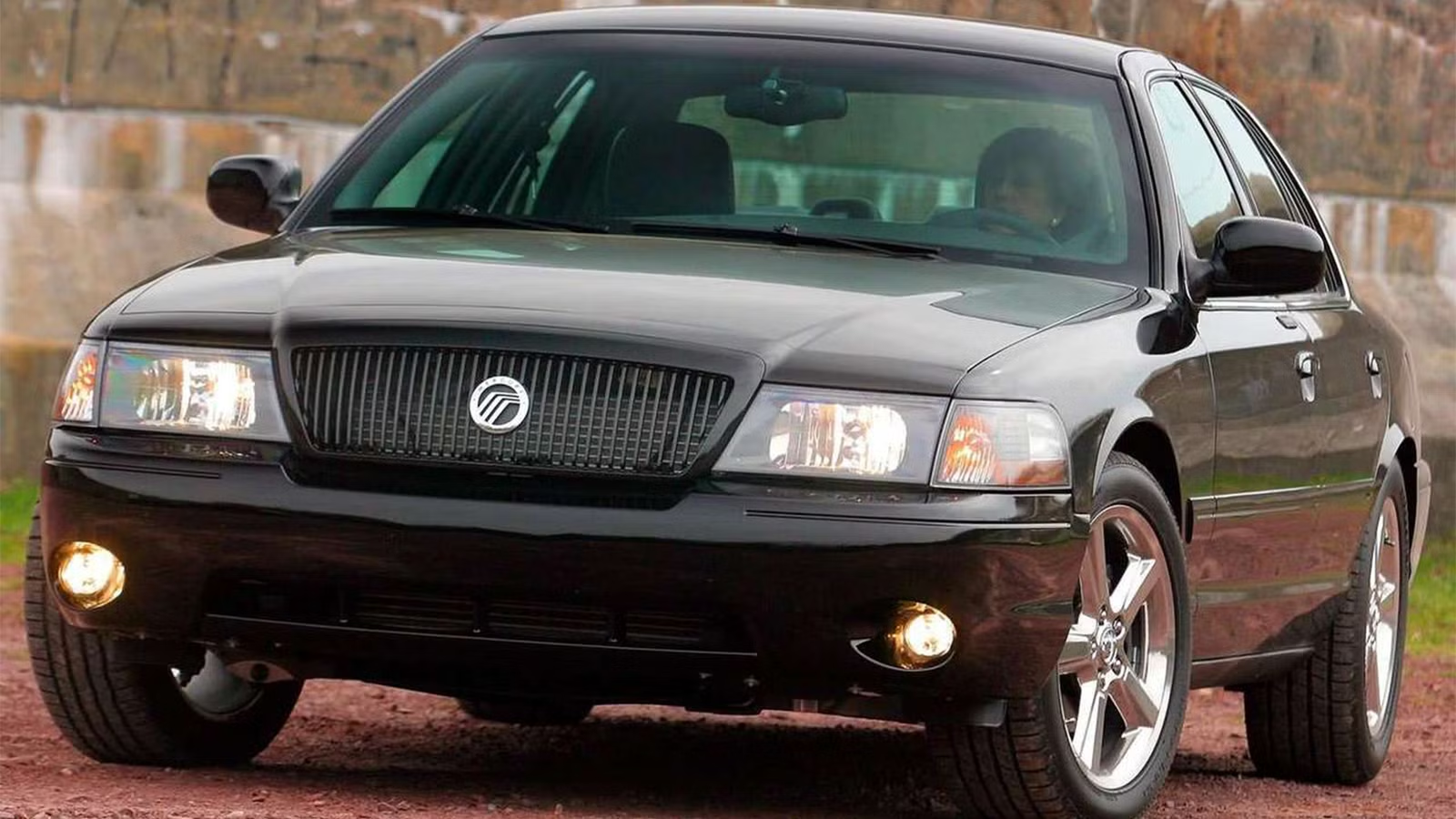
The Marauder needs no excuse in an Impala SS comparison. Mercury gave the Panther platform a 4.6-liter DOHC 32-valve V8 producing 302 hp and 318 lb-ft of torque. Its engine shared important DNA with the Mustang Mach 1, Cobra, and Lincoln Aviator, and it loved revs more than the Chevy’s pushrod LT1. Mercury also added a 3.55:1 limited-slip axle, aluminum driveshaft, firmer suspension tuning, staggered 18-inch tires, bucket seats, a console shifter, and auxiliary gauges. It remains the only production Panther sedan with Ford’s four-cam Modular V8.

Oddly, the Marauder still did not beat the Impala SS cleanly at the drag strip. Its weight, softer low-rpm torque, and automatic transmission blunted the advantage. But the 2003 Panther chassis gave it better steering feel and body control than older full-size Fords, while the DOHC engine offered plenty of tuning potential. Mercury sold only about 11,000 over two years, turning disappointing showroom numbers into modern rarity. That scarcity, combined with the engine and factory attitude, puts the Marauder at the top of many Panther wish lists.
Source: Ford, Lincoln, Mercury

Related posts

Latest Post


No Comments