
Every Hybrid Pickup Truck You Can Buy In 2026, Ranked
Hybrid pickups have quietly become one of the truck market’s most interesting subcategories, spanning a $28,000 compact hauler to a $95,000 luxury barge. But “hybrid” gets applied loosely across this group, and lumping a 48-volt belt-starter system in with a full parallel hybrid muddies any honest comparison. Here’s every genuine hybrid pickup sold in the US for 2026, defined consistently and ranked on price, power, efficiency, capability, and the complete ownership case, not horsepower alone.

Before ranking anything, the distinction matters. A mild hybrid, like Ram’s eTorque, uses a small belt-driven motor-generator to smooth stop-start cycles, add brief torque assistance, and recover braking energy, but it cannot move the truck on electric power alone and barely touches fuel economy. A full hybrid, like Toyota’s i-FORCE MAX, Ford’s PowerBoost, and the Maverick Hybrid, integrates a real electric motor into the drivetrain that can contribute meaningful propulsion and deliver a genuine mpg gain over the equivalent gas engine. Both technologies are covered here, but they’re judged against the promises made for their own category.
Ram 1500 eTorque V6
305 hp
The eTorque 3.6-liter Pentastar V6 is the entry point into Ram’s hybrid technology, and it’s the weakest case for calling any Ram 1500 a hybrid at all. The belt-driven motor-generator adds up to 90 pound-feet of supplemental launch torque, quiets the stop-start system, and recovers a bit of braking energy, but there is no electric-only driving and no meaningful fuel savings beyond what a well-tuned stop-start system already delivers. Output lands at 305 hp and 269 pound-feet, with EPA estimates of 20 mpg city and 25 mpg highway in 4×2 form, numbers that owe more to the Pentastar’s light weight than to electrification.


That light weight does translate into the highest payload rating in the Ram 1500 lineup at 2,360 lbs, useful for contractors who load the bed harder than they tow. Towing tops out at 8,130 lbs, adequate for a single-axle trailer or a fishing boat but well behind every other truck on this list except the Maverick. Pricing starts around $42,400 for the Ram 1500 lineup, with the V6 eTorque standard on Tradesman, Express, Big Horn, and Warlock trims. It is a capable, honestly priced half-ton, but the “hybrid” badge here is doing very little actual work, which is exactly why it ranks last.
Ram 1500 eTorque V8
395 hp

The 5.7-liter HEMI V8 returned to the Ram 1500 lineup for 2026 after a year off, and it carries the same eTorque 48-volt mild-hybrid system as the V6, just scaled up to 130 pound-feet of supplemental torque. Output climbs to 395 hp and 410 pound-feet, and Ram’s Multi-Displacement System deactivates four cylinders under light highway cruising to help offset the V8’s thirst. Towing improves meaningfully to roughly 11,320 lbs when properly equipped, a real step up from the V6, though fuel economy slips to an EPA-estimated 17 mpg city and 22 mpg highway. Premium fuel is not required, but the extra weight over the front axle does eat into payload versus the lighter V6.

The case for the HEMI over the V6 is straightforward. It offers more towing margin, the classic V8 character buyers have wanted back since it was discontinued, and a mild-hybrid system that at least earns its keep by allowing the cylinder deactivation to work more seamlessly. It still isn’t a fuel-economy play, and Ram’s turbocharged Hurricane inline-sixes outperform it on both power and towing for similar money. But as a nostalgia-driven, capability-focused option with a mild-hybrid assist bolted on rather than built around a true efficiency story, it edges out the V6 without threatening the trucks positioned above it on this list.
Toyota Tundra i-FORCE MAX
437 hp

This is where the list moves into genuine full-hybrid territory. The Toyota Tundra’s i-FORCE MAX pairs a twin-turbo 3.4-liter V6 with an electric motor built into the 10-speed automatic, drawing from a 288-volt nickel-metal hydride pack. Combined output is 437 hp and 583 pound-feet, the strongest numbers in this entire ranking, with peak torque arriving at just 2,400 rpm. EPA ratings run up to 20 mpg city and 24 mpg highway in 2WD form, a real improvement over the standard 389-hp twin-turbo V6.

Capability is where the complications arise. Towing on i-FORCE MAX models actually falls short of the gas Tundra’s best rating, topping out around 11,450 lbs on the Limited versus 12,000 lbs for the non-hybrid SR5, and payload takes a real hit too, generally landing in the 1,485 to 1,680 lb range depending on trim because of where Toyota packages the battery. Pricing starts around $56,595 for a Limited i-FORCE MAX, roughly a $3,300 premium over the equivalent gas Limited. Toyota backs the hybrid components with an 8-year/100,000-mile warranty and the battery for 10 years/150,000 miles, which matters given how central the electric motor is to the Tundra’s personality. It’s the most powerful hybrid pickup sold today, but the towing and payload trade-offs keep it from the top half of this list.
Toyota Tacoma i-FORCE MAX
326 hp

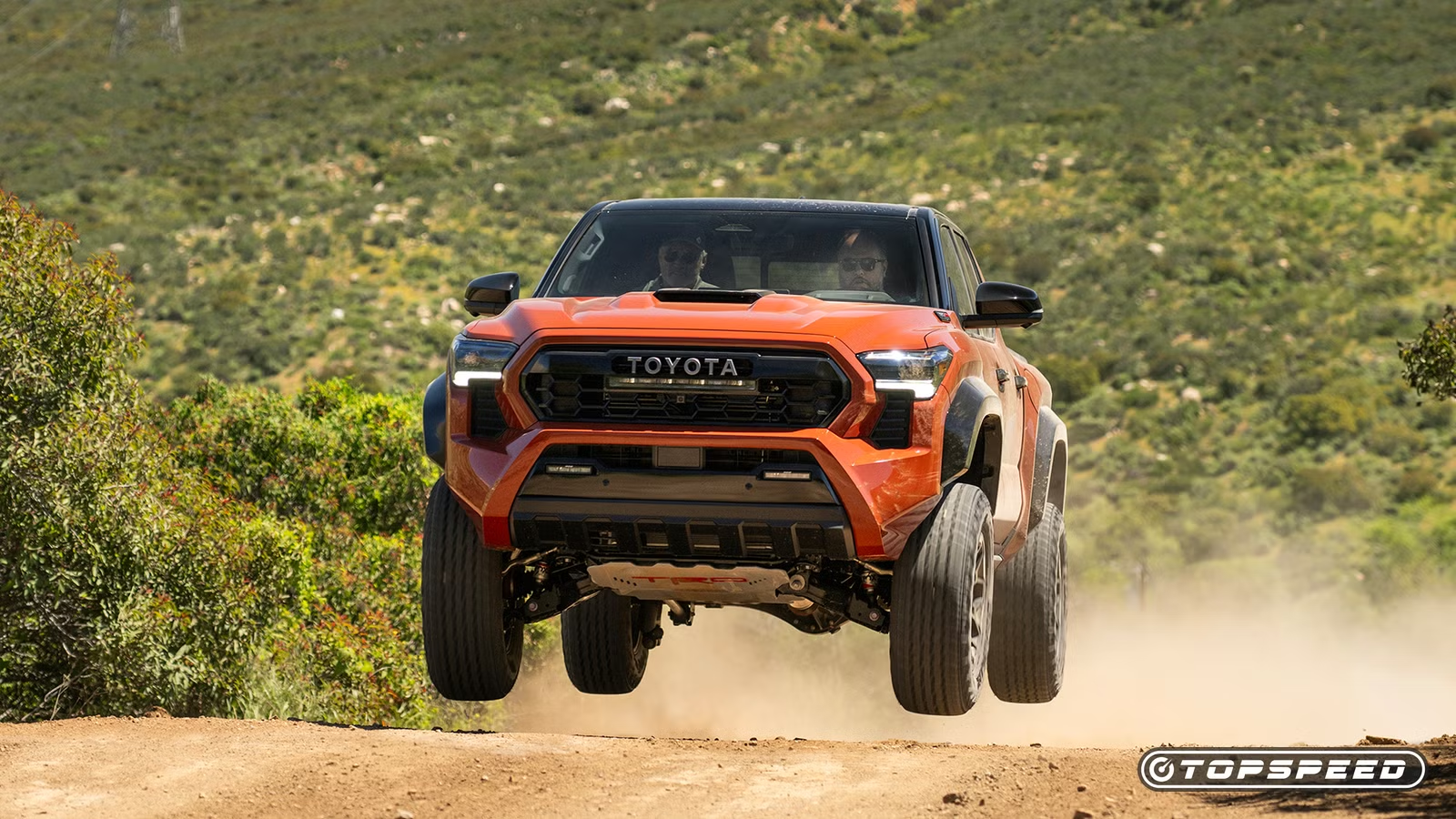
Toyota’s midsize hybrid takes a completely different approach from its full-size sibling. The Tacoma i-FORCE MAX pairs a 2.4-liter turbo four-cylinder with a 48-hp electric motor built into the 8-speed automatic, producing 326 hp and a segment-leading 465 pound-feet, a 75 percent torque jump over the outgoing V6 Tacoma that arrives at a low 1,700 rpm. Every i-FORCE MAX Tacoma comes standard with four-wheel drive, and fuel economy reaches an EPA-estimated 23 mpg combined on the Limited, genuinely competitive for a midsize truck with this much low-end shove.

Towing dips slightly against the gas Tacoma, 6,000 lbs versus 6,500 lbs, and payload maxes out at 1,705 lbs on the TRD Off-Road i-FORCE MAX. Pricing starts at $48,830 for the TRD Sport i-FORCE MAX, which is a meaningful jump over a base gas Tacoma, but the hybrid system also brings a genuinely useful feature: a 120-volt household outlet routed to both the bed and cabin, standard on every hybrid Tacoma, letting owners run power tools or a portable fridge without a separate generator. For buyers who want low-end pulling power, strong efficiency for the segment, and onboard power without stepping up to a full-size truck, this is a compelling midsize hybrid, held back only by a towing number that trails its own gas sibling.
Ford F-150 PowerBoost
430 hp

Ford’s full hybrid F150 remains the most towing-capable hybrid pickup on sale. The 3.5-liter twin-turbo PowerBoost V6 pairs a 35 kW electric motor and a 1.5 kWh lithium-ion battery with the gas engine for 430 hp and 578 pound-feet, and unlike the Tundra, the hybrid system here does not cost the F-150 any towing margin against its combustion-only siblings in the same weight class. Properly configured, PowerBoost trucks tow up to 11,600 lbs, more than either Toyota hybrid, and EPA estimates land at 22 mpg city and 24 mpg highway, a genuine three-mpg combined improvement over the standard EcoBoost V6.

Payload runs up to 1,740 lbs depending on configuration, competitive for the segment even if it trails the F-150’s non-hybrid payload champion. The standout feature is Pro Power Onboard, a generator built into the hybrid system that outputs up to 7.2 kW on higher trims, effectively turning the truck bed into a jobsite power source, a genuinely useful advantage over every other truck here except the similarly equipped Tacoma. PowerBoost is available on XLT, Lariat, King Ranch, and Platinum trims, giving buyers a wide range of price points to choose from. Between the strong towing, the mpg gain that does not come at capability’s expense, and the onboard generator, this is the most well-rounded full-size hybrid on the market, and it would rank higher still if real-world mpg did not tend to fall noticeably short of the EPA sticker under load.
Ford Maverick Hybrid
191 hp

On paper, the Ford Maverick Hybrid looks like the weakest truck in this entire field, and by raw output, it is. The 2.5-liter Atkinson-cycle four-cylinder hybrid produces just 191 hp, standard towing is a modest 2,000 lbs, and even with the optional 4K Tow Package it caps out at 4,000 lbs, less than half the smallest full-size hybrid here. But judged on the complete ownership proposition rather than the spec sheet, it’s the most compelling hybrid truck sold in America.

Start with the number that actually matters to most owners: fuel economy. The Maverick Hybrid returns an EPA-estimated 42 mpg city, 33 mpg highway, and 38 mpg combined with front-wheel drive, more than double what any other truck on this list achieves, and Edmunds testers regularly beat 40 mpg combined in real-world driving. Then look at the price. The Maverick Hybrid starts at $28,145, less than a third of a loaded Tundra i-FORCE MAX and roughly $18,000 below where PowerBoost trucks begin. Payload still reaches a genuinely useful 1,500 lbs thanks to the unibody platform’s efficient packaging, and Ford includes a trailer brake controller and both 4-pin and 7-pin connectors as standard, details rivals charge extra for. For the overwhelming majority of truck buyers who need occasional light towing, daily practicality, and a fuel bill that does not sting, nothing else on this list comes close to the Maverick Hybrid’s value. It will not pull a full-size camper up a steep mountain pass, but it does not need to in order to be the smartest hybrid pickup purchase you can make in 2026.
Sources: Kelley Blue Book, Cars.com & Edmunds

Related posts

Latest Post


No Comments