
This Was The Fastest Sedan In America In The 2000s, Now It’s Worth $9k
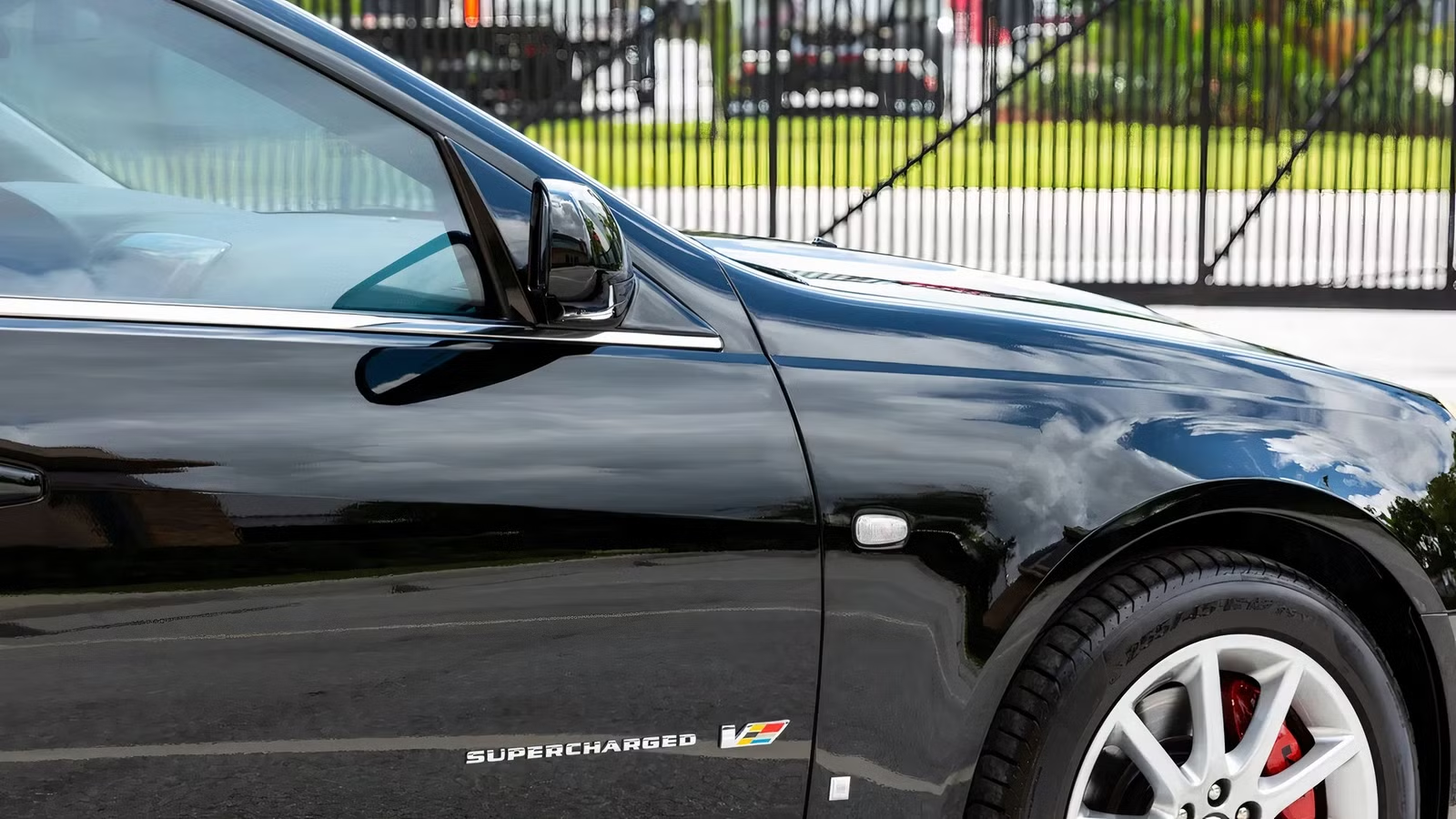
It’s easy to forget just how seismic the Cadillac STS-V felt when it broke cover. Here was a brand long associated with country-club comfort suddenly showing up at the Detroit Auto Show with a supercharged V8, Brembo brakes, and the audacity to challenge BMW’s M division and Mercedes-AMG on their own turf. The performance figures were genuinely startling for a car wearing a Cadillac badge, and the sharp-edged styling signaled that this was a company serious about reinventing itself as a performance player in the luxury sedan segment.

There was just one problem: the STS-V cost almost $80,000 new. Within a few years, the global economy had cratered, and niche luxury performance cars were among the last things on buyers’ minds. Meanwhile, a more raw and straightforward American muscle car had returned in four-door form at roughly half the price, stealing some of the Cadillac’s thunder before it ever had a chance to build momentum.
The years haven’t been kind to either of them — both have suffered dramatic depreciation and can now be found for less than $10,000. So, if you’re ready to take the brave pill, let’s take a look at the fastest sedan in America in the 2000s — plus one that was hot on its heels — and how you can pick them up today for the price of a secondhand Mini.
The Cadillac STS-V Was The Fastest Sedan In America In The 2000s
2006 Cadillac STS-V Specs
 54 autotech Engine |
Supercharged 4.4-liter V8 |
|
Power |
469 hp |
|
Torque |
439 lb-ft |
|
0 – 60 mph |
4.6 seconds |
Source: Cadillac
By the 2000s, BMW and Mercedes-AMG had fine-tuned the idea of the high-performance luxury sedan and were, let’s face it, completely owning the segment. The BMW M5 had a Formula 1-inspired, naturally aspirated 5.0-liter V10 and a top speed in excess of 200 mph, and the Mercedes-Benz E63 AMG was fitted with a snarling 6.2-liter V8. These were luxury sedans that performed like supercars, forcing enthusiasts to completely recalibrate what a performance machine could be. It would take a brave company to step into this particular arena.
Coincidentally, at the time, Cadillac was working hard to shed its image of being staid and old-fashioned. The company had launched the CTS-V in 2004 — an M3 rival powered by the LS6 5.7-liter V8 from the C5 Corvette Z06 — and it seemed to work. That car marked the beginning of Cadillac’s V-Series range of high-performance models.
Cadillac then set its sights on the M5, unveiling the STS-V to the public at the 2005 Detroit Auto Show. The car wore the brand’s new sharp-edged design language — an evolution of the look Cadillac had dubbed “Art & Science” at the turn of the millennium. The STS-V looked good in an understated way, which only made the performance figures more surprising.
The Cadillac STS-V Was Hot On The Heels Of The BMW M5
Under the hood of the STS-V sits a 4.4-liter supercharged version of the car’s DOHC 32-valve Northstar V8, producing 469 horsepower and 439 lb-ft of torque. The official top speed was a limited 155 mph, and the STS-V could hit 60 mph in 4.6 seconds.
The M5 reached the same speed in 4.2 seconds, but it did have two more cylinders, 31 more horsepower, and a significantly higher price tag. Whatever way you look at it, the STS-V was a seriously fast car and, although we wouldn’t condone trying it, if you were going to attempt the Cannonball Run challenge, something this innocuous yet brutal would perhaps be a fine choice.
A Closer Look At The Cadillac STS-V
The supercharged V8 was linked to GM’s six-speed automatic transmission, and Sachs shocks along with larger front and rear anti-roll bars were fitted, resulting in suspension that was 15% stiffer than the standard STS. The steering was a touch quicker, and three driver modes were on offer: Normal, Sport, and Competitive — the last of which made the STS-V noticeably more playful and less Cadillac-like in character. Brembo brakes sourced from the CTS-V were fitted, with 14.0-inch front and 14.3-inch rear discs clamped by four-piston calipers. The STS-V also came loaded with standard features that were cutting-edge at the time, including Bluetooth integration, satellite navigation, and a premium audio system.
Here Is What A Cadillac STS-V Is Worth Now

2006 Cadillac STS-V Values based on 12,000 miles driven per year
|
Condition |
Trade-In |
Private Party |
Dealer Retail |
|
Outstanding |
$5,535 |
$6,414 |
$6,920 |
|
Clean |
$5,183 |
$5,991 |
$6,445 |
|
Average |
$4,598 |
$5,284 |
$5,654 |
|
Rough |
$3,837 |
$4,366 |
$4,625 |
Source: Edmunds.com
The STS-V had a base sticker price of $77,090 when new, but it’s worth considerably less today. Used examples can be found for well under $10,000 depending on condition and mileage — a remarkable fall for a car that once rivaled the BMW M5. Edmunds has listed dealer retail prices for well-maintained examples in the mid-to-high single thousands, while higher-mileage cars trade for even less. Go for a clean or average example and you’ll pay even less than that.
While low-priced examples do exist, a high-mileage (149,000-mile) STS-V on Edmunds.com was listed at $7,999. Over at Bringatrailer.com, a Japanese import with 54,000 miles sold for $13,266. And just in case you were wondering, that mighty BMW M5 of the mid-2000s is also an affordable sleeper car now.
There Was An American Sedan in 2006 That Was Half The Price Of The STS-V

2006 Dodge Charger SRT8 Specs
|
Engine |
6.1-liter Hemi V8 |
|
Power |
425 hp |
|
Torque |
420 lb-ft |
Dodge
In some ways, the old-school Dodge Charger SRT8 stole a bit of the Cadillac STS-V’s thunder. Muscle cars were enjoying a revival in the 2000s, with Ford’s Mustang making a comeback, and the Charger was one of the most hotly anticipated returns of the era.
The sixth-generation Charger had arrived after a near 20-year hiatus, and even though it was now a four-door sedan rather than a two-door coupe, it was as mean as ever. The blunt styling harked back to the Charger’s glory days and, to really evoke the golden muscle car era before regulations and the oil crisis took hold, there was a big performance model too.
The Dodge Charger SRT8 packed a 425-horsepower version of the Hemi V8, with 420 lb-ft of torque peaking at 4,800 rpm. Dodge claimed a 0-60 mph time of five seconds and a quarter-mile run in under 14 seconds. At launch, the Charger SRT8 carried a starting price of around $38,095 — roughly half what the STS-V cost.
Used examples can now be found for similar money to the Cadillac, which is worth keeping in mind: the Charger was half the price new, so in terms of depreciation-adjusted value, the STS-V arguably represents the stronger buy. That said, well-preserved low-mileage examples of the Charger SRT8 have sold at auction for considerably more — a sign that collector interest is beginning to firm up prices at the top end of the market.
Sources: Cadillac, Dodge, Bring a Trailer, KBB, Edmunds.

Related posts

Latest Post


No Comments