
1969 Oldsmobile 442 W-32: The 297-Unit Automatic Secret
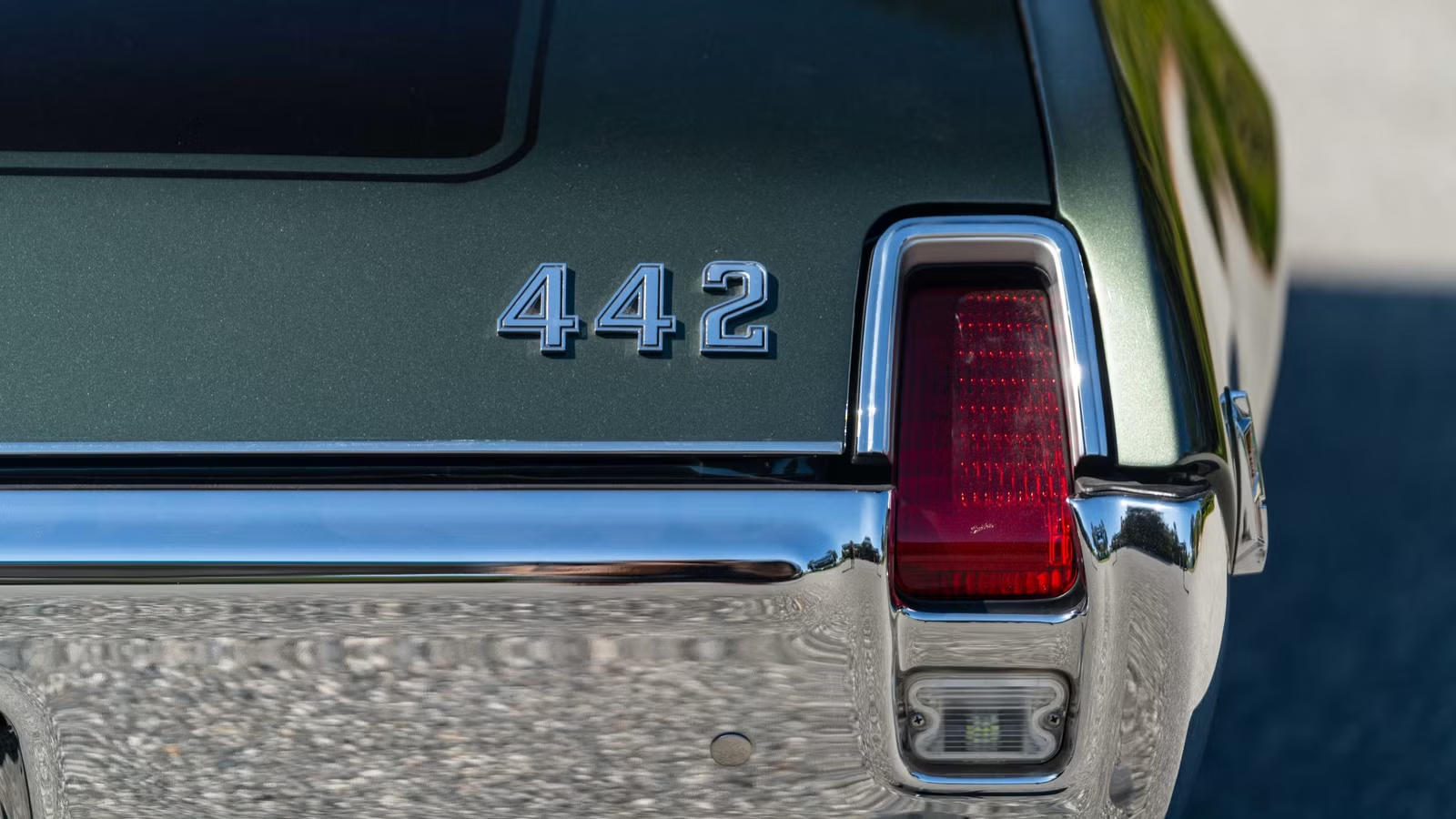
General Motors capped every one of its intermediate cars at 400 cubic inches through 1969. It was a corporate rule, born out of fear of regulators cracking down on large-displacement engines. Ford and Chrysler had no such ceiling, so while the 426 Hemi and 440 roamed free, GM’s mid-size divisions built to a number that someone else had picked.

The Chevelle SS 396 became the car the street measured itself against. Ticking the automatic box on almost any GM muscle car cost you horsepower, and buyers accepted that as the price of convenience. One division quietly refused to charge that price, built 297 of them, and barely advertised its existence.
The 400 CI Ceiling That Shaped Every GM Muscle Car Of 1969
The 400-cubic-inch ceiling covered every GM intermediate, with the Corvette as the lone exception. Cars like the Pontiac GTO and Buick GS 400 were left fighting Ford and Chrysler rivals that carried 100 more cubic inches, without penalty.

That same rule is why 427-powered Camaros had to be ordered through the back door of the COPO system, and why a 454 Chevelle could not exist until GM dropped the restriction for 1970. The ceiling was set in the early 1960s alongside GM’s retreat from racing, and it held for the rest of the decade.

Chevrolet sold 86,307 Chevelle SS 396 models in 1969 across three power levels. The base engine made 325 hp and 410 lb-ft, the middle L34 made 350 hp, and the L78 topped the range at 375 hp, with torque reaching 415 lb-ft. Every GM division was working toward the same displacement number, so the only thing left to compete on was how well you engineered underneath it.
Oldsmobile Built 297 Of These Without Ever Advertising Them

Oldsmobile built 297 examples of the 1969 442 W-32, an option code that most 442 owners have never heard of. It was offered for one model year and then dropped. The package paired the 400-cubic-inch Ram Air V8 with a heavy-duty automatic, and nothing on the outside said so.
The 297 cars broke down into 247 Holiday Coupes, 25 Sports Coupes, and 25 convertibles. That 247 figure turns up in auction listings as though it were the full production number, which is where most of the confusion around the W-32 starts.

Oldsmobile built 906 regular-production Hurst/Olds hardtops the same year, the car most enthusiasts name when asked for the rarest 442 of 1969. The W-32 is roughly three times harder to find and still sells for a fraction of the price.
The W-32 carried no badge, no stripe package, and no marketing campaign, and it looked like an ordinary 442 because that is exactly what Oldsmobile designed it to look like. A Hurst/Olds announces itself from 50 feet away, while a W-32 reads as a Cutlass with a good interior. Rarity and value have never been the same thing, and this car is the proof.

A late release in the model year and almost no promotion explain the low number better than a lack of interest does. Dealers had little reason to push a car that looked identical to the 442 already sitting on the lot, and buyers had no easy way to know what the order code actually did.
Today the W-32 sits below the celebrity Oldsmobiles in recognition but above a standard 400/automatic 442 in rarity and specialist interest. Many of its components were shared with or visually similar to other W-Machine hardware, so authentication leans on factory documentation, build records, original driveline evidence, and correct induction parts.
The Automatic With The 442 Was Not A Compromise

The 1969 442’s base 400-cubic-inch V8 made 350 hp with a manual transmission but dropped to 325 hp when buyers chose the Turbo Hydra-Matic. Oldsmobile’s own 1969 fact sheet lists that automatic-only version at 325 hp at 4,600 rpm. The W-32 made 350 hp and was automatic-only.
Ordering an automatic normally cost 25 hp, and the W-32 was the order code that refused to charge for it. Output came to 350 hp and 440 lb-ft, routed through a heavy-duty Turbo Hydra-Matic 400 and a limited-slip differential. Against the Chevelle SS 396’s 410 to 415 lb-ft, the Oldsmobile made more torque from 4 fewer cubic inches.

The milder camshaft calibration was the primary difference between the W-32 and the W-30. Oldsmobile used the same thinking on the 1970 W-30 automatic, where the gentler cam profile is what made power brakes and air conditioning possible in the first place.
The W-32 came with a special camshaft and distributor, a heavy-duty water pump, and an aluminum fan. Ordering it also required the anti-spin rear axle, heavy-duty radiator, fiberglass belted tires, and the M-YO Turbo-Hydramatic, so the package reached well past the engine itself. Documented examples carry carburetor 702925 and a 286-degree cam with a 0.472-inch lift.

The cooling upgrades point at how Oldsmobile expected the car to be used. A heavy-duty water pump, a clutched aluminum fan, and an upgraded radiator are parts you specify for a car that sits in traffic and then pulls hard, not one built for a single quarter-mile pass.
The W-32 Ran The Chevelle SS 396 With An Automatic And A Milder Cam

Period testing put the W-32 at 0-60 mph in the mid-six-second range and a quarter mile in the high 14s. Quick-ratio power steering and a firmed-up suspension also made it one of the better-handling cars in its class, which was not the usual Oldsmobile reputation.
Car and Driver recorded 5.8 seconds to 60 mph and a 14.4-second quarter mile at 97.4 mph from the 325 hp SS 396, while Motor Trend logged 7.6 seconds and 15.4 seconds at 92.0 mph from the 350 hp L34. Car Craft ran the 375 hp L78 to 14.1 seconds at 101.9 mph, and a separate test of the same engine returned 14.7 seconds at 101.0 mph. The spread across a single model year of single model year of Chevelles.

That places the W-32’s high-14s inside the L78’s own tested bracket and a full second ahead of Motor Trend’s L34, achieved with an automatic and a milder camshaft. The L78 was a solid-lifter engine built around a manual gearbox and a driver willing to use it.
Axle ratios, tires, and test conditions moved these numbers more than horsepower ratings did. That is how a 325 hp Chevelle ended up quicker in print than a 350 hp one, which is worth remembering before treating any single figure as settled.

Chevelle buyers in 1969 treated the automatic as the slow choice, and the numbers usually backed them up. Oldsmobile built the one car in the class where the automatic was the quick choice, then sold 297 of them to people who mostly did not know what they had.
The 1970 442 Showed What The Rule Was Costing Oldsmobile

GM dropped the 400-cubic-inch rule for 1970, and Oldsmobile made the 455 standard in the 442 at 365 hp and 500 lb-ft. The W-30 option raised that to a quoted 370 hp, a figure most engine builders consider conservative.
That 500 lb-ft matched the Chevelle LS6 exactly, which is the clearest measure of what Oldsmobile could do once the ceiling came off. Motor Trend ran a W-30 four-speed with 3.91 gears to 14.2 seconds at 102 mph and noted that Oldsmobile’s engineers had managed 13.7 seconds on that same car with a fresh tune.

The W-32 was not outclassed by the 1970 cars on engineering. It was 55 cubic inches short by corporate order, and it still ran with the Chevelle that everybody actually bought. The car Oldsmobile engineered to look like nothing at all is the reason almost nobody remembers it existed.
Sources: Hagerty, Car and Driver, Motor Trend, Car Craft, Muscle Car Facts

Related posts
Latest Post


No Comments