
The Plymouth Barracuda Revival Carroll Shelby Personally Killed In 1985
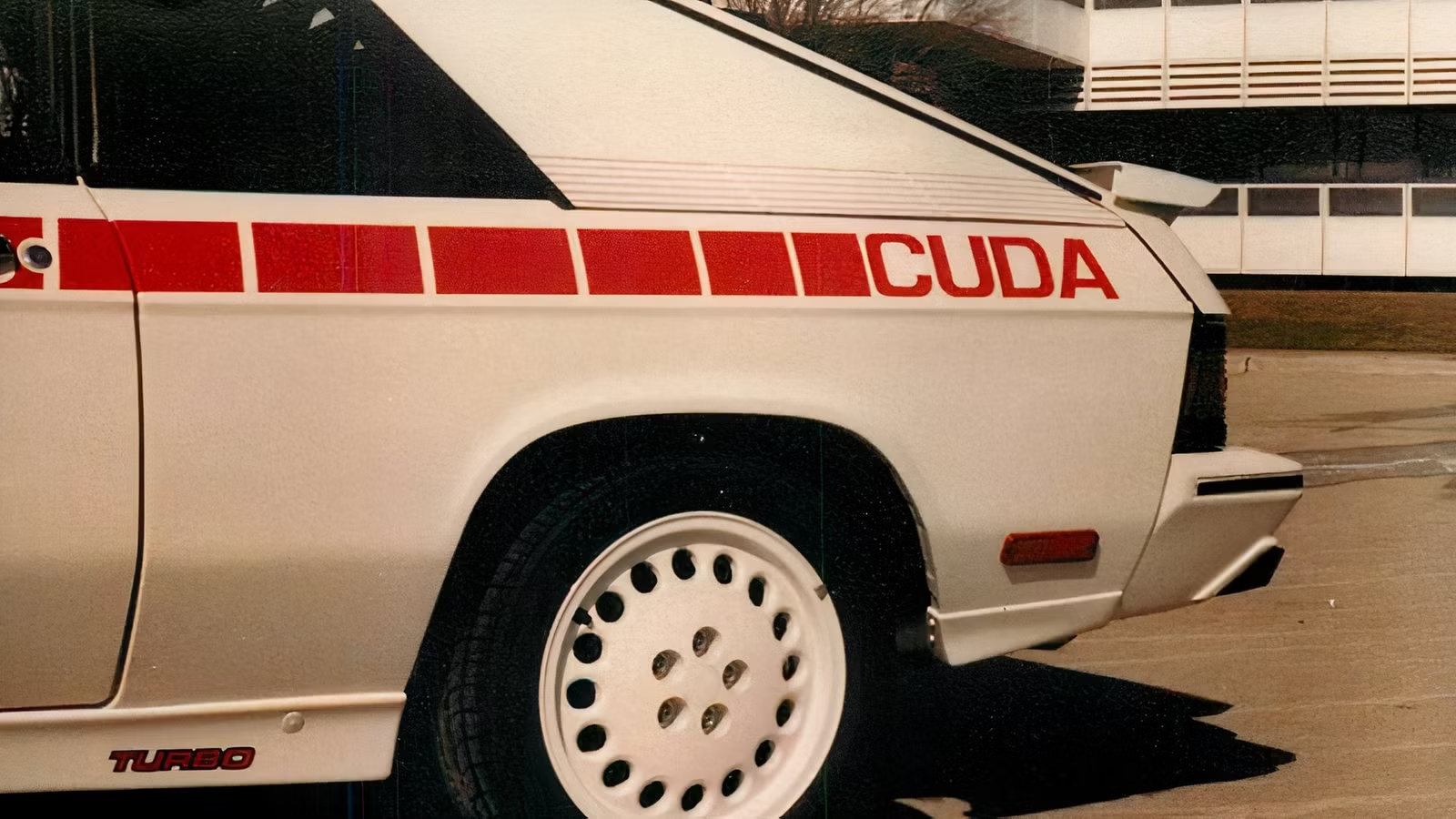
Plymouth was in the middle of an identity crisis in the mid 1980s. Unable to offer their usual fare of some of the coolest muscle cars that ever saw the light of day, Chrysler’s long-forgotten third passenger car brand had to find a way to deliver a rough facsimile for an age in which the muscle car no longer existed. That meant executing a plan that didn’t just try to revive an iconic muscle car nameplate, but to reinvent the car altogether. What resulted came and went in a timeframe so small, it hardly even registered in the automotive zeitgeist.
Plymouth In The 80s: An Impotent Brand Tries To Get Its Mojo Back

The best way to describe the state of Plymouth in the mid-1980s would be “deflated.” Both in worker morale and in sales figures relative to Toyota and Honda, Plymouth arguably suffered more than any other OEM after the muscle car era came to an end. In the wake of a global oil shortage brought on by geopolitical turmoil, plus the founding of the EPA, the American auto industry was forced to downsize, restrict emissions, and fundamentally change who they were as automakers to even stay in business.
Plymouth still had a catalog of famous names and intellectual properties from the muscle car era in its back pocket. Fresh from a massive direct cash bailout from the federal government the decade prior, Chrysler’s leading man, Lee Iacocca was primed to do something novel with Plymouth. Instead of lumbering muscle cars that got two or three miles to the gallon, Iacocca envisioned a line of cars built around the same platform, using engines a quarter the size of what the brand used to offer. At the time, the move was nothing short of a humiliation. In the end, it wound up saving Chrysler Corporation.
Such was the impetus for the plain and drab K-platform vehicles: the Dodge Aries, the Plymouth Reliant, and the Chrysler LeBaron, as well as the Dodge Caravan in a modified form. But along with the generic offerings that guaranteed Chrysler could pay its government loans back, Chrysler gathered a small group of engineers and designers to try to revive at least one of its most famous names. They’d never know it at the time, but all that effort would soon be in vain.

Bringing a Classic Muscle Car Back From the Dead

To make it happen, Chrysler dug deep through its parts bin and determined that the front-wheel-drive Plymouth Horizon/Turismo would be the best fit for a sporty nameplate. Based on the same Chrysler L platform as the Dodge Omni, the Rampage light pickup, and the controversial fifth-generation Charger, the L platform wasn’t entirely unfamiliar with sports car applications. The Charger in particular was given the Shelby treatment on more than one occasion, with Carroll Shelby jumping ship from Ford after being tempted away by his old friend Lee Iacocca.
The Shelby Charger sported beefed-up suspension, a Shelby-specific decal kit, and, starting in 1985, a multi-port-injected turbocharged four-cylinder engine with 146 hp on tap. The updated Charger GLHS (Go Like Hell S’more) added an updated variant of that same 2.2-liter engine, a forged crankshaft, and higher turbo boost pressures to squeeze 175 hp out of that tiny engine. In the era before Honda brought small, high-revving engines capable of handling that kind of power to the US, that output was nothing short of extraordinary.
Clearly, if there was any vehicle primed to revive an iconic Plymouth, it was the Turismo variant of that same Dodge Charger. To do so, Plymouth planned to draw directly from the same hardware that turned a stock Charger into a Shelby Charger. As it turned out, that would prove to be a problem for all parties involved.
1985 Plymouth Barracuda Concept: The Parts-Bin Raid You’ve Never Heard Of

The group Chrysler picked to bring the iconic Barracuda line back to life was a ragtag team of eight recent college graduates, including future notable figures like Mike Wolterman, a devoted Mopar enthusiast with a classic Superbird in his collection. The team gathered at Chrysler’s Belvidere Assembly Plant in Illinois, tasked with brainstorming how they might merge the Shelby Charger and Plymouth Turismo into something approximating a new Barracuda.
Because the group had a severely limited budget, they couldn’t afford to dedicate an assembly line or the associated manpower typically needed to develop a prototype. Instead, they hand-assembled the car directly on the production floor, using Dodge Chargers and Plymouth Turismos that should have been sent to dealerships. Because computerized inventory systems of the day were primitive, it was far easier to divert a couple of cars marked as Shelby Chargers off the line to turn into prototypes. Had the same stunt been pulled today, modern cameras would’ve foiled the plan in minutes.
Using the Turismo as a template, the team added the “Go-Wing” rear decklid spoiler from a G-Body Dodge Daytona. Though G-Bodies were notoriously larger than their L-Body counterparts, the rear wing fit the rear end of a Plymouth Turismo with surprising grace. Elsewhere, a custom paint scheme was applied, directly inspired by the iconic 1970 AAR ‘Cuda. Officially, there weren’t any “Shelby” parts added to the car to make it sleeker, but unofficially, it had the Shelby Charger’s “High-Output” variant of the 2.2-liter, SOHC four-cylinder, complete with 8.1:1 compression and a Garrett T3 turbocharger. With a white exterior, sunroof, and red interior for the first prototype, and a red paint scheme over gray cloth for the second, the ’85 Barracuda prototype genuinely resembled a worthy successor to the originals.
The Car That Made Carroll Shelby Furious, Allegedly

So, how do you think Carroll Shelby reacted to seeing a Plymouth ‘Cuda forged out of the very same Charger sports car he helped develop? There are two prevailing theories about what exactly happened. The first is that he flew into a fit of rage and demanded the program be canceled, for fear of making his Dodge Shelbys feel less exclusive. Another is that he was completely and utterly oblivious to the project, and the dirty deed of canning the program was handled entirely by Mopar’s top brass.
Either way, the two prototypes, vibrant decal sets and all, drew the ire of someone — or more likely a group of people — who you really didn’t want to cross at Chrysler Corp. Just like that, the eight-man team sent to Belvidere was promptly sent back to Detroit without ceremony, tasked with selling inexpensive commuter cars more suited to Plymouth’s diminished standing in the market. Nearly as quickly as it had arrived, the project was dead, its prototypes dispatched to places where nobody at Chrysler Corp would have to look at them.
The red car with no sunroof wound up in the hands of an automotive trade school in Ohio, where it was eventually crushed. The other? That’d wind up in the hands of a Chrysler fleet manager who successfully saved the car from the shredder. In private hands, that car sat in a garage in suburban Chicago until internet sleuths located it more than 20 years later. Even all these years later, the single surviving prototype remains in the possession of the family that saved it. Should it go to auction, it stands to reason that the only ’85 Barracuda in existence would command a significant sum. Possibly as much as a well-sorted HEMI ‘Cuda from the early ’70s.
Source: Mopar Insiders, Chrysler

Related posts


Latest Post


No Comments