
The Oldsmobile Luxury Car That Made Front-Wheel Drive Genuinely Terrifying
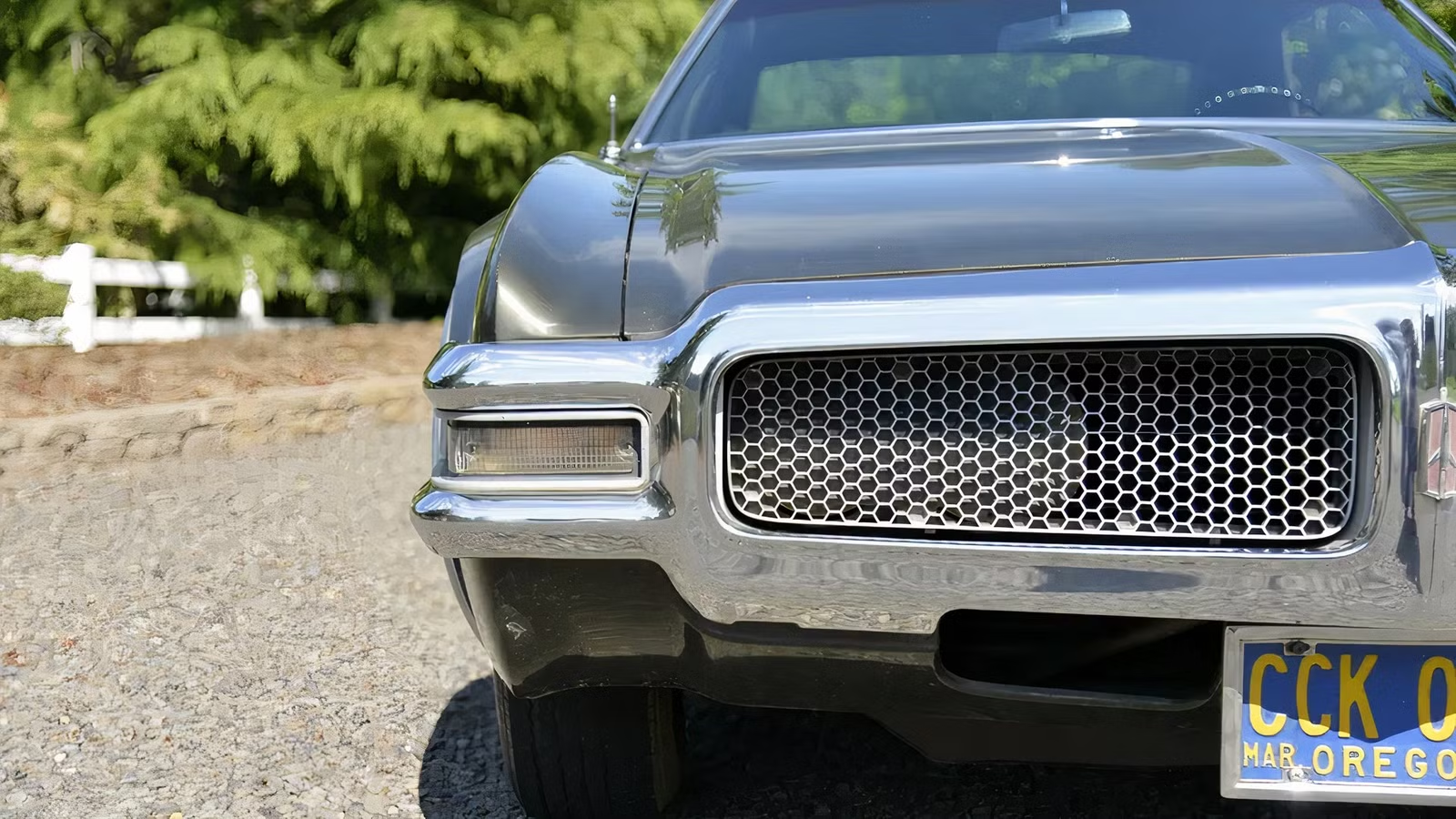
The late 1960s horsepower war followed a simple formula. Bigger engines demanded rear-wheel drive, wider tires, and stronger rear axles, because that was the only proven way to harness ever-increasing torque. As American manufacturers competed for supremacy, nobody questioned whether the recipe itself could be improved.

One division inside General Motors did. Instead of accepting that front-wheel drive had limits no engineer should cross, Oldsmobile set out to prove those limits were far higher than Detroit believed.
Detroit Had Already Decided Big-Block Power Belonged At The Rear
By 1968, every major American performance car relied on rear-wheel drive. Chevrolet’s big-block Chevelles, Pontiac’s GTO, Dodge’s Coronet R/T, and Plymouth’s Road Runner all followed the same mechanical blueprint because it worked. The rear axle handled acceleration, while the front wheels remained responsible for steering.

Front-wheel drive presented an entirely different set of challenges. Feeding hundreds of pound-feet of torque through the steering wheels risked torque steer, excessive drivetrain stress, and packaging compromises that became increasingly difficult as engine size grew. Even if those problems could be solved, most manufacturers saw little reason to invest in such an expensive alternative. That thinking left front-wheel drive largely confined to smaller cars and niche applications. A luxury coupe powered by one of GM’s biggest V8s simply wasn’t supposed to exist.
The Engineering Problem Wasn’t Building It—It Was Making It Work

Installing a large-displacement V8 under the hood wasn’t the difficult part. Making that engine deliver its power cleanly through the front wheels without overwhelming the chassis was the real engineering challenge.
A conventional transmission layout couldn’t simply be adapted for the task, and existing front-wheel-drive systems weren’t designed to cope with the immense torque generated by a modern American big-block. Engineers also had to prevent the steering from becoming unstable under hard acceleration while ensuring every major drivetrain component could survive years of use.
Most manufacturers considered those compromises reason enough to avoid the idea altogether. Oldsmobile’s engineers chose a different path by redesigning the drivetrain from the ground up.
Meet The 1968 Oldsmobile Toronado W-34

Oldsmobile’s answer was the 1968 Toronado W-34, a factory performance package that transformed an already unconventional personal luxury coupe into one of the most technically ambitious American performance cars of its era.
At its heart sat the new 455-cubic-inch Rocket V8. Equipped with Force-Air induction and dual exhausts, it produced a factory-rated 400 horsepower and a formidable 500 lb-ft of torque. That output was routed through a Turbo Hydra-Matic automatic transmission to the front wheels, creating a combination virtually unmatched anywhere in the American market.
The W-34 package was never intended to be a high-volume seller. It carried a premium price, was ordered in very small numbers and remains one of the rarest factory performance Oldsmobiles built during the muscle-car era. Surviving examples are prized today not only because of their scarcity, but because they represent one of the boldest engineering experiments ever approved for production by a Detroit manufacturer.
The Unified Powerplant Package Was The Real Breakthrough

While the 455 supplied the headlines, the real innovation lay underneath it. Oldsmobile’s Unified Powerplant Package mounted the engine longitudinally while positioning a specially modified Turbo Hydra-Matic transmission alongside it rather than directly behind it.
A massive Hy-Vo silent chain connected the engine to the transmission, allowing the drivetrain to package efficiently without sacrificing durability. The arrangement also distributed mechanical loads more effectively than many engineers believed possible, enabling the system to withstand torque levels that would have overwhelmed more conventional front-wheel-drive designs.
The layout solved more than a packaging problem. It gave Oldsmobile the confidence to pair one of GM’s largest production V8s with front-wheel drive while maintaining the refinement expected of a premium grand-touring coupe.
Its Biggest Achievement Was The Lack Of Torque Steer

On paper, a 4,600-pound front-wheel-drive coupe producing 500 lb-ft of torque sounds intimidating. The expectation would be constant steering corrections, violent wheel tug and unpredictable behavior every time the throttle reached the floor. That isn’t what drivers experienced.
Period road tests consistently praised the Toronado’s composure under acceleration, noting that the steering remained remarkably stable despite the enormous torque being sent through the front wheels. Rather than fighting the driver, the car behaved with a level of refinement that surprised even experienced testers.
That composure was no accident. Careful driveshaft geometry, extensive suspension development, and the Unified Powerplant Package worked together to minimize torque steer before it ever reached the steering wheel. The terrifying part wasn’t how the Toronado behaved—it was realizing just how much power the front tires were quietly managing.
Detroit Never Tried Anything Like It Again

The Toronado proved that a high-torque front-wheel-drive American performance car could work, but it also demonstrated how much engineering was required to make it succeed. Its drivetrain was expensive, highly specialized and developed specifically for a large luxury platform. Other manufacturers continued refining conventional rear-wheel-drive muscle cars, while later generations of front-wheel-drive performance models adopted transverse engines, compact transaxles, and electronic driver aids that fundamentally changed the engineering equation.
No Detroit manufacturer attempted to duplicate the Toronado’s formula of pairing a longitudinal big-block V8 with a dedicated chain-driven front-wheel-drive transmission. Rather than launching a new performance trend, the Toronado remained a remarkable engineering outlier.
Why The W-34 Finally Deserves More Credit

For years, the Toronado W-34 lived in the shadow of more conventional muscle cars whose achievements were easier to understand. Yet time has shifted the conversation. Collectors increasingly recognize that its significance lies not in quarter-mile statistics, but in the sophistication required to make such an unconventional drivetrain succeed.
Its rarity has only strengthened that appreciation. Authentic W-34 cars remain exceptionally scarce, and restoring one correctly demands careful attention to components unique to the package. As a result, originality and factory documentation have become just as important as matching numbers.
The Toronado W-34 deserves far more recognition than history has given it. Plenty of American cars made 400 horsepower in 1968. Only one quietly proved that a 500-lb-ft big-block could pull from the front wheels with remarkable composure, overturning one of Detroit’s longest-held engineering assumptions in the process.
Sources: Oldsmobile, General Motors

Related posts

Latest Post


No Comments