
1969 Dodge Super Bee Coupe With A Tree Growing Through Its Roof Has Rotted In A Field For 42 Years
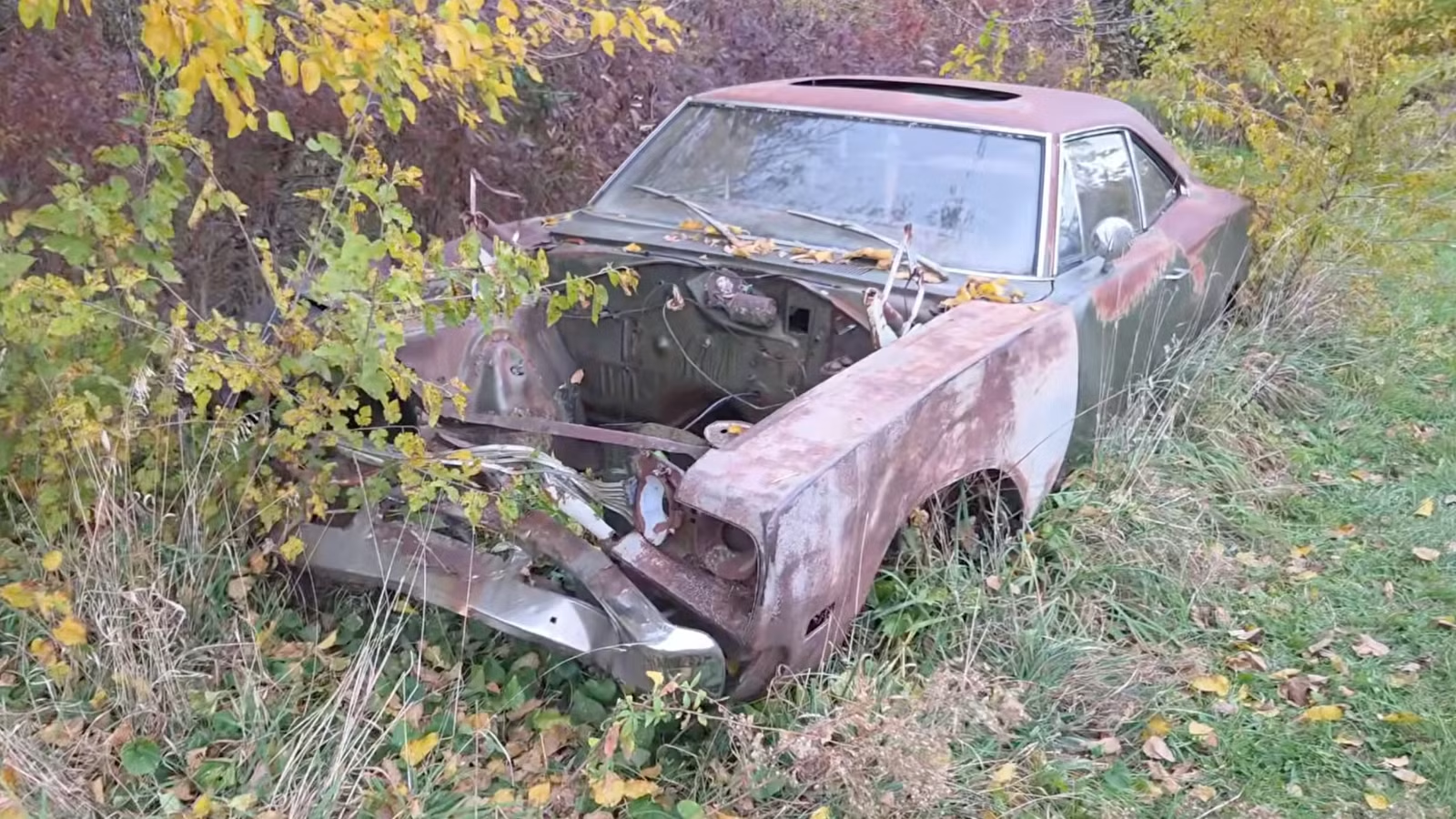
A 1969 Dodge Super Bee has been sitting in an Illinois farm field so long that a tree now grows straight up through its roof. Cows have used it as a rubbing post, and decades of Illinois weather have done the rest.

Ryan Brutt, the Midwest barn-find hunter better known as the Auto Archaeologist, first filmed this Mopar back in 2011. He returned in late October 2026 to check on it, and 15 years had barely changed a thing, apart from the tree getting taller.
A Mailman’s Tip Led To This Field Twice
Brutt first heard about the Super Bee around 2008 from a former mailman while working at a NAPA store in DeKalb, Illinois. He filmed it in 2011 for his first-ever adventure video. Today, he writes for Hot Rod and has written several books on barn finds.

A previous owner had already wrecked the car, hitting a tree with the front passenger corner and scraping the driver’s side along a concrete wall. In 1983, a local family whose brothers both owned ‘69 Super Bees bought it as a donor and parked it in this field. The engine and transmission went elsewhere, and other parts helped rescue a black ‘69.
In 2026, Brutt learned his friends Matt Olsen and Steve Lauderdale knew the family.
Why This 1969 Super Bee Coupe Is The Scarcer Version
Dodge added a pillarless hardtop to the Super Bee for 1969, and buyers flocked to it. Of the 26,563 Super Bees shipped to US dealers that year, 18,361 were hardtops and just 8,202 were pillared coupes like this one. That makes the coupe less than a third of production.
The coupe was the cheaper Super Bee, listing at $3,076 versus $3,138 for the hardtop. Power came from the standard 383 Magnum big-block, rated at 335 hp at 5,200 rpm and 425 lb-ft. Only 166 buyers chose the 426 Hemi that year, making 383 cars like this the range’s working-class heroes.
The field car is a 383 automatic with an 8 3/4 rear axle, a non-vinyl roof, and few options. It wears F8 paint, which Dodge’s 1969 paint codes list as Dark Green Metallic, over a green interior with a white bumblebee stripe across the tail. Its fender and VIN tags are still attached.
A Tree Through The Roof And An Uncertain Future

The faded ghost stripe still shows on the quarter panels and trunk, and the original Super Bee emblem hangs on in the tail panel. The aftermarket sunroof someone cut into the roof decades ago now has a tree growing straight through it. At some point, the car also picked up chrome reverse wheels wrapped in old drag slicks.
Brutt’s friends Eric and Ron crawled underneath and reported there’s barely anything left holding the car together. The owner listed it on Facebook Marketplace roughly six months before the visit, and a buyer reportedly snapped it up but hadn’t hauled it home yet. Brutt hopes the new owner saves it, though he admits a parts car this rough will probably get stripped.

Related posts



Latest Post



No Comments