
The Last Hand-Built American V8 Super-Sedan Nobody Noticed Cadillac Killed
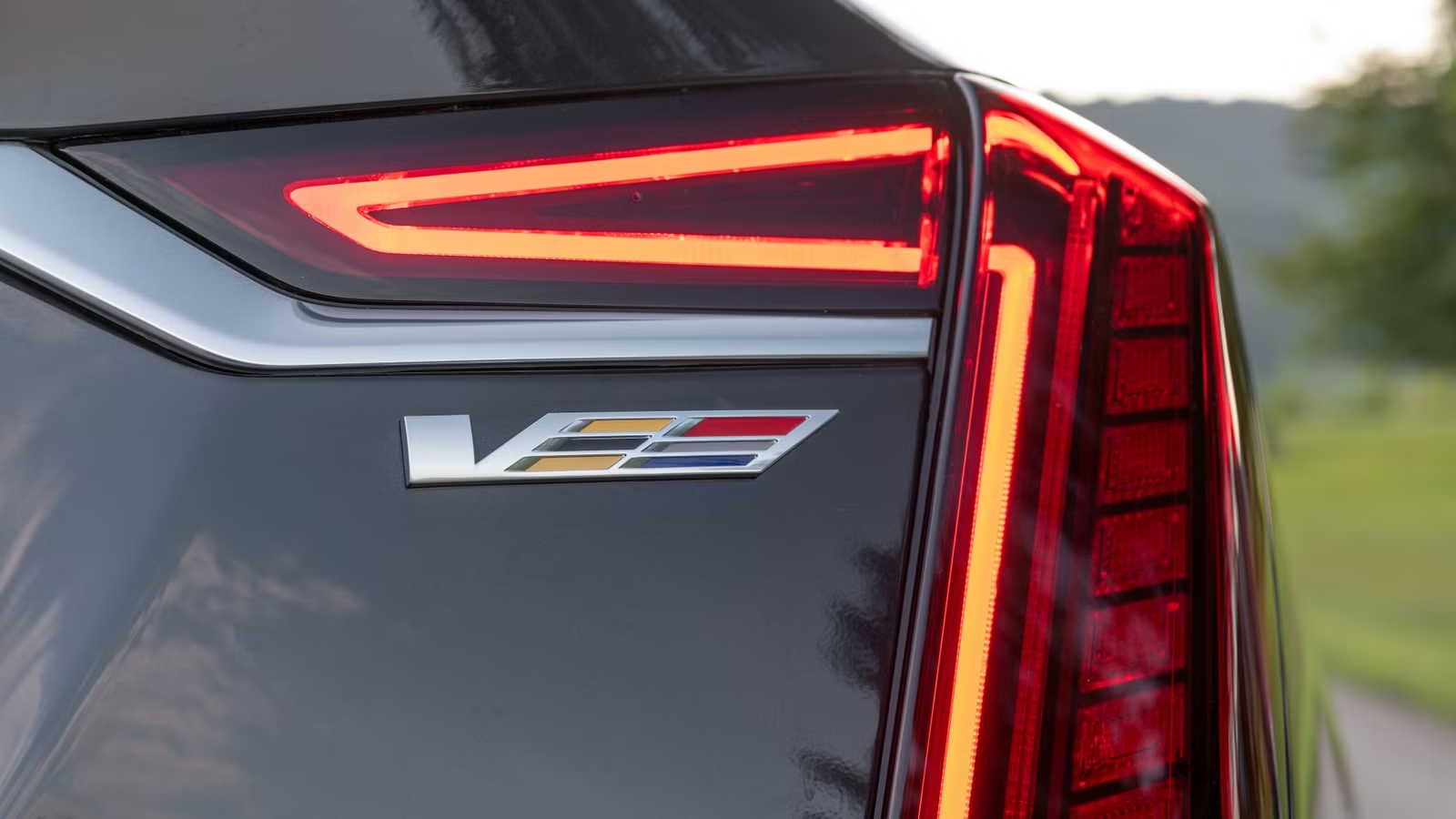
Cadillac once spent serious money engineering a twin-turbo V8 that shared almost nothing with GM’s familiar small-block playbook. Specialists assembled each engine by hand, and engineers paired it with an advanced aluminum-heavy chassis, all-wheel drive, rear steering, magnetic dampers, and enough power to embarrass sports cars. Then the sedan underneath it disappeared almost as soon as buyers noticed. Today, that strange decision has created one of the most interesting used American performance cars of the modern era.
This Wasn’t Another Pushrod V8 Pulled From The GM Parts Bin

A high-performance GM V8 usually comes with a familiar family tree. Think big displacement, pushrods, two valves per cylinder, and some connection to a Corvette or Camaro. That formula works – GM has spent decades making the small-block powerful, compact, relatively simple, and easy to share across different vehicles. The modern supercharged LT4 follows that tradition, and versions of the basic architecture have powered everything from Corvettes to Cadillac performance sedans.
Then Cadillac’s engineers went in a completely different direction. Their new engine displaced only 4.2 liters and used twin turbochargers, direct fuel injection, dual overhead camshafts, and four valves per cylinder for 32 valves total. A forged-steel crankshaft turned forged-steel connecting rods inside an aluminum block. The twin-scroll turbos could make as much as 20 psi of boost, while two water-to-air charge coolers handled intake temperatures. It even used cylinder deactivation during light loads. None of that sounds much like the traditional recipe for a hot GM V8.
The bigger surprise sat between the cylinder banks. Cadillac placed both turbochargers inside the V of the engine and reversed the normal intake and exhaust paths through the cylinder heads. Engineers call this a hot-V layout. Shorter exhaust paths helped the turbos respond quickly while making the engine package more compact. German brands had already explored similar ideas, but for GM this represented a striking clean-sheet move away from another small-block variation.

The Sedan Wrapped Around It Was Far More Serious Than It Looked

The body surrounding that engine hardly advertised what lurked underneath. It looked long, clean, and expensive, with none of the visual theater that usually follows a 500-plus-horsepower sedan. There were performance details, but they required an enthusiast’s eye: darker trim, different wheels, a mesh grille, a small rear spoiler, and discreet badging. That restraint gave it genuine sleeper appeal, but it also probably helped the car drift past people who expected their performance sedan to arrive wearing vents, wings, and the facial expression of an angry vacuum cleaner.
Underneath, GM had already given the big sedan one of its most ambitious modern platforms. The Omega architecture mixed aluminum and steel instead of relying on a conventional all-steel body structure. Roughly two-thirds of the platform used aluminum, with engineers placing steel where it could improve stiffness, noise control, and crash performance. Cadillac used 13 large aluminum castings and other weight-saving tricks to make a full-size sedan weigh more like something from the class below.
Then Cadillac filled that light, stiff foundation with serious hardware. Magnetic Ride Control constantly adjusted damping, active rear steering helped the long wheelbase turn more eagerly, Brembo brakes handled stopping duty, and special spring and shock tuning sharpened the performance version further. The all-wheel-drive system also kept a rear-drive flavor. In Sport mode, it could send 80 percent of available torque toward the rear axle.
The Cadillac CT6-V Was The Blackwing Nobody Remembers

That mystery sedan was the Cadillac CT6-V, and its highlight was the 4.2-liter twin-turbo Blackwing V8. In production tune, Cadillac rated the CT6-V at 550 horsepower and 640 lb-ft of torque, feeding a 10-speed automatic and all-wheel drive. The engine mattered for more than its output – the automaker created it specifically for its own flagship rather than borrowing an existing Chevrolet V8. Six builders eventually hand-assembled Blackwings at GM’s Performance Build Center in Bowling Green, Kentucky. In a company famous for spreading good engines across multiple brands, the Blackwing remained unusually exclusive.
That engine also explains why the word Blackwing means something different now. Most enthusiasts today hear it and picture the CT4-V Blackwing or CT5-V Blackwing. Cadillac originally attached the name to this 4.2-liter twin-turbo V8, however. When the engine’s future vanished, Cadillac kept the excellent name and turned it into an ultra-performance model designation. The later CT4-V Blackwing never used the V8 at all, while the CT5-V Blackwing went back to a supercharged 6.2-liter small-block.

The CT6-V itself made the engine’s numbers even stranger. The car stretched 204 inches from bumper to bumper, seated five people, drove all four wheels, and behaved like a proper flagship in normal traffic. Yet testing put 60 mph only 3.8 seconds away. A large sedan with massage seats and enough rear legroom for actual adults could therefore reach highway speed in roughly the time it takes someone at a green light to look up from their phone.
That distinction separated the CT6-V from the old CTS-V philosophy. Cadillac had made earlier V cars feel like American muscle sedans with luxury equipment bolted around the violence. The CT6-V delivered its speed with far less drama — it had a quiet startup, a restrained exhaust note, a compliant ride, precise steering, and acceleration without the theatrical kick expected from 640 lb-ft. The result felt closer to Cadillac’s answer to an AMG or BMW M flagship than a four-door Corvette impersonator.
Cadillac Killed It Just As Buyers Started Paying Attention

The story gets muddled whenever the number 275 appears. Cadillac initially offered 275 CT6-Vs, and that first allocation sold out in roughly two hours. Those 275 cars did not represent the entire production run, though – the manufacturer responded to demand by extending availability. The 2019 Blackwing allocation grew to about 600 engines across the United States and Canada, including the lower-output, 500-hp CT6 Platinum. Cadillac expected about three-quarters of the added allocation to become CT6-Vs.
Buyers had finally found the car, but the factory beneath its future had already become a problem. GM had marked Detroit-Hamtramck, where workers assembled the North American CT6, for major changes. In January 2020, GM announced a $2.2 billion investment to turn the site into its first assembly plant devoted entirely to electric vehicles. CT6 and Chevrolet Impala production soon ended as the company prepared the facility for that new mission. North American CT6 production wrapped up in early 2020, and Detroit-Hamtramck eventually became Factory ZERO.

That decision effectively orphaned the Blackwing V8. Cadillac had designed the engine around a flagship that no longer existed, and the smaller CT5 could not simply inherit the entire package. Cadillac had no announced second home waiting for it, and the engine therefore followed an unusually short arc: it arrived as a clean-sheet technological statement, proved that Cadillac could build a refined twin-turbo DOHC V8, and then lost the vehicle program that justified its existence.
That strange history now makes the used market worth watching. As of August 2026, TrueCar shows only eight CT6-Vs for sale nationwide, with advertised prices running from about $45,359 to $72,884. Listings can change quickly, but the snapshot shows how scarce the cars have become. The CT6-V never qualified as cheap transportation — 2020 models started at $94,895, while the 2019 model launched in the $88,790 to $90,000 range.
The Best Time To Buy The CT6-V May Be After Cadillac Stopped Building It

The appeal goes deeper than depreciation. Cadillac spent the resources to create an engine outside GM’s normal V8 playbook, gave it forged internals, reverse-flow heads, twin turbos, advanced fuel control, and individual hand assembly, then paired it with one of GM’s most ambitious luxury-car platforms. The company even had only six builders assembling Blackwing engines in Bowling Green as demand grew. Then the CT6 disappeared and took the business case for the engine with it. That sequence gives the CT6-V something modern performance cars often struggle to acquire on purpose: a genuinely odd story.
Cadillac’s later use of the Blackwing name makes the original even easier to overlook. The 2026 CT5-V Blackwing still uses a hand-built V8, but it comes from the familiar small-block family: a supercharged 6.2-liter making 668 hp and 659 lb-ft. It is an outstanding engine in a wildly capable sedan, yet it has no mechanical connection to the 4.2-liter twin-turbo motor that first carried the Blackwing name. Cadillac successfully made “Blackwing” famous after the actual Blackwing engine had already vanished. Automotive history has produced cleaner jokes, but few with 550 hp.

Nobody can promise that CT6-V values will explode, and rarity alone never turns every unusual car into a winning investment. A complicated, low-production luxury sedan can also deliver complicated, low-production luxury-sedan bills. The better reason to pay attention sits under the hood and around it – very few modern American sedans combine a Cadillac-exclusive clean-sheet V8, hand assembly, hot-V twin turbos, rear-biased AWD, magnetic dampers, rear steering, and genuine full-size luxury. Fewer still appeared and disappeared this quickly.
Source: Cadillac, TrueCar

Related posts




Latest Post



No Comments