
1965 Shelby Cobra 427: First Production Car Under 4 Seconds 0-60
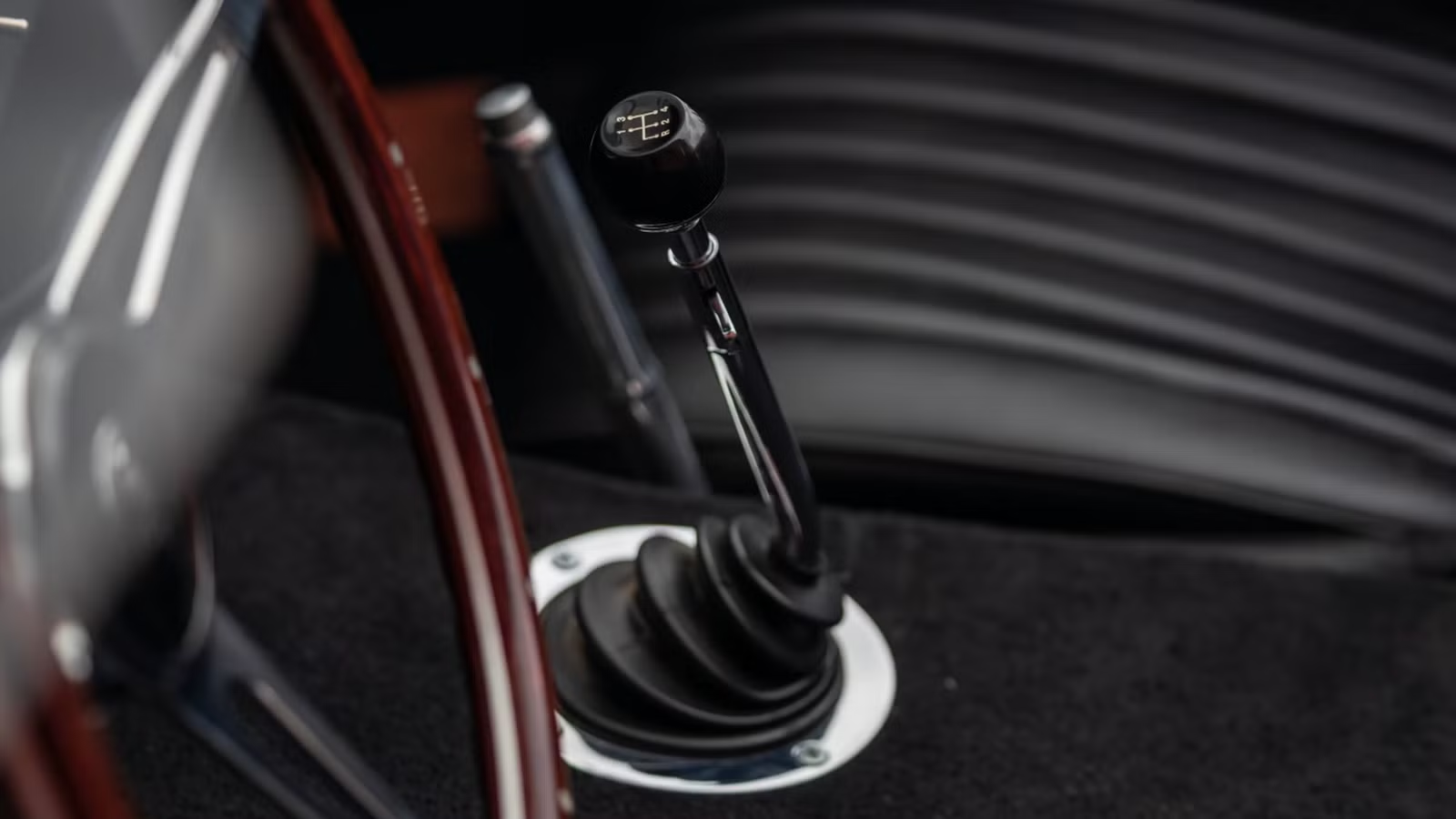
Sub-4-second 0–60 mph times are everywhere now. Electric SUVs post them. Hot hatches flirt with them. Even family sedans are closing in. But strip away the software, the instant torque, and the launch-control wizardry, and a genuinely startling question emerges: who got there first? The answer isn’t a McLaren, a Ferrari, or any other supercar. It came out of a small shop in Venice, California, decades before most of those brands had even drawn a sketch of their most iconic cars.

Long before digital traction control existed, one analog American automobile broke the 4-second barrier using nothing but raw mechanical grip and a manual gearbox — decades before most homes even had a color TV.
Breaking The 4-Second Barrier Came Long Before The 80s And 90s
When we discuss the prestigious sub-4-second club, our minds usually drift toward the bedroom poster cars of the late 1980s and early 1990s. This was the era of the high-tech supercar boom, where manufacturers finally began to master aerodynamics and turbocharging. For many, the true starting point for this level of performance was the 1987 Ferrari F40. Remembered as the first production car to break the 200 mph barrier, its 0–60 mph time of roughly 4.0 seconds felt like the absolute limit of what a road car could achieve. A few years later, the McLaren F1 arrived with its gold-lined engine bay and a staggering 3.2-second sprint, cementing the idea that sub-4-second times were a modern, high-tech phenomenon.


However, if you look closely at automotive history, there’s a fascinating rip in the timeline that most people overlook. While the world spent the 1970s and 1980s trying to claw its way toward these benchmarks, a specific lightweight roadster from Venice, California, had already beaten them to the punch decades earlier. In 1965, the average performance car was considered exceptionally fast if it could reach 60 mph in under 6 seconds.
Most high-end machinery of that era was still fighting the laws of physics with heavy steel bodies and narrow tires. Yet, in the middle of this era, a mechanical anomaly appeared that posted acceleration times competitive against world-class supercars for the next thirty years. This outlier proved that you didn’t need computer-controlled fuel injection or advanced carbon fiber to move the needle — just the bold vision to shoehorn a massive-displacement engine into a very small, very light package.
The 1965 Shelby Cobra 427: How Carroll Shelby Left Maranello In The Dust

|
Shelby Cobra 427 |
Ferrari 275 GTB |
Lamborghini 350 GT |
|
|
0-60 MPH |
~3.4–4.3s |
~6.0s |
~6.5–6.8s |
|
Top Speed |
~164–185 mph |
~160 mph |
~152–158 mph |
|
Engine |
7.0L V8 |
3.3L V12 |
3.5L V12 |
The 1965 Shelby Cobra 427 was a mechanical sledgehammer that effectively reset the expectations for automotive performance. While the November 1965 issue of Car and Driver recorded a 4.3-second sprint on standard street tires, the car was capable of more. Running Goodyear Blue Dot road tires, the test rated the Cobra 427’s “Power-to-ground transmission” as “good” but not excellent, acknowledging there was room for improvement. The period review went on to state that “Cobra test driver Ken Miles has done the job [0–100–0 mph] in as little as 13.8 seconds, and who knows how much improvement could be made with racing tires.”
With Miles at the wheel and more grip from race tires, the 427 Cobra was widely reported to hit 60 mph in under 4 seconds. This claim is supported by the duPont Registry and was frequently cited in historical dossiers by auction houses like Christie’s and Sotheby’s. To understand how radical that was, we have to look at the Italian elite of the mid-sixties.
In 1965, if you walked into a Ferrari or Lamborghini dealership, you were looking at the pinnacle of European engineering. But on the drag strip, the Cobra made them look like they were standing still. While a Ferrari 275 GTB needed about 6 seconds to hit 60 mph and the Lamborghini 350 GT took nearly 7 seconds, the Cobra was already disappearing into the next zip code.

The performance gap was staggering. The Shelby utilized a massive 427 (7.0-liter) Ford FE V8, while the Italians relied on smaller, high-revving V12 engines — a 3.3-liter for the Ferrari and a 3.5-liter for the Lamborghini. Even in terms of top speed, the Cobra S/C variants could push toward 185 mph, comfortably outpacing the 160 mph ceiling of the 275 GTB.
The difference, however, wasn’t just in the numbers; it was in the philosophy of the build. The Ferraris and Lamborghinis were designed as refined Grand Tourers — built for aerodynamic stability at high speeds and long-distance comfort, draped in luxurious leather and underpinned by sophisticated suspension systems.
The Cobra, by contrast, was a stripped-back monster that prioritized raw mechanical grip and an extreme power-to-weight ratio. It lacked the long-distance elegance and interior plushness of its European rivals, but it achieved its goal of humiliating them in a straight-line sprint. It was a raw, visceral experience that favored brute force over Italian finesse, and it remains one of the greatest performance upsets in history.
The Ford 427 “Side-Oiler” And The British Chassis Marriage

The magic of the Cobra began with a cross-continental marriage. Carroll Shelby took the lightweight, nimble AC Ace chassis from Britain and stuffed it with massive Ford V-8 power. By the time 1965 rolled around, that combination had evolved into the legendary 427 Cobra. The heart of this beast was the Ford 427 FE Side-Oiler engine.
This was an extraordinary motor built on a high-performance block specifically designed for NASCAR competition and to beat Ferrari at the 24 Hours of Le Mans with the Ford GT MkII. Because oil was fed to the main bearings first along the side of the block, the engine could survive the high-rpm stress required to produce the car’s record-breaking acceleration. Without this race-bred displacement, the sub-4-second sprint would have been impossible.
Shelby Promised The 427, Delivered With The Incorrect 428

However, there is a famous bit of controversy regarding what was actually under the hood of many production models. Because the Side-Oiler 427 was expensive and difficult to source in high volumes, about 100 Shelby Cobras left the factory with the Ford 428 cubic-inch Police Interceptor engine instead. While the 428 was a capable motor with plenty of low-end torque, it wasn’t the race-spec 427 that buyers thought they were paying for.
The 428 was more affordable and considerably easier to live with on the street, but it lacked the high-revving character of its famous sibling. Eventually, Ford intervened, and Shelby had to navigate the fallout of selling 428-powered cars wearing 427 badges. Over time, many of these cars were retrofitted with the proper 427 engines, but the mix-up remains a legendary chapter in the car’s history. It highlights the chaotic, high-stakes nature of Shelby’s operation during the 1960s, where the goal was always speed at any cost, even if it meant getting creative with the spec sheet.
Why The Cobra 427’s 0–60 Claim Is Still Debated Today

The Shelby Cobra 427’s sub-4-second sprint sounds like a clean, headline-grabbing fact, but like many performance claims from the 1960s, it lives in something of a gray area. Back then, standardized testing methods didn’t exist the way they do today. Publications used different surfaces, tire compounds, launch techniques, and even rollout assumptions — all of which could dramatically affect recorded acceleration times.
When Car and Driver tested the Cobra in 1965, they recorded a 0–60 mph time of around 4.3 seconds on street tires. That alone was staggering for the era. However, claims of sub-4-second runs often came from factory drivers like Ken Miles, who pushed the car harder than any journalist likely would — and sometimes on stickier racing rubber.
That distinction matters. On modern tires and a prepped surface, the Cobra almost certainly had the mechanical potential to dip below four seconds. But under the typical road-test conditions of the time, those results weren’t consistently repeatable. It’s less about whether the Cobra could do it, and more about how often — and under what conditions.
This doesn’t weaken the Cobra’s legend. If anything, it reinforces it. Even its most conservative numbers were decades ahead of the curve, and the fact that there’s still debate only adds to the mystique.
Why The Cobra Is Now The Ultimate Auction Prize

Today, the 1965 Shelby Cobra 427 is one of the most coveted prizes in the automotive world, and its market value reflects its status as a giant killer. If you are looking to add a standard street version to your collection, expect to pay anywhere from $1.3 million to $2.2 million. The price climbs sharply for a rare Semi-Competition or S/C model, typically reaching $2–3.5 million. These high-performance variants, or those with a direct connection to Carroll Shelby himself, have been known to clear between $5 million and $13 million at major auctions — putting the Cobra in a very exclusive league, often outpacing the European rivals it once embarrassed on the track.

When we compare these figures to the Italian titans of the same era, the investment gap is fascinating. A Ferrari 275 GTB typically ranges from $2 million to $3 million, while the Lamborghini 350 GT generally sits between $600,000 and $900,000. While the Ferrari remains a high-value blue-chip collectible, the Cobra’s top-tier pricing shows just how much collectors value its raw, unfiltered American heritage. It is a car that stands as more than just a fast machine; it is a historical milestone.
The 427 Cobra represents the exact moment when American hot-rodding culture collided with European sophistication and won. It forced the global automotive establishment to rethink the definition of performance and proved that a small team from California could rewrite the rulebook. Decades later, it remains the ultimate symbol of analog speed, reminding us that long before computers took over, a big engine and a light frame were all you needed to make history.
Source: Car and Driver, DuPont Registry, Hagerty

Related posts
Latest Post


No Comments