
The Pontiac Sleeper That Outsmarted The 1970s Insurance Crackdown
Imagine a buyer walking into an Akron Pontiac dealership in 1970 looking for GTO performance. They can handle the car payment, but the insurance bill threatens to flatten their budget before the V8 turns once. Dealer Bill Knafel offers them something stranger instead: a plain Pontiac with no famous muscle car badge, a basic cabin, and the same kind of firepower hiding under its hood. The solution sounds simple, but it exposed a major change in Detroit. By 1970, building speed had become easier than finding an affordable name for it.
Insurance Companies Were Pricing The GTO Off The Road

The American muscle car reached a strange peak in 1970. Detroit offered some of its largest engines and loudest colors, yet insurers had started treating recognized performance models like rolling claim forms. Companies added steep surcharges to cars that met certain power-to-weight rules, and some carriers showed little interest in covering them at all. Contemporary reports described annual premiums that could reach $1,000 or more on cars costing only a few times that amount.
The Glasgo family gave that problem a face. Pontiac guru Tom Glasgo, whose sons today run Glasgo Performance and Restorations in Akron, had bought new GTOs regularly and had no desire to leave Pontiac performance behind. After a crash destroyed his 1969 GTO, however, his insurer reportedly resisted covering another one. Glasgo still wanted the big engine, strong acceleration, and familiar Pontiac feel. The famous three-letter badge now worked against him.
That shift changed the job facing Pontiac and its dealers. Engineers could still create a fast intermediate, but speed alone no longer guaranteed a sale. The company also had to keep the complete ownership cost within reach. Insurance companies had effectively joined product planning without attending a single styling meeting.

One Akron Dealer Had Access Detroit’s Average Showrooms Didn’t

Bill Knafel owned Knafel Pontiac in Akron, Ohio, but the business operated far beyond the limits of a normal neighborhood dealership. Its “Tin Indian” drag cars competed from 1959 through 1970 and helped build Pontiac’s performance image through records, national wins and relentless track activity. Knafel also maintained personal ties with major Pontiac figures, including Pete Estes and John DeLorean. Those connections placed him among a small group of dealers that received unofficial help after General Motors publicly withdrew from organized racing. Pontiac had closed the front door on factory competition, but trusted racers still knew where someone had left a side window open.
That access mattered because Pontiac’s regular 1970 order structure kept an important line between the GTO and cheaper intermediates. A Tempest or LeMans buyer could select a 400-cubic-inch V8, including a four-barrel version rated at 330 hp. Pontiac reserved the 350-hp, four-barrel 400 for the GTO, where it served as the standard engine. The difference involved more than displacement printed on an air-cleaner lid. A normal showroom could not simply check a box and place the GTO’s exact 350-hp package inside the least expensive intermediate body. Knafel reportedly used his contacts to arrange precisely that combination for a small run.
No national campaign supported the project. Pontiac did not ship examples to thousands of dealers or buy magazine spreads explaining a clever new insurance strategy. Knafel created a hyperlocal response to a problem he could see across his own sales desk. Akron customers still wanted fast Pontiacs, but the GTO identity had grown expensive. His solution depended on his reputation, his factory relationships, and his willingness to invent a model that Pontiac itself did not formally offer.
The Magnum 400 Put A GTO Heart Inside A Pontiac Sleeper
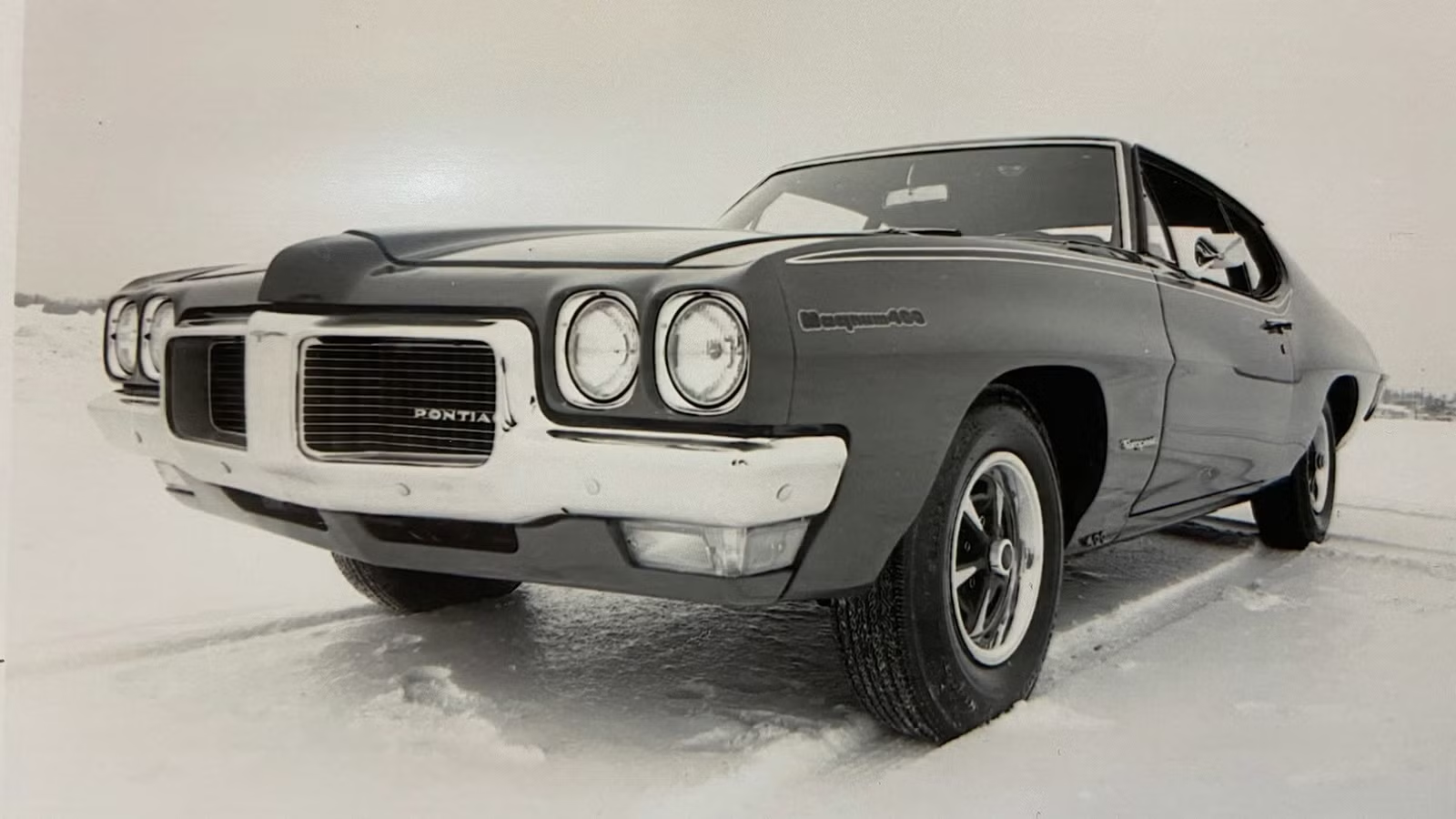
The car was the 1970 Knafel Pontiac Magnum 400. Knafel’s special paired a basic Pontiac intermediate body with the 400-cubic-inch V8 used in the standard GTO, carrying a period rating of 350 hp. That figure followed the generous SAE gross method of the era, so it should not enter a barroom comparison with modern net ratings without a small history lesson and perhaps a designated driver. Reports describe manual and automatic transmission availability, although the surviving record remains thin and some later summaries identify only four-speed cars.
Knafel added enough decoration to keep the Magnum from looking like a rental-counter reject. Rally II wheels sharpened its stance, side stripes borrowed their general look from the 1969 GTO Judge, and color-matched “Magnum 400” graphics gave the dealer-created model its own name. The interior stayed basic, often described with a bench seat and little of the visual theater found in a well-optioned GTO. Knafel advertised the package at roughly $3,200. That worked out to a little over nine dollars for each advertised hp, although the rear tires probably demanded their own entertainment budget.

The resulting car carried a wonderful identity crisis. Its body and cabin belonged to Pontiac’s lower ranks, while its stripes suggested that a Judge had wandered through the graphics department and left fingerprints. Its engine came from the GTO’s side of the family, yet no GTO emblem appeared to give the game away to anyone sorting cars by familiar model names. The Magnum 400 therefore worked as an insurance sleeper more than a pure visual sleeper.
Demand suggests that customers understood the idea immediately. Most accounts place the run at roughly 50 cars. Knafel reportedly said the dealership sold 37 during the model’s unveiling night. Surviving paperwork cannot verify every detail with factory-model precision, but the claim fits the problem Knafel aimed to solve. Buyers had not suddenly stopped wanting torque – they had grown tired of paying a financial penalty for a famous badge.
One detail continues to divide historians: the exact body beneath the package. Hemmings presented the cars as 1970 Tempests, and Paul Glasgo’s later tribute also used a Tempest. The Pontiac Preservation Association’s Bill Knafel biography describes Knafel ordering LeMans hardtops before adding the engines, stripes and graphics. Pontiac’s shifting 1970 intermediate lineup makes the disagreement more than a spelling error; Tempest, LeMans and the midyear T-37 occupied closely related parts of the same family.
The Clever Disguise Became The Reason Almost Nobody Remembers It
The same traits that helped the Magnum 400 reach customers also made it easy to lose. Knafel created only a tiny batch, and Pontiac never treated it as a regular factory model. Dealer-installed graphics and local advertising left a much thinner paper trail than a national option code. The cars also began life as ordinary intermediates rather than prized GTOs, so owners had less reason to store them once rust, accidents or mechanical trouble arrived.
Paul Glasgo remembered seeing the cars around Akron when he was young. Local Pontiac fans knew what they were, but many still ranked them below real GTOs. That judgment made sense at the time – used-car buyers usually wanted the famous badge, not a local dealer’s workaround. The cruel joke arrived later. Once collectors began valuing dealer specials, undocumented performance packages, and tiny-production oddities, the known original cars seemed to have disappeared. The Magnum had hidden from insurers so effectively that it also hid from history. Its disguise solved the first problem, then spent the next few decades creating another.
Glasgo eventually built a tribute because he could not locate a verified survivor. He started with an unusually well-preserved, 22,000-mile 1970 Tempest found in 1997 and recreated the Magnum’s character, including its drivetrain, Judge-style stripe and hard-to-copy graphics. Accounts of the project say Knafel helped guide the work and pointed Glasgo toward the company connected with the original decals. The finished car later joined the 2006 Ames Performance Pontiac Nationals display honoring Knafel and the Tin Indian racing legacy. There it sat beside genuine race cars with documented histories, serving as the visual stand-in for a street model that history had nearly erased.
The Magnum 400 Proved Who Really Controlled The Muscle-Car Market
The Magnum 400 deserves attention for more than its rarity. It showed that insurance classifications could shape a performance car as strongly as an engineer, racer or buyer. Pontiac created the 400-cubic-inch hardware and attached it to the GTO identity. Insurers made that identity expensive, and Knafel separated the two at dealership level, placing the desirable engine inside a less notorious package.
That opening-night rush offers the story’s clearest lesson. Traditional muscle did not vanish overnight because buyers woke up bored with big engines. Many still wanted the sound, shove and theater of a strong Pontiac V8. They simply needed a package that did not carry the same insurance stigma as the GTO. Knafel gave them one by changing the badge while keeping the part that mattered most. The Magnum 400 outsmarted the crackdown for a brief moment, then almost disappeared because its trick worked too well.
Source: Pontiac, HotRod

Related posts





Latest Post


No Comments