
2026 Kia Sportage Hybrid Vs PHEV Vs Gas: Which Powertrain Actually Pays Off For Buyers Right Now
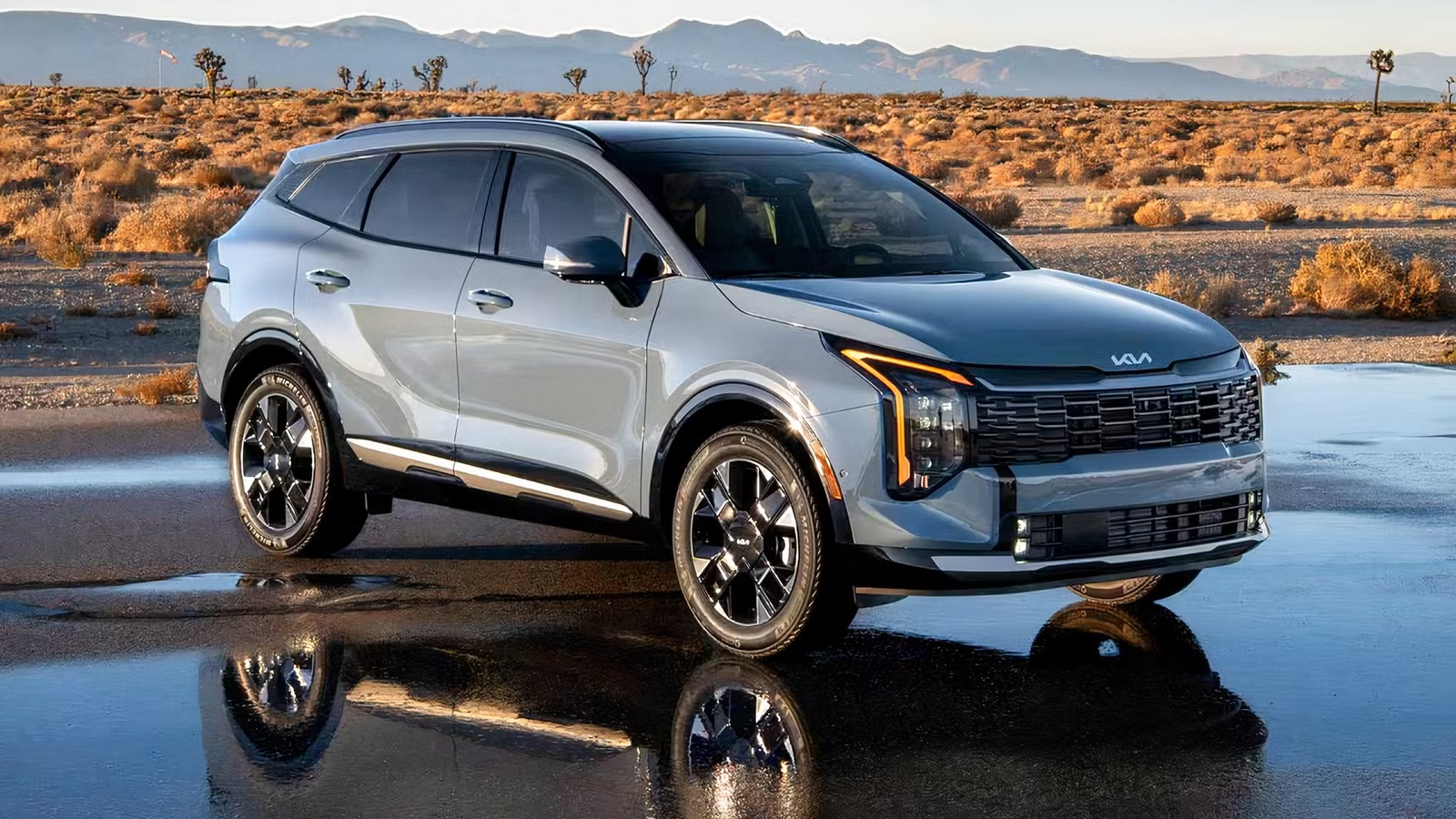
The 2026 Kia Sportage now comes in three powertrain flavors, gas, hybrid, and plug-in hybrid, spread across six trims, and the math on which one actually saves you money isn’t as simple as picking the biggest battery. Kia built a real competitor to the RAV4 and CR-V here, but the smarter question isn’t which Sportage is quickest or quietest. It’s which one pays for itself before you trade it in.

The short answer: for most shoppers, the regular hybrid is the sweet spot. The gas model only makes sense if you drive very little, and the PHEV only earns its premium back if your commute is short and you plug in every single night.
The Sportage Hybrid starts at $32,790, roughly $2,000 above a comparably equipped gas AWD trim, and in return you get 232 horsepower and noticeably better real-world efficiency. That’s a modest premium by hybrid standards, and it shows up fast in ownership math. Kelley Blue Book’s five-year cost-to-own analysis pegs the Hybrid’s total cost at $48,751 against $53,558 for the gas Sportage, a roughly $4,800 gap driven mostly by fuel savings. The Hybrid also holds value slightly better, retaining 57% of MSRP after five years compared to 51% for the gas model.

The most efficient configuration in the lineup isn’t even the priciest one. The front-wheel-drive Hybrid LX, the base trim, delivers up to 575 miles on a tank, more range than the plug-in hybrid offers, and costs only about $2,000 more than the equivalent non-hybrid LX. If your driving is mostly highway miles or long-distance commuting where you can’t recharge a battery anyway, this is the trim that makes the most financial sense, full stop.
The PHEV Only Wins If Your Commute Is Short And You Actually Plug In

The Sportage PHEV starts well above the hybrid, with the X-Line trim at $40,490 and the X-Line Prestige at $47,190. That’s a $4,800 to $6,600 sticker premium over the equivalent hybrid, before you factor in a Level 2 home charger, which runs another $800 to $1,500 if you don’t already have one installed. In exchange, you get up to 34 miles of electric-only range and a six-speed automatic sending power to all four wheels.
The problem is the break-even math doesn’t flatter the PHEV unless your use case is narrow. Even with nightly charging, the PHEV saves only $250 to $350 a year in energy costs compared to the hybrid, which stretches the payback period to 8 to 11 years, longer than most people keep a vehicle. The PHEV only becomes the smarter buy if your round-trip commute is consistently under 34 miles and you’re disciplined about charging every night. Skip a few charges, or drive a longer loop, and you’re just carrying a heavier, pricier Sportage that burns gas like the hybrid anyway.
Matching The Powertrain To Your Actual Commute

Strip away the spreadsheet and the recommendation is straightforward. If you drive under 10,000 miles a year and mostly short local trips, the gas Sportage is fine; you won’t put enough miles on it to recoup any hybrid premium regardless of which one you pick. If your daily round trip is longer than 34 miles, or you do a lot of highway driving, the regular hybrid wins outright, cheaper to buy, cheaper to maintain, and it never needs a charger. If your round-trip commute is reliably under 34 miles and you have a driveway or garage to charge in every night, the PHEV can work, but only as a lifestyle choice rather than a cost-saving one, since the payback period runs nearly a decade.
The Sportage’s test-drive impressions back up the spreadsheet conclusion too: the hybrid system adds weight but earns it back in stop-and-go driving through regenerative braking, while the gas AWD trims feel like the engine is working harder to move the same vehicle. For most buyers cross-shopping a RAV4 or CR-V, the hybrid Sportage isn’t just the efficient choice, it’s the one that actually makes financial sense without requiring any change in how you live with the car.

Related posts





Latest Post




No Comments