
The Forgotten Lexus That Changed The Luxury-Sedan Game
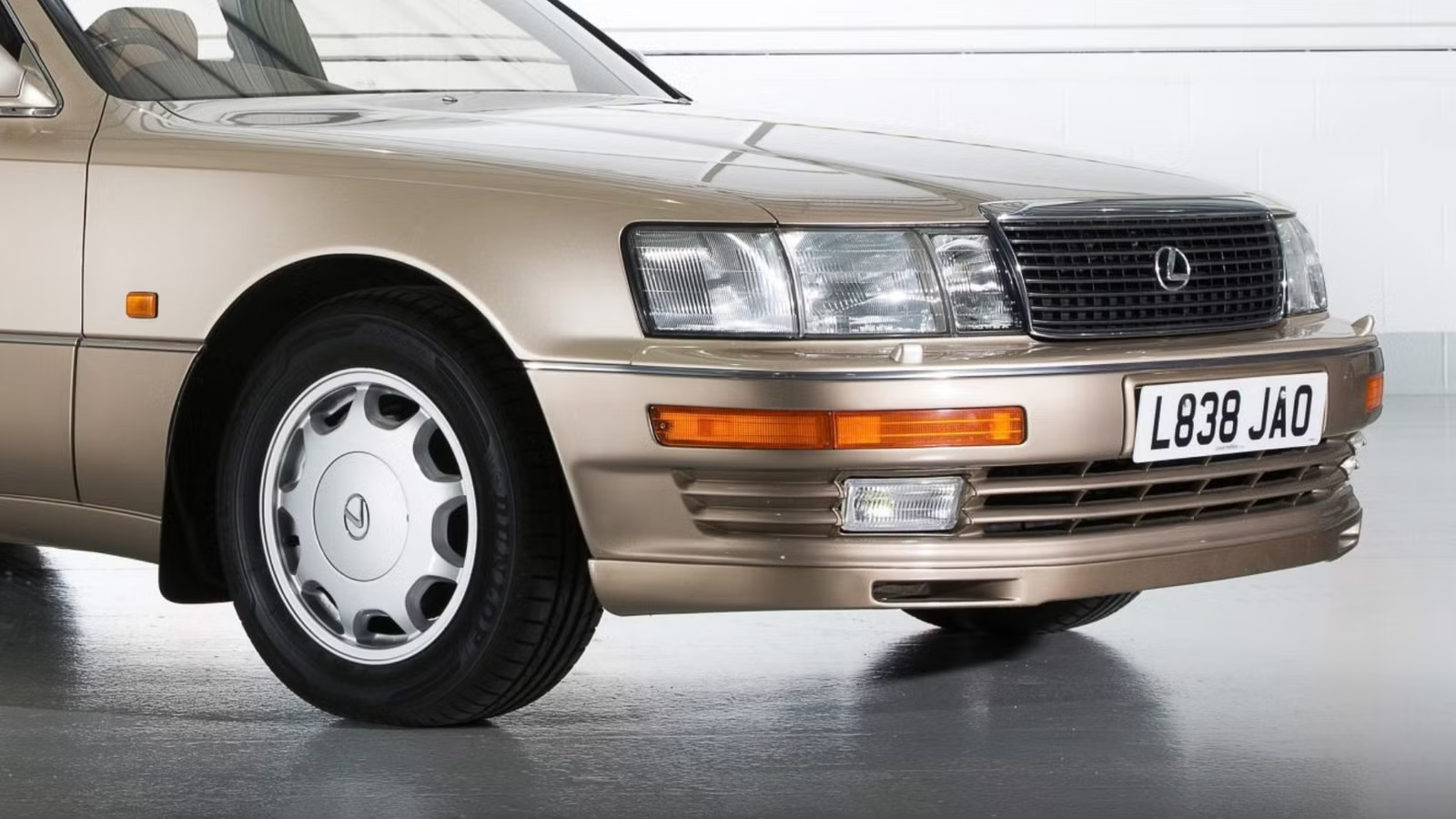
In the late 1980s, the upper echelons of the luxury car world were virtually an exclusive club with impenetrable European dominance. If you were a chief executive, a politician, or a captain of industry, you more than likely had a Mercedes-Benz W126 or an E32 BMW 7 Series. The Germans had spent decades establishing an unchallenged monopoly on prestige, charging eye-watering premiums under the assumption that no rival could ever match their engineering authority, high-speed autobahn composure, or brand clout.

To the suits in Stuttgart and Munich, Japanese automakers were masters of economical hatchbacks and bulletproof sedans, but fundamentally incapable of building true luxury flagship cars. That arrogance proved to be a fatal miscalculation. Secretly brewing inside Toyota was an obsessive, billion-dollar project designed not just to compete with Europe’s elite, but to humiliate them at their own game.
The Secret Era: Project F1 And The Obsession With Perfection
The Origins Of Toyota’s Secret Mission
The story didn’t begin in a design studio or a boardroom, but with a clandestine mandate. In August 1983, Toyota Chairman Eiji Toyoda posed a simple yet ambitious question to his top strategists and engineers: “Can we create a luxury car to challenge the world’s best?” The top-secret program was codenamed Project F1, short for “Flagship One.”


The objective was not to build a slightly nicer Toyota Crown, but rather to construct an entirely new flagship vehicle from a blank sheet of paper, alongside a dedicated luxury brand that could shed Toyota’s budget image. Toyota established specialized design teams in Southern California to study the wealthy American lifestyle, observing how luxury buyers lived, spent, and perceived craftsmanship.
Uncompromising Engineering And Testing

Project F1 became an exercise in industrial obsession that had never been seen before in the automotive world. Toyota allocated a blank-check budget exceeding $1 billion. The engineering army was unprecedented. Over 1,400 engineers and 2,300 technicians were assigned to the project. 450 experimental prototypes were built and destroyed.

Test mules logged over 2.7 million kilometers across frozen Swedish lakes, scorching Arizona deserts, and high-speed German autobahns. Engineers refused to compromise on opposing goals. Typically, high speed required stiff air resistance, and strong performance meant heavy fuel consumption.

Toyota insisted on achieving best-in-class drag coefficients alongside whisper-quiet acoustic suppression. To eliminate vibration at the source, tolerances were tightened to fractions of a millimeter, and a brand-new, quad-cam 4.0-liter V8 engine, known as the legendary 1UZ-FE, was designed from scratch specifically for the platform.
Unveiling The Legend: The 1989 Lexus LS 400 Drops The Mic
The Debut That Left German Engineers Speechless

In January 1989, at the North American International Auto Show in Detroit, Toyota officially dropped the veil on its new luxury brand, Lexus, and its inaugural flagship sedan: the LS 400. The industry was stunned. The car was aerodynamic, polished, and featured an interior with fluid power seats, electro-luminescent gauge clusters, and California walnut trim. To demonstrate its balance, Lexus filmed its famous commercial featuring a pyramid of champagne glasses stacked on the hood of an LS 400 running at 145 mph on a dyno, without spilling a drop.
Disruptive Pricing And Unmatched Quality


While the engineering blew automotive journalists away, the pricing structure sent shockwaves through executive boardrooms. At its 1989 debut, the LS 400 carried a starting price tag of $35,000. To put that into perspective, a base six-cylinder Mercedes-Benz 300SE cost roughly $51,400, while a V8-powered Mercedes 420SEL demanded over $60,000, according to J.D. Power. Lexus was delivering a vehicle that was faster, quieter, smoother, and vastly more equipped than German V8 competitors for nearly half the price. It wasn’t just a budget alternative; in nearly every measurable metric, the LS 400 was simply the better engineered automobile.
The Ripple Effect: How Europe Was Forced To Adapt
Panic In Stuttgart And Munich
When Mercedes-Benz and BMW engineers finally acquired early production models of the LS 400 and disassembled them down to their bare unibodies, corporate dread set in. At Mercedes-Benz, the arrival of the LS 400 triggered a severe internal crisis. Mercedes was in the final stages of completing its upcoming flagship, the W140 S-Class. Realizing how far behind they were in manufacturing cost efficiency and acoustic isolation compared to the $35,000 Lexus, Mercedes pushed back the launch of the W140 to overhaul its design and add feature sets, racking up massive cost overruns.
Chief Engineer Wolfgang Peter was ultimately ousted due to the development cost spirals precipitated by Lexus’s disruption. At BMW, executives realized their 7 Series could no longer rely purely on dynamic handling to justify a massive price premium when Lexus had reset customer expectations regarding cabin isolation and standard equipment.
Redefining Customer Experience

Lexus didn’t just disrupt the vehicle assembly line; it revolutionized auto retail. Prior to 1989, luxury dealerships often treated buyers with a degree of smug superiority. Lexus required its dealers to offer white-glove service, complimentary car washes, plush waiting lounges, and loaner vehicles.
When a minor electrical defect regarding a high-mount brake light affected early LS 400 models shortly after launch, Lexus didn’t wait for complaints. They voluntarily recalled all 8,000 sold vehicles, picked up the cars directly from owners’ homes, returned them washed and fully fueled, and included a personal gift. This unprecedented level of customer service turned a potential safety scandal into a masterclass in brand loyalty, forever changing dealership standards across the globe.
The Legacy And Cultural Aftermath
The Forgotten Hero

Despite completely rewriting the rules of the luxury auto industry, the original LS 400 often finds itself unfairly relegated to the shadows of enthusiast culture. Why doesn’t the original LS receive the same reverence as the BMW E38 7 Series or the tank-like Mercedes W140 S-Class?
There are three main reasons for this, which can be summarized as subtle styling, appliance-like perfection, and pop-culture cachet. The LS 400 was styled conservatively, intentionally designed not to ruffle feathers, which meant it lacked the aggressive road presence of its European contemporaries. The car was so quiet, reliable, and decoupled from mechanical strain that automotive purists sometimes deemed it “devoid of emotion” or “too perfect.”

European flags held court in 90s cinema and rap culture as symbols of old-money status, leaving the Lexus viewed as the sensible choice for sensible people. Yet, this perception ignores its engineering brilliance. The 1UZ-FE V8 is now recognized as one of the most durable engines ever produced by human hands, routinely passing 500,000 to 1,000,000 miles on original internals with basic maintenance.
The Blueprint For Modern Luxury
The original LS 400 proved that luxury didn’t have to mean fragile electronics, oil leaks, and condescending dealership visits. It proved that extreme refinement and bulletproof reliability could coexist in a premium package. Every modern luxury car, from quiet cabin acoustic deadening to standard luxury amenities, operates under standards established by Project F1. Lexus forced the entire industry to raise its build quality while checking its pricing hubris.
The 1989 Lexus LS 400 was more than just a new luxury car; it was a seismic shift for the automotive industry. Through six years of relentless development, thousands of prototypes, and an uncompromising refusal to accept standard industry compromises, Toyota accomplished what European executives deemed impossible.

While collector markets continue to chase European badges of the 1990s, the LS 400 remains the quiet pioneer that changed the game forever. It was the ultimate underdog: a masterwork of engineering disguised as a sensible sedan that broke an empire and set the template for modern automotive luxury.
1989 Lexus LS 400 Specifications
|
Feature/Metric |
Specification |
|---|---|
|
Engine |
4.0-liter (3,969 cc) DOHC 32-valve 1UZ-FE V8 |
|
Transmission |
4-speed electronically controlled automatic |
|
Power |
250 hp @ 5,600 RPM |
|
Torque |
260 lb-ft @ 4,400 RPM |
|
Drivetrain |
Rear-wheel drive |
|
0-60 mph |
7.9 to 8.5 seconds |
|
Top Speed |
155 mph |
|
Curb Weight |
~3,759 – 3,792lbs |
|
Coefficient of Drag |
0.29 Cd |
|
Launch Price (1989) |
~$35,000 USD |
Sources: OEMs, J.D. Power, UPI

Related posts




Latest Post


No Comments