
RUF Just Dropped A 1,000-HP Flat-8 Supercar Prototype Nobody Saw Coming — And It Debuts At Goodwood
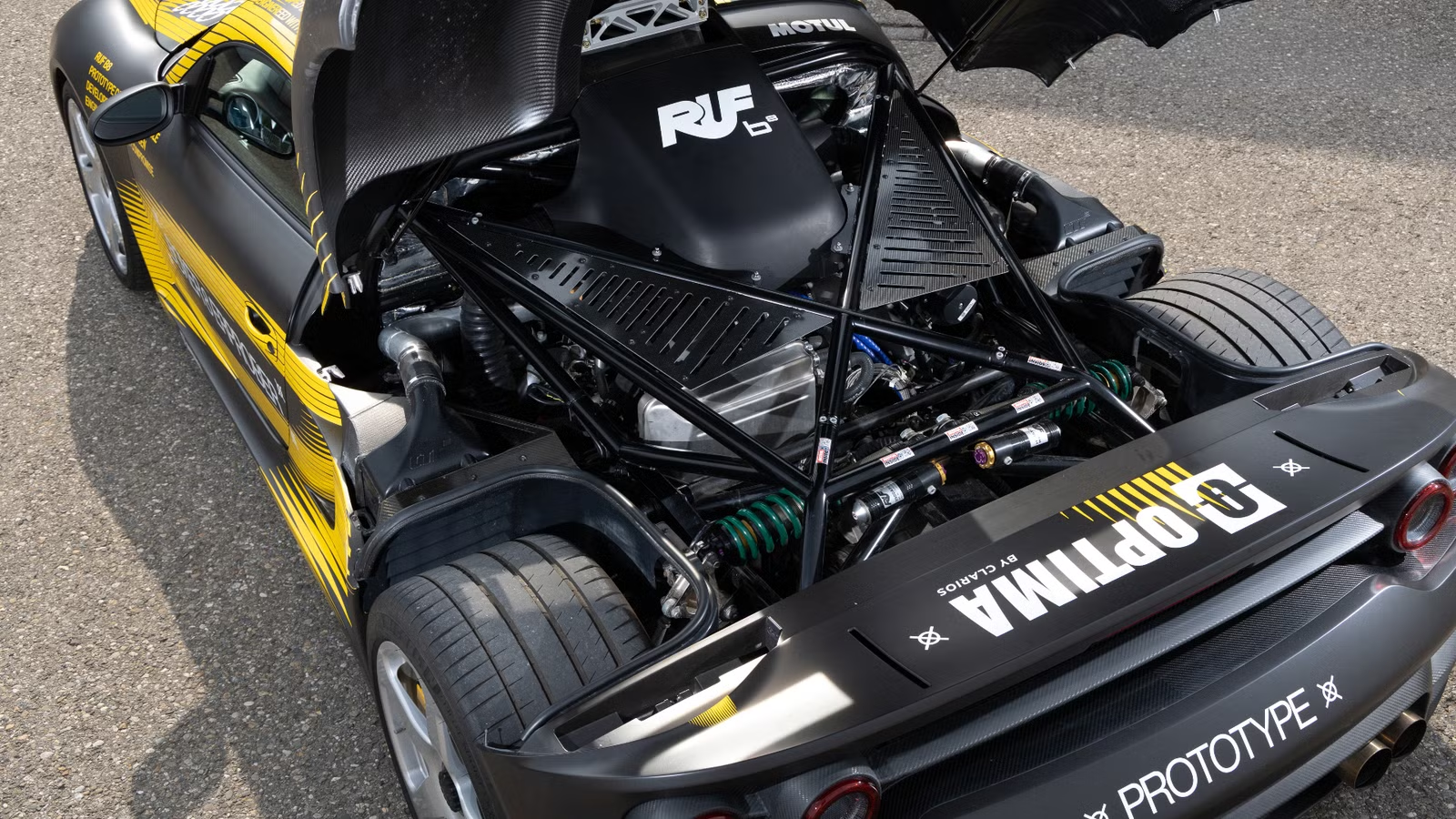
RUF Automobile has built a 1,000-horsepower flat-eight engine — a boxer configuration with eight cylinders — and strapped it into a supercar prototype making its public debut at the Goodwood Festival of Speed this week. That sentence deserves a second read, because nothing like it has ever reached production. Not from Porsche. Not from anyone.

The Pfaffenhausen-based shop has spent decades squeezing extraordinary performance out of Porsche’s flat-six architecture, but this is something categorically different. A bespoke boxer-eight is an engineering statement so audacious that even Ferrari, with all its flat-twelve heritage, never attempted it in a road car. RUF just did.
Why A Flat-Eight Is Engineering Madness — And Why Nobody Has Tried It

A boxer engine works by opposing pairs of pistons that punch outward horizontally, canceling each other’s primary forces and sitting low in the chassis. It’s why Porsche’s flat-six is so beloved: inherently smooth, low center of gravity, compact. Add two more cylinders and the math gets brutal.
A flat-eight is nearly a meter wide. That’s not a packaging inconvenience — it’s a structural crisis. The engine has to live somewhere in the car, and in a mid- or rear-engine layout, that width fights the rear subframe, the suspension pickups, and the crash structure simultaneously. Cooling is the second nightmare: the outermost cylinders on a wide boxer are starved of airflow compared to a V8, where the valley between banks creates a natural duct. Getting heat out of a flat-eight uniformly, without cooking the end cylinders, requires bespoke cooling architecture that simply doesn’t exist off any shelf.
Balance is the third problem. A flat-eight fires in an uneven sequence compared to a V8, which means the crankshaft has to be counterweighted with precision that scales poorly from the flat-six RUF knows cold. Every additional cylinder in a boxer multiplies the torsional complexity of the crank. Getting to 1,000 horsepower on top of all that isn’t incremental engineering — it’s a ground-up commitment.
Why Porsche’s Flat-Six Legacy Made This Less Likely, Not More

Here’s the counterintuitive part: Porsche’s mastery of the flat-six is precisely why Stuttgart never chased a flat-eight. The 911’s entire identity — its weight distribution, its engine bay geometry, its cooling evolution from air to water — is optimized around six cylinders. Porsche’s engineers have spent sixty years making that configuration do things nobody thought possible. Abandoning it for eight cylinders means abandoning the institutional knowledge, the tooling, the supplier relationships, and the brand mythology that makes a 911 a 911.
When Porsche wanted more power, it went turbo, then twin-turbo, then hybrid. The flat-six got wider bore, longer stroke, direct injection, and eventually the 9,000-rpm naturally aspirated masterpiece in the GT3 RS. But it stayed six cylinders. The architecture was the identity.
RUF doesn’t carry that constraint. The company builds its own chassis, holds its own VIN certification in Germany, and has always treated Porsche’s platform as a starting point rather than a sacred text. That independence is what makes a flat-eight possible — and what makes this prototype genuinely significant rather than just a stunt.
What RUF’s Goodwood Debut Actually Signals

Goodwood is a carefully curated stage, and RUF didn’t bring a prototype here by accident. The Festival of Speed draws the collectors, the press, and the marque faithful who will actually write checks for something like this. Debuting there says RUF believes this car is close enough to real that it can survive public scrutiny at full throttle up the hill.
One thousand horsepower from a naturally aspirated flat-eight — if that’s the configuration — would put this engine in genuinely rarefied air. The closest production parallel in boxer history is Ferrari’s flat-twelve, which topped out around 440 horsepower in the Testarossa era and disappeared from production precisely because of the packaging compromises it demanded. RUF appears to have solved problems Ferrari walked away from, in a smaller shop, with a configuration nobody else attempted.
Whether this becomes a limited production run or remains a halo prototype, the engineering credibility is already established. RUF has always been the outfit that made Porsche’s engineers quietly uncomfortable — the CTR Yellowbird embarrassed supercars that cost three times as much in 1987, and the company has been making similar statements ever since. A bespoke 1,000-horsepower flat-eight is the loudest one yet. Gearheads who’ve followed RUF’s trajectory should be watching Goodwood very closely this week.

Related posts





Latest Post


No Comments