This BMW Is A Depreciation Disaster, And That’s Why It’s Worth Buying It Used
8 minutes reading
Tuesday, 28 Jul 2026 16:00 0 136 autotech
Luxury cars are generally not known for great resale values, though Lexus is an exception since its Toyota-based engineering helps its strong resale values. On the other hand, you’ve got a brand like BMW. Though its cars are usually at or below average in terms of depreciation, there are some models that depreciate rapidly.
Case in point, the BMW in today’s article. There’s nothing inherently wrong with this vehicle. In fact, it’s great at being a luxury sedan that still offers a degree of athleticism. So what’s causing this car to have massive depreciation? This is what we’re going to find out with this article.
Close-up shot of 2026 Genesis G70 hood badgeGenesis
To understand where this BMW model stands in the depreciation spectrum of best to worst, let us first take a look at how the best and worst brands perform.
Lexus is unsurprisingly at the top when it comes to depreciation. Thanks to its Toyota-based roots of reliability and durability, Lexus models remain attractive to even the third owner and beyond. According to CarEdge, Lexus has the best five-year resale value among luxury brands, as it still holds 61.6 percent of its value within that time. Following closely behind is Mercedes-Benz with 53.8 percent, while Acura has slightly lower depreciation than the Stuttgart-based brand at 53.2 percent. Audi is in fourth at 52.3 percent, while Bentley completes the top five at 50.6 percent.
Where is BMW? Well, as mentioned, the brand is right within average for the segment. CarEdge says that it holds 50.1 percent of its value in five years, placing it in sixth. The primary reason why the Japanese luxury brands occupy two of the three top spots is, of course, their durability, but this reliability is attributed to their vehicles being mechanically simpler than what the other luxury brands engineer. On a per-model basis, Lexus occupies seven out of the top 10 spots on CarEdge’s list.
Italian Luxury At The Bottom
2020 Maserati Quattroporte front fasciaMaserati
Perhaps to no one’s surprise, the Italians are at the bottom of the list. Maserati is in dead last at 16th place, with the brand’s models holding just 24.7 percent of their value in five years. Alfa Romeo is somewhat better at 34.5 percent, though. In 14th place is a Japanese outlier, which is Nissan’s luxury brand Infiniti, holding 37.4 percent of its value in five years. Meanwhile, Tesla is also included with 39.2 percent of its value held in five years, and completing the bottom five is Land Rover at 39.4 percent, with Jaguar just outside the bottom five at 41.4 percent.
Infiniti’s case is less on reliability and durability, but more on the fact that it doesn’t have a lot of desirable models at the moment. Tesla’s low resale is primarily due to the Model S and X, which are some of the fastest depreciating luxury EVs. Luxury EVs also tend to depreciate faster, mostly due to the rapid pace of EV innovation versus internal combustion engine (ICE) and hybrid cars. Jaguar, Land Rover, Alfa Romeo, and Maserati all have a reputation for complex maintenance and below-average reliability. And indeed, it is ease of maintenance and reliability that also dictates the resale value of a vehicle.
Complexity Depreciates The BMW 7 Series
A 2024 BMW 7 Series parked outside an officeBMW
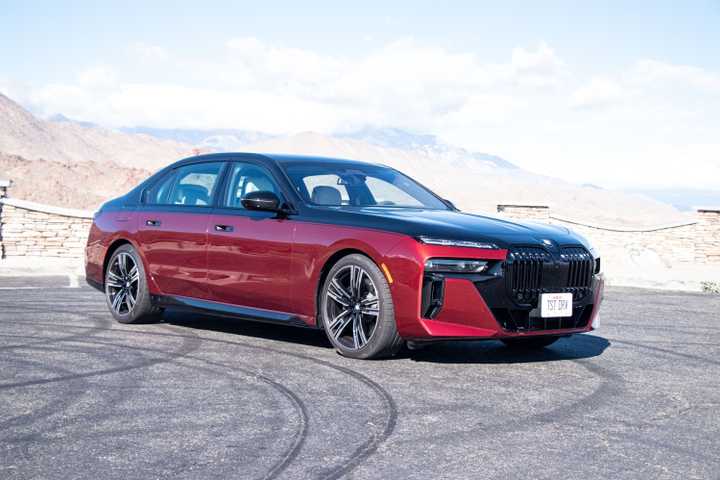
While BMW as a brand is about average for the luxury market in terms of resale values, the BMW 7 Series is one of the fastest depreciating models. Though it isn’t as bad as the Italian or British luxury models, it is below average for the luxury market.
$36,126 Lost In A Year
Front shot of a 2023 BMW 7 Series driving through the hillsBMW
BMWBlog has determined that the BMW 7 Series on average loses $36,126 of its value in just a year, or a depreciation rate of 29.8 percent. iSeeCars states that the BMW 7 Series will lose 43.3 percent of its value in just three years, and 61.8 percent in five years. The plug-in hybrid versions are even worse, with 50.1 percent of its value already lost in just three years, while 65.1 percent of its value is already erased in five years. Over at CarEdge, the five-year resale values of the 760i and 750e plug-in hybrids are at 50.9 percent, the fully-electric i7 at 45.4 percent, and surprisingly, the base 740i at 42.3 percent. For reference, in CarEdge’s rankings, the Lexus RC F has the highest five-year resale value at 72.6 percent.
A Valid Case Of Technophobia
The interior for the 2024 BMW 7 SeriesBMW
As we’ve established earlier, ease of maintenance and reliability dictate a vehicle’s resale value. In the case of the BMW 7 Series, its sheer complexity makes it a long-term liability to own. Auto Web Expo says that you can expect annual costs for the BMW 7 Series and X7 to range from $1,200 to $2,500. The 7 Series has complex adaptive air suspension systems that do a great job of keeping the car stable and level, while plug-in hybrid versions add a layer of electrical complexity to an already mechanically complex car.
There are also its numerous motorized luxury features, which include the self-opening and closing doors, as well as the window shades for the glass roof, rear windshield, and rear doors. But perhaps the biggest complexity of them all is the optional $4,750 31.3-inch Theater Screen. It’s a full-blown entertainment suite, so you can only imagine the complex wiring and motorized features needed to make its automatic folding mechanisms work. Complexity is the enemy of reliability, and the more moving parts you have, the higher the chances of a part failing in the future. Good luck if there’s going to be a mechanic that will happily repair your 7 Series.
2025 BMW 7 Series dashBMW
And though motorized features may take the bulk of the reliability concerns, do note that sensors and cameras do wear out eventually. See the gaping grille of the BMW 7 Series? These hide a set of sensors for the advanced driver-assistance systems (ADAS). The facelifted 2027 7 Series will have even more sensors, not to mention added interior tech features. You can now perform Zoom calls in the Panoramic iDrive, among other telematics capabilities.
Consider The BMW 7 Series With Caution
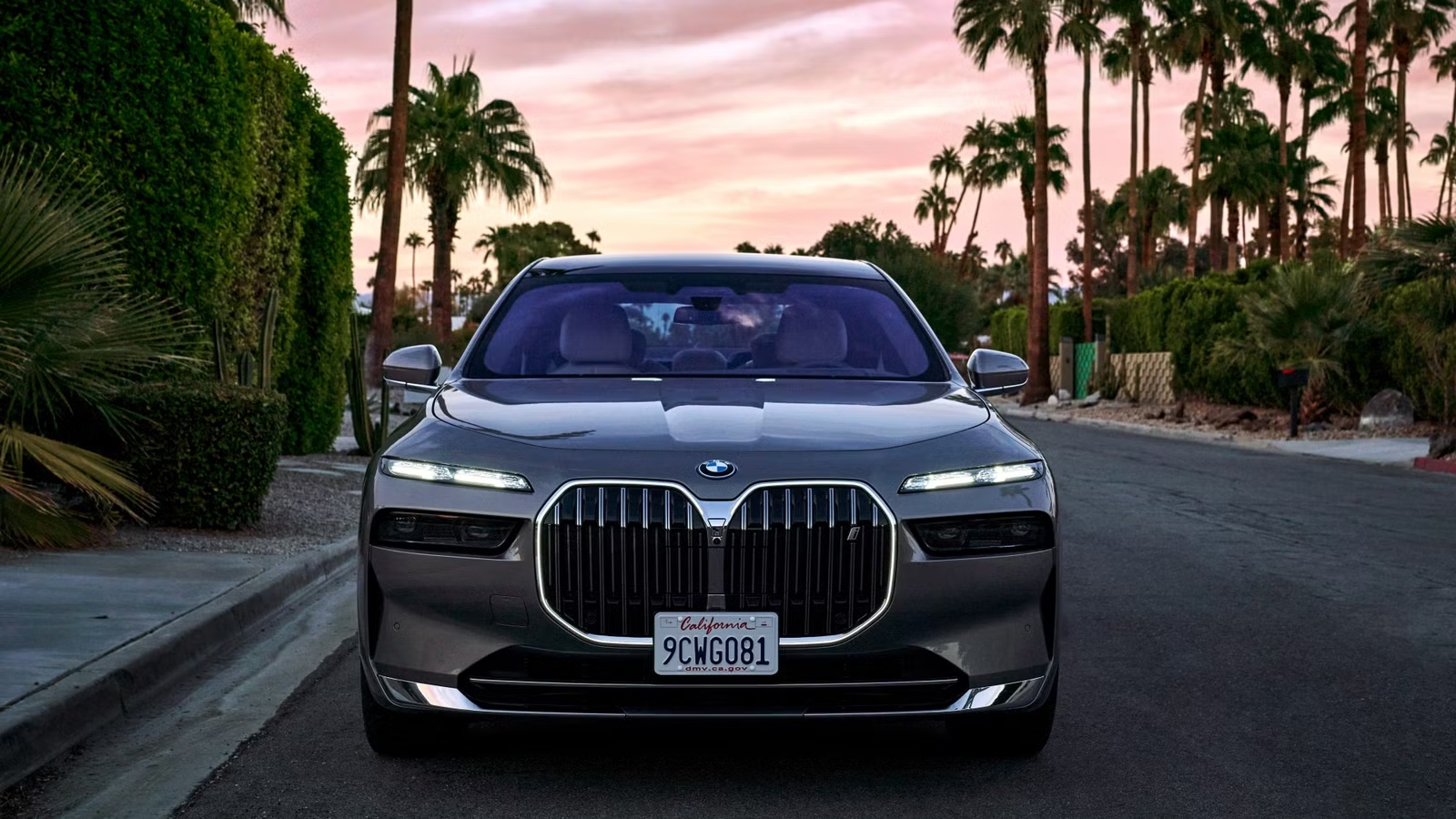
A front quarter shot of a 2023 BMW 7 Series traveling through Palm SpringsBMW
But if you’re fully committed to getting a used BMW 7 Series in its current G70 generation, just be aware that you will definitely face expensive repairs in the future, whether due to the drivetrain or its complex luxury features.
Average Five-Year Residual Value Of $37,914
A left hand-side shot of a 2023 BMW 7 Series parked on the roadBMW
As mentioned, the 7 Series in pure gas form will lose 61.8 percent of its value in five years, which is below the 54.9 percent average for the full-size luxury sedan segment. As for its average market value, the 7 Series sells for $37,914 on average. That sounds very tempting, especially since you can either get a popular compact crossover SUV or BMW’s absolute flagship sedan, but you have to remember that this depreciation is due to fears that this will be a complex car to maintain in the long run.
Our advice? Opt for a version without the 31.3-inch Theater Screen, or perhaps you may want to consider a reliable alternative from Lexus. The Lexus LS flagship luxury sedan is a lot more reliable and is far easier to maintain, so unsurprisingly, this luxury car still holds its value really well. The LS 500 will only lose 42.4 percent of its value in five years, which translates to an average residual value of $56,393.
Consider Leasing When Buying New
2027 BMW 7 Series front 3/4 shotBMW
On the other hand, if you’re considering a BMW 7 Series as a brand-new luxury car splurge, you may want to consider leasing instead. Currently, what you can get is already the facelifted 2027 model, and it’s only available in 740 or 740 xDrive. The plug-in hybrids will follow later this year, while the fully electric i7 is already on sale.
The 7 Series starts at $99,800 and based on what we’ve learned so far, the 7 Series will depreciate by more than $30,000 in just the first year. That’s just the average. Considering that BMWs come with complimentary maintenance for three years, leasing may be a good option. Ultimately, the math of leasing will still be up to you, especially when you start adding insurance and having the freedom to no longer deal with selling a used 7 Series. For now, the discounted lease offers are being offered for the outgoing pre-facelift 2026 model, so be sure to check with your nearest BMW dealer if you’re interested in leasing a 2027 7 Series.












No Comments