
10 Kawasaki Motorcycles That Owners Never Stop Recommending
From cross-country interstate runs to canyon carving and track days, American riders expect bikes to take a real beating. Kawasaki has quietly nailed that balance. They build motorcycles that easily rack up big miles while keeping maintenance simple and cheap. Whether it is an indestructible KLR tackling rugged BDR routes, a Ninja carving up the Tail of the Dragon, or a Versys cruising down the Pacific Coast Highway, certain Team Green machines earn riders for life. If you are looking for your next ride, here are 10 Kawasaki motorcycles that US owners swear by and never stop recommending.
Kawasaki Ninja 500
Price: $5,399

The Ninja 500 is ostensibly a beginner motorcycle, and it performs its job really well. It is a lightweight sport bike that builds confidence in those interested in furthering their riding skills, and it does it with the help of a 451 cc parallel-twin engine that generates 51 horsepower and 31.7 pound-feet of torque. Its 180-degree firing order encourages you to rev it while still having a decent amount of torque in the midrange.

What is truly nice about the Ninja 500 is that Kawasaki has two variants that cater to different mindsets. The base Ninja 500 offers all the mechanicals that help you enjoy the ride with no decoration or added cost. You can add ABS for $400, and if you want a fully modern Ninja 500, the Ninja 500 SE costs $6,499. It adds a TFT instrument cluster, LED turn signals, a pillion seat cowl, a USB-C charging socket, keyless ignition, and a larger windshield.
Kawasaki KLX230
Price: $5,499


The KLX 230 is a tiny dual-sport powered by a 233 cc single-cylinder engine that makes adventure riding less intimidating. It is air-cooled, has a single cam, and two valves. Kawasaki does not quote an official power figure, but it generates approximately 17 horsepower at 8,000 RPM and 13 pound-feet of torque at 6,400 RPM. This is paired with a six-speed gearbox.

As simple as the engine is, Kawasaki decided to pair it with a perimeter frame and link-type rear shock. With its lightweight chassis, it is a very good companion on single-track or technical trails. You can also opt for ABS for an extra $300, and Kawasaki provides you with a slightly larger front brake disc if you do. With its simplicity, reliability, and ability to keep going no matter what, it is little wonder that owners recommend this to others.
Kawasaki KLX300SM
Price: $6,049

Look up the word “fun” in the dictionary, and there will be a photo of a supermoto there. The KLX300SM is one of the Kawasakis worth owning at least once; you definitely get the most fun per dollar with it. It is essentially a street version of the KLX300, which means you get a steel semi-double-cradle frame with 17-inch wire-spoke wheels and sticky tires.

Powering it is Kawasaki’s 292 cc single-cylinder engine that develops 25 horsepower and 17.7 pound-feet of torque. The suspension is not merely long-travel; with 9.1 inches available at the front and 8.1 inches at the rear, it also offers adjustable compression damping at the front and adjustable spring preload and rebound damping at the back.
Kawasaki KLR650
Price: $6,999

Even casual fans of motorcycling would have known that the KLR would be on this list. This is a dinosaur that has not needed to evolve over the three decades that it has been on sale. In its current form, it has fuel injection, an all-digital LCD instrument cluster, and you can specify it with ABS for an extra $300. There is also the option of lowered suspension to make it more accessible.

The 652 cc thumper puts out 38.5 horsepower and 39.1 pound-feet of torque through a five-speed gearbox, but its USP is its ability to keep going no matter what. You do not need a Kawasaki owner to recommend the KLR to you; the US military will do it too!
Kawasaki Z900
Price: $9,999

The Z900 is not the range-topping Kawasaki naked anymore, but it still remains the most powerful naked motorcycle available for under $10,000. That sets the tone for what this middleweight Z is about: maximum bang for your buck. The 948 cc inline-four offers 123 horsepower and 73.1 pound-feet of torque with a six-speed gearbox, an assist and slipper clutch, and a two-way quickshifter. You also get a by-wire throttle with ride modes and cornering traction control.

A steel trellis frame keeps weight low, and it uses inverted forks and a link-type rear shock, both of which offer preload and rebound adjustability. The six-axis IMU also offers cornering ABS, while a five-inch TFT display is equipped with Bluetooth and navigation right out of the box. For a couple of thousand dollars more, you can get top-shelf front brakes and a rear monoshock. But the base model’s value is what keeps Kawasaki owners recommending it to others.
Kawasaki Versys 650 LT
Price: $10,399

On the face of it, it looks quite mad that the parallel-twin middleweight with less displacement that is based on a smaller middleweight costs more than the Z900, but the Versys 650 LT commands a higher price because, like its name, it truly is that versatile. This is one of the best all-around motorcycles for daily rides and weekend trips, especially now that Kawasaki has given it a 4.3-inch TFT display with Bluetooth and navigation, three-level traction control, a manually adjustable windscreen, and quick-release luggage.

The rest of it was already very good, which is why Kawasaki did not mess with it. The 649 cc 180-degree parallel twin still generates 67 horsepower and 44 pound-feet of torque. It puts this down through a six-speed gearbox with an assist and slipper clutch, but a quickshifter is not available even as an accessory from the factory. The inverted forks have spring preload and stepless rebound adjustability, whereas the rear offset shock has remote adjustable preload. This is a genuinely reliable, comfortable bike for anything tarmac-related.
Kawasaki Ninja ZX-6R
Price: $11,599

The Ninja ZX-6R is a throwback supersport motorcycle that has somehow stayed constant through changing times. It is not very cheap, and the base price does not include ABS, which is a $1,000 option. It also does not have a six-axis IMU or a two-way quickshifter. This is still one of the best motorcycles to hone your skills with if you visit a racetrack often, so it is little wonder that this is the Kawasaki that riders secretly recommend to their friends.

It has an old-school inline-four engine that displaces 636 cc and generates 127 horsepower and 52.1 pound-feet of torque. An aluminum perimeter frame with Showa SFF-BP inverted forks and a linkage-type rear shock offers full adjustability, and track-focused monobloc front brake calipers help harness its power. It has its share of technology with a 4.3-inch TFT display, ABS, traction control, and an upshift-only quickshifter.
Kawasaki Ninja ZX-14R
Price: $17,599

The ZX-14R, like the ZX-6R, is a model from a time gone by, but it ages better than riders expect. With the kind of power it generates, it can hold its own against pretty much anything at the drag strip. It houses the largest displacement inline-four engine fitted to a mass-production motorcycle at 1,441 cc, generating 197 horsepower and a scarcely believable 116.5 pound-feet of torque.

It has quite a few modern features as well: two power modes, a slipper clutch, three-level traction control, Brembo M50 monobloc calipers, and, unlike the Suzuki Hayabusa, stainless steel braided clutch and brake hoses. The next emissions update is pretty much guaranteed to kill off the ZX-14R, but in the meantime, it remains one of the few bikes that is simultaneously extremely comfortable at a cruise and terrifying at wide-open throttle.
Kawasaki Ninja H2
Price: $34,400

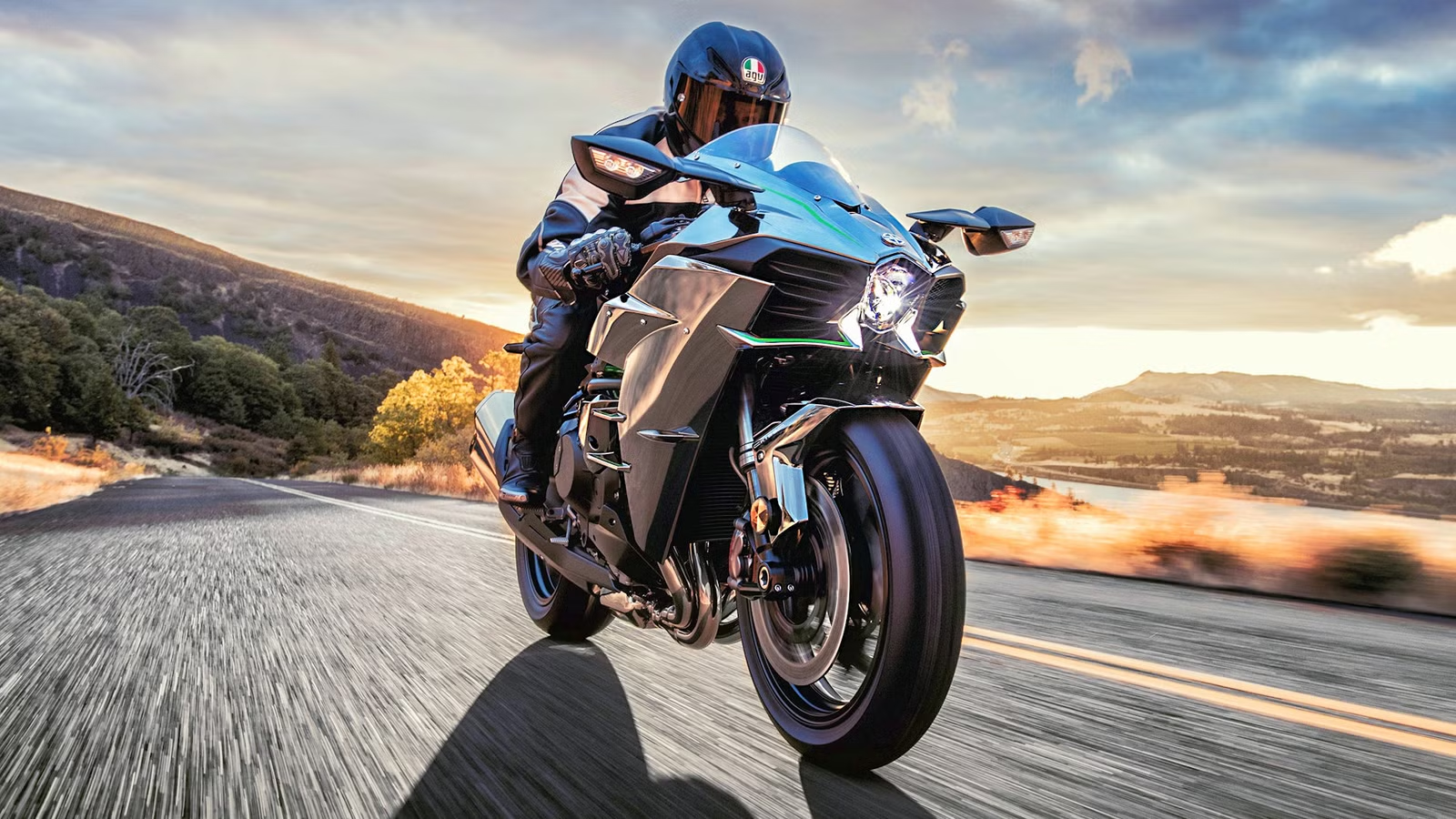
The Ninja H2 picks up where the ZX-14R leaves off. This is the current-day Kawasaki hyperbike. It has been on sale for a decade now, and it still remains the fastest superbike and the only production motorcycle with forced induction. The supercharger gives it a unique flavor, and it allows the 998 cc inline-four engine to generate 240 horsepower and 104.9 pound-feet of torque. Of course, this being a flagship, it goes without saying that Kawasaki has loaded it up with all the technology possible.

In fact, Kawasaki had to involve its aerospace division to use Inconel, an alloy that could stand the heat and pressures required. It also has thrown in relatively ordinary motorcycle technology like top-shelf KYB front forks and Öhlins rear shock, a two-way quickshifter, nine-level traction control, ABS, launch control, a TFT instrument cluster with Bluetooth and navigation, and even self-healing paint. This remains a one-of-a-kind motorcycle, which is why Kawasaki owners always recommend it to others.
Source: Kawasaki USA

Related posts
Latest Post


No Comments