
10 Greatest Multi-Carb Classic Muscle Cars of All Time
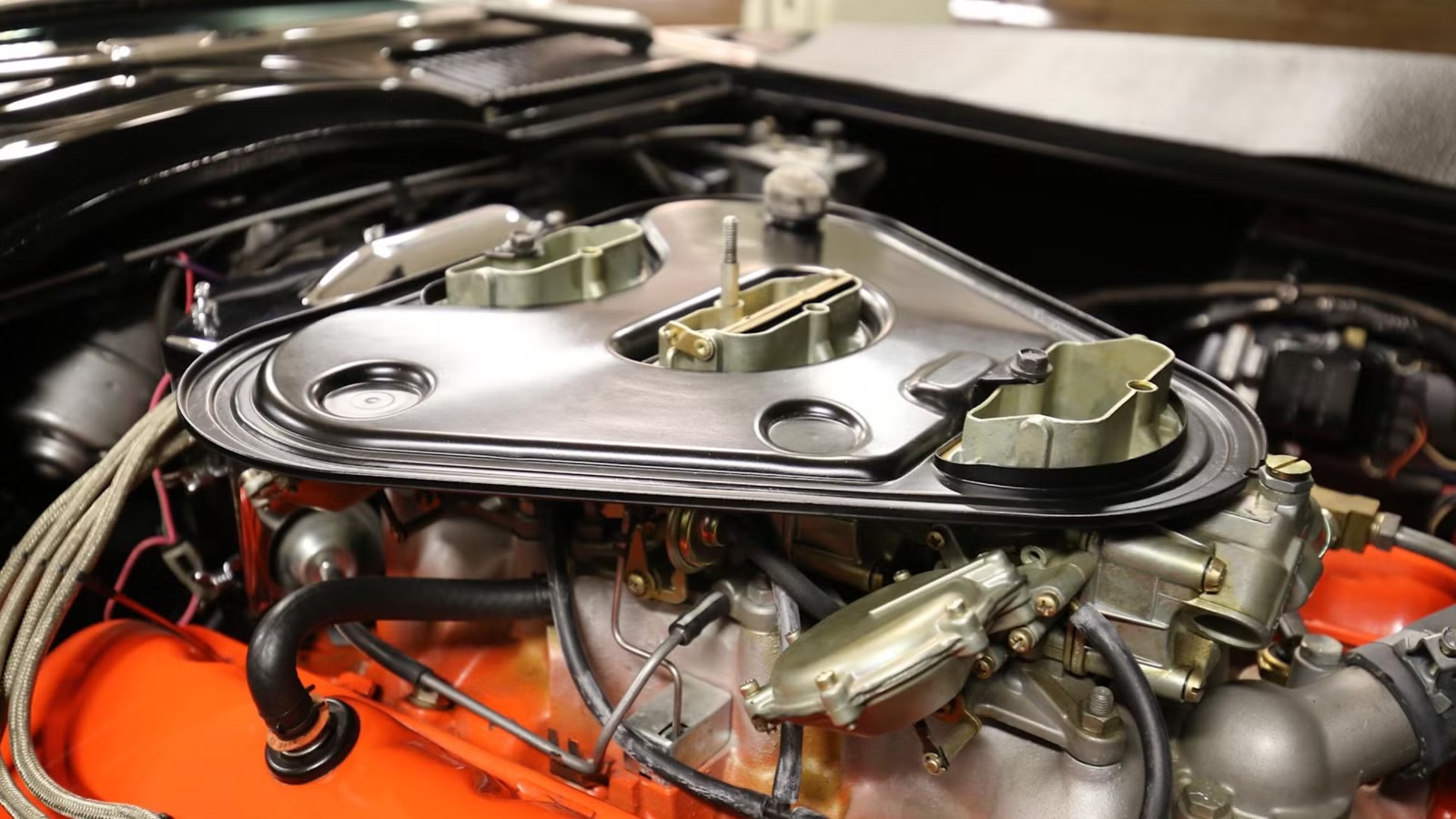
For street performance, the equation is pretty simple: the more fuel and air an engine can consume, the more power it creates. Back in the day, engines were fed by carburetors, not fuel injectors, so the more barrels, the more air flow and gas consumption, which, as we’ve already established, means more power. Some of the most formidable rides of the Golden Age were packing multi-carb engines with 3×2 and dual-quad setups that really got them screaming down the road. For those wondering why nobody made a six or eight-barrel carb, it’s because two and four-barrel carbs already existed and there would have been no power advantage to warrant engineering something bigger. In any case, here are the multi-carb street superstars that made the classic age so memorable.

10
1970 Dodge Challenger T/A
290 HP 340ci Six Pack V-8
The 1970 Dodge Challenger T/A was designed to compete in the SCCA’s Trans-Am racing series and, sadly, wasn’t very good at it. As a street rod, however, it was aces and one of the few small-block Mopars that could hang with the big dogs. With a 340ci Six Pack V-8 that featured three Holley 2300 two-barrel carburetors, it produced 290 hp and 345 lb-ft of torque. Obviously, this was not mind-blowing for the Golden Age of American Muscle, but it was almost certainly underrated, as this car was capable of hitting 0-60 in 5.8 seconds and running a quarter-mile in 14.1 seconds, which was comparable to or better than Ford and GM big-block cars. Grand Spaulding Dodge in Illinois did a dealer build for the 1971 Dodge Demon with a 340 Six Pack that they claimed was 400+ horsepower, so this was a seriously tunable small-block that could embarrass the high-displacement A-Listers of the day.
9
1965 Pontiac GTO
360 HP 389ci Tri-Power V-8

The Pontiac GTO launched the classic muscle car era in 1964, and a good argument can be made that it came about because of then-division head John DeLorean’s annoyance with GM’s infamous big engine ban. In 1963, GM decided that none of its divisions could participate in racing activities and put a cap of 400 cubic inches on engines for intermediate cars. DeLorean decided to drop a 389ci Tri-Power V-8, which was the biggest thing they had that conformed with GM’s silly edict, under the hood of the new Pontiac Tempest, and called it the GTO. By 1965, the 389 was fed by three Rochester 2-barrel carburetors, producing 360 hp and 424 lb-ft of torque. This gave the GTO a 5.8-second 0-60, a 14.4-second quarter-mile ET, and a 120 mph top speed, which was impressive for any non-Mopar that year. For the record, GM amended its pointless big engine ban in 1966 to include no multi-carb engines except for the Corvette, because it apparently wanted to lose the Horsepower Wars.
8
1957 Chrysler 300C
375 HP 392ci FirePower V-8
The 1957 Chrysler 300C was the fastest and most powerful car on the planet at the time and was marketed as such. Its 392ci FirePower V-8, part of the original line of engines with hemispherical combustion chambers, was fed by a pair of Carter AFB four-barrel carburetors. This setup produced 375 hp and 420 lb-ft of torque, which was around twice as much power as almost every other car made that year. The 300C was a massive luxury land yacht, so that unprecedented power didn’t make it a scorcher by today’s standards, but its 8-second 0-60 time and 15.9-second quarter-mile were more than enough to blow the doors off everything in 1957. There was actually a more powerful fuel-injected version of the 392 for the 1958 300D that upped the output to 390 hp, but the system was unreliable, and 15 of the 16 cars equipped with it were recalled and fitted with dual quads.
7
1969 Plymouth Road Runner A12
390 HP 440 Six Barrel V-8
Introduced in 1968, the Plymouth Road Runner was a no-frills street machine anyone could afford, and in 1969 got a budget big-block that delivered Hemi-like performance at half the price. The ’69 Road Runner A12 came equipped with the 440ci Six Pack V-8, which Plymouth called the 6BBL, Six-Barrel, or 440+6. This much cheaper option was fitted with three Holley 2300 two-barrel carbs and was rated at 390 hp and a Hemi-matching 490 lb-ft of torque. Accelerating from 0-60 in 6.0 seconds and ripping the quarter-mile in 13.8 seconds, the Road Runner A12 was competitive with Hemi-equipped cars and outperformed anything Ford or GM had on the streets in ’69. The thing is, a bone-stock A12 actually pulled a 13.1-second ET with professional drag racer Ronnie Cox behind the wheel, and then with some simple modifications, blazed a 12.91-second quarter-mile. Just by throwing on some racing slicks and taking the air cleaner off, the Road Runner A12 became a Hemi-killer.
6
1962 Pontiac Catalina Super Duty
405 HP 421ci SD V-8
The 1962 Pontiac Catalina Super Duty was a factory-built race car, for use in NASCAR and NHRA, but was totally street legal. Its 421ci SD V-8 had Carter AFB 4-barrels, producing 405 hp and 425 lb-ft of torque, but for race applications it was much more powerful. Despite being a boat, the street version of the ’62 Catalina Super Duty could zip from 0-60 in 5.4 seconds and gobble up a quarter-mile in 13.9 seconds. The next year, the “Swiss Cheese” Super Duty was unleashed with holes drilled in the frame to reduce weight, and that car turned in some blazing 12-second ETs. This car, along with the Chevy Impala Z11 factory drag car, is responsible for GM implementing its big engine ban when executives saw the raw power these vehicles were capable of and likely worried about the liability of selling machines like these to the public. GM even sent Pontiac a cease and desist letter with regard to the Super Duty production, which remains amusing six decades later.
5
1962 Dodge Dart 440
420 HP 413ci Max Wedge V-8
The 1962 Dodge Dart 440 equipped with the 413ci Max Wedge V-8 definitely has a claim as the first true American muscle car and the only thing holding it back is that it was kind of a weird-looking ride. Muscle cars are supposed to be aggressive and intimidating, but the Dart 440 had about a dozen styling cues that were peculiar to say the least. When it came to street performance, on the other hand, this car was nothing but ferocious. Featuring dual Carter AFB carbs, the 413 Max Wedge produced 420 hp and 470 lb-ft of torque, giving it a 4.9-second 0-60 time and a blistering 13.4-second quarter-mile. The Beach Boys actually wrote a song called “Shutdown” about the ’62 Dart 413 Max Wedge in which a 327 ‘Vette beats it in a drag race, which is obviously a complete work of fiction.
4
1963 Chevrolet Impala SS
409 HP 425ci V-8
The Beach Boys also wrote a song professing their love for the Chevrolet Impala SS with a 409ci V-8, conveniently enough, titled “409”. That song, however, was for the ’62 Impala, but they should have held off until ’63, when it got the 425 hp, 425 lb-ft dual-quad version of the 409. The ’63 Impala SS was a full-size car that weighed around 4,000 pounds, so the 425 hp had its work cut out for it, but this was still a car that could hit 0-60 in 6.0 seconds and run in the low 14s. Also in ’63, there was the Impala Z11 factory drag car with a dual-quad 427ci V-8 that was rated at 430 hp, but when tuned for the track could turn ETs in the 11s. We chose the 409, because it was a genuine street vehicle and not a track-purpose ride, plus we have an even better multi-carb 427 on this list. Something built for professional racing isn’t quite as remarkable as a raging beast anyone could have bought from their local dealership.
3
1964 Plymouth Sport Fury
425 HP 426ci Max Wedge V-8
The Plymouth Fury holds the distinction of having the most aggressive name of any car ever made. It perfectly captures the fury of a powerful automobile, and even Stephen King recognized this, making a 1958 Fury the killer car in his novel and film adaptation Christine. By 1964, the Plymouth Sport Fury finally lived up to its name when equipped with a 426ci Max Wedge V-8. Boasting twin Carter AFB four-barrel carbs, this engine produced 425 hp and 480 lb-ft of torque, which was nearly as powerful as the 426 Hemi, which was introduced that same year for NASCAR racing. On the street, the ’64 Sport Fury Max Wedge was good for a 5.5-second 0-60 acceleration time and a door-removing 13.3-second quarter-mile. Remember, ’64 was the dawn of the Golden Age of American Muscle, where GTOs and Chevelles were running in the 14s or 15s, while the Plymouth Sport Fury was already establishing the 13-second car as the standard.
2
1968 Dodge Charger Hemi R/T
425 HP 426ci Hemi V-8
In 1968, Dodge effectively defined the entire Golden Age of American Muscle with the release of the second-gen Charger, which was the defining vehicle of the era. With sexy Coke bottle curves and a bold stance, there literally is no other car that looks as good from any angle. It also had access to the 426ci Hemi V-8, which was the defining engine of the classic age, so putting these two together created the ultimate classic muscle car. Fed by a pair of Carter AFB four-barrel carburetors, the 426 Hemi was rated at 425 hp and 490 lb-ft of torque, but it was almost certainly underrated, with most enthusiasts estimating it was closer to 450+ hp. Turning in a 5.3-second 0-60 time and a 13.5-second quarter-mile straight from the factory, the ’68 Charger Hemi R/T was the car to beat on the streets, but nothing Ford or GM had to offer could come close. They also lacked the charisma of the second-gen Charger which has gone on to become the biggest movie star car in Hollywood.
1
1967 Chevrolet Corvette L71
435 HP 427ci Tri-Power V-8
A lot of people try to lump the Chevrolet Corvette in with the muscle cars, but it has always been a two-seater, making it a sports car. Semantics aside, the ‘Vette was undeniably a street machine that infuriated muscle car owners to no end, especially in 1967. Chevy sent the C2 out in style with the ’67 Corvette L71, which was equipped with a 427ci Tri-Power V-8 fed by three Holley two-barrel carbs. This 3×2 setup produced an era-best 435 hp and 460 lb-ft of torque. Its 4.7-second 0-60 time and 13.3-second quarter-mile could not be matched by any other car in 1967. The next best competitors were the ’67 Dodge Charger Hemi and Plymouth Hemi GTX, both of which ran several tenths of a second slower. The Corvette would lose its street dominance in the C3 generation that began in 1968 to Hemi-powered Mopars that could run in the low 13s and high 12s, but in 1967 the L71 was untouchable.
Sources: Chrysler, Ford, GM

Related posts

Latest Post


No Comments