
The Performance Car Built Right Before Everything Changed
By late 1970, the American performance car was running out of road. Insurance companies had started attaching heavy surcharges to anything with a big engine and a young driver, federal emissions rules were tightening with every model year, and automakers across Detroit were quietly cutting compression ratios ahead of the switch to unleaded fuel. The muscle car era was not coming to an end with a bang, so much as a series of memos.

One automaker built a final, uncompromised performance car anyway, releasing it midway through the model year and killing it within twelve months. Fewer than 2,000 were made, and in period testing it outran its big-block sibling.
Why 1971 Was The Last Real Year Of American Muscle
The pressure on performance cars came from every direction at once. Environmental regulators wanted cleaner exhaust, insurers wanted fewer claims, and both forces pushed automakers toward lower compression, milder camshafts, and smaller carburetors. The 426 Hemi, the most famous engine of the muscle car era, was already gone from the options sheet.

The 1972 model year made the retreat official in two ways. Federal rules required lowered compression so engines could run on unleaded fuel, which stripped away the high-octane tunes that had defined the previous decade. At the same time, the industry switched from gross horsepower ratings, measured with a bare engine on a stand, to net ratings measured with the alternator, air cleaner, mufflers, and other equipment installed.
The net system produced lower but far more honest numbers, and the timing could not have been worse for showroom bragging rights. A car rated at well over 300 hp in 1971 could return in 1972 with a figure that looked like a misprint, even when the hardware underneath had barely changed. Buyers reading the brochures saw performance collapsing on paper before it fully collapsed in the metal.
That left 1971 as the last season an automaker could build a performance car without apology, and one company did exactly that.
The Rarest Ford Small Block Muscle Car Ever Produced
Big block Fords are typically the rarer breed, but we found what we believe to be the most elusive of the small blocks.
The 1971 Ford Mustang Boss 351 Arrived Late And Left Early

|
Engine |
Transmission |
Power |
Torque |
|
5.8-liter V8 |
4-speed manual |
330 hp |
370 lb-ft |
Ford introduced the 1971 Mustang Boss 351, a machine that almost did not exist at all. Ford had slashed its racing budget from $12 million to $2 million for 1970, and in November of that year it announced a full withdrawal from motorsports. Kar Kraft, the company’s private racing contractor, was shut down so abruptly that the locks on the doors were changed.
The Boss 351 was born inside that retreat. Development did not begin until June 1970, and while the rest of the 1971 Mustang line met the press on August 20, 1970, the Boss 351 did not reach dealers until the first week of November. Unlike the Boss 302 before it, which existed to homologate a 5.0-liter engine for Trans-Am racing, the Boss 351 carried no racing mandate of any kind.

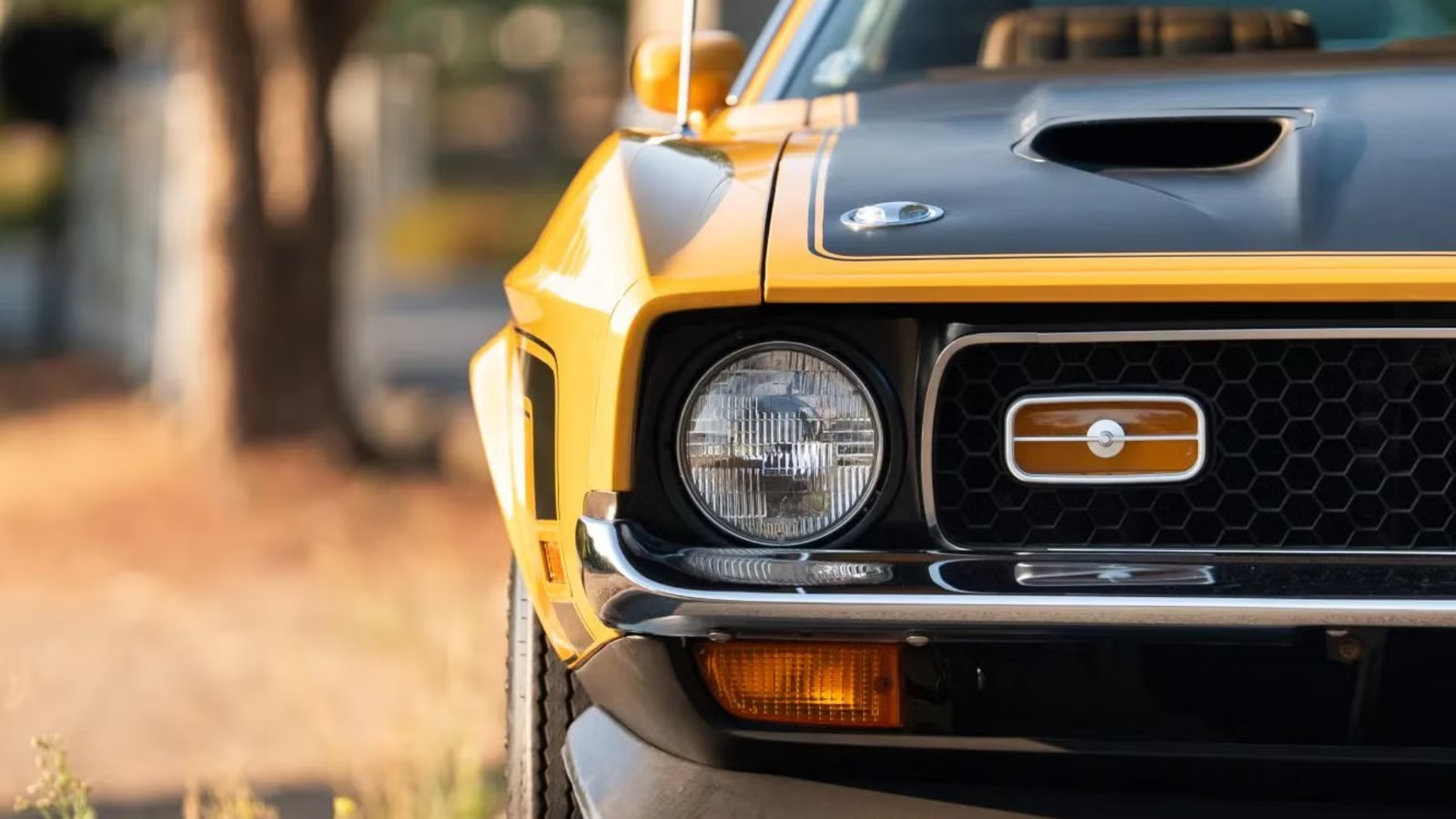
What it carried instead was performance, and plenty of it. Priced at approximately $4,120, the Boss 351 wore special graphics, a flat-black hood, and styling that leaned heavily on the Mach 1, yet it went on to become one of the fastest Mustangs of its day. It was also one of the rarest, with just 1,806 cars built before Ford ended production.
The Boss name then disappeared from the Mustang lineup entirely, and it stayed gone until 2012. The car built right before everything changed turned out to be a one-year proposition in every sense.
The Rarest Ford Small Block Muscle Car Ever Produced
Big block Fords are typically the rarer breed, but we found what we believe to be the most elusive of the small blocks.
The Boss 351’s Solid-Lifter Cleveland Embarrassed Ford’s Own Big-Block

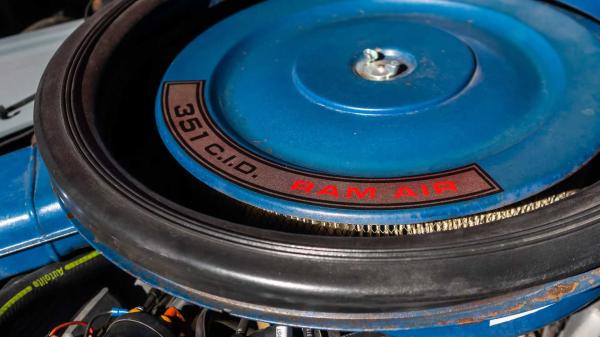
The R-code 351 Cleveland under the hood read like a hot rodder’s wish list. Ford fitted four-bolt main bearing caps, forged pistons, shot-peened connecting rods, a high-lift camshaft, an aluminum intake topped by a 750-cfm carburetor, dual-point ignition, and functional ram air. The result was 330 hp at 5,400 rpm and 370 lb-ft of torque at 4,000 rpm.
The number that mattered most, though, was the factory-advertised 11.7:1 compression ratio. In a year when nearly every rival had already detuned for the coming switch to unleaded fuel, Ford shipped a solid-lifter engine that demanded premium and made no excuses for it. The rest of the package matched the engine, with a four-speed manual and Hurst shifter, a 3.91:1 Traction-Lok 9-inch rear end, competition suspension, and power front disc brakes.

The proof came when Motor Trend lined the Boss 351 up against its own big-block siblings. On paper, the 429 Cobra Jet Mach 1 held every advantage with 370 hp and 450 lb-ft of torque, yet the Boss 351 beat it in every metric. The smaller car reached 60 mph in 5.8 seconds against 6.5, and ran the quarter mile in 13.8 seconds at 104 mph while the 429 needed 14.61 seconds at 96 mph.
Car and Driver reached a similar verdict, judging the Boss quicker than supercars carrying an extra 100 cubic inches of displacement. The magazine praised the engine while calling the ride punishing, thanks to very stiff competition springs, and period critics also knocked the poor outward visibility. Nobody, however, questioned the speed.
One Model Year Later, The Same Engine Lost 55 HP

For 1972, the R-code engine survived in name only, rebadged as the 351 HO. The changes were internal detuning rather than add-on equipment, with flat-top pistons replacing the forged domed units, open-chamber heads in place of the closed-chamber design, reduced camshaft duration, and compression cut to 9.2:1. The Ram Air option disappeared from the order sheet entirely.
The paired numbers tell the story better than any adjective could. Output fell from 330 hp to 275 hp under the new net rating system, while compression dropped from 11.7:1 to 9.2:1. The 351 HO ran the quarter mile in 15.1 seconds at 95.6 mph, against the 13.8 seconds at 104 mph the Boss had posted a year earlier.
Even the production figures chart the decline. Ford built 1,806 Boss 351s in 1971, then just 398 Mustangs with the 351 HO in 1972, every one of them a four-speed car. The Boss 351 and the 429 Cobra Jet both vanished from the 1972 lineup, leaving the Mach 1 to carry the performance banner, and the smaller, slower Mustang II arrived soon after. The window had closed in a single model year.
Here’s How Much A 1969 Mustang Boss 302 Is Worth Today
The 1969 Ford Mustang Boss 302 is an iconic muscle car from a bygone era, but it’s still not out of reach.
Why The Boss 351 Outsells Its Big-Block Sibling At Auction

The collector market has spent five decades confirming what those 1971 road tests found. Over the last 12 months, Boss 351 sales have averaged $73,692, with the strongest result in that window reaching $108,500. The most recent notable sale came at Mecum Indy in May 2026, where a Boss 351 sold for $72,600.
Recent Bring a Trailer sales show the same strength. A Bright Blue Metallic SportsRoof with 90,000 miles sold in April 2025, while a 16,000-mile Medium Yellow Gold example, one of just nine built in that specification, sold in September 2025 at a price $108,500 – in the top 20% of all recorded Boss 351 results.

Rarity does part of the work, since the scarcest production colors, Grabber Lime and Medium Green, account for just 67 cars each. But the deeper driver is the comparison that started it all, because Boss 351s consistently sell for thousands more than 429 Cobra Jet Mach 1s. The Boss 351 was never the fastest muscle car ever built, but it was the last one Ford built without compromise, and the market has never stopped paying for that.
Sources: Ford, Classic, Hagerty, Mecum, Bring A Trailer, MotorTrend

Related posts


Latest Post


No Comments