
Pontiac’s Last Sports Car Is Still a Bargain at Auction
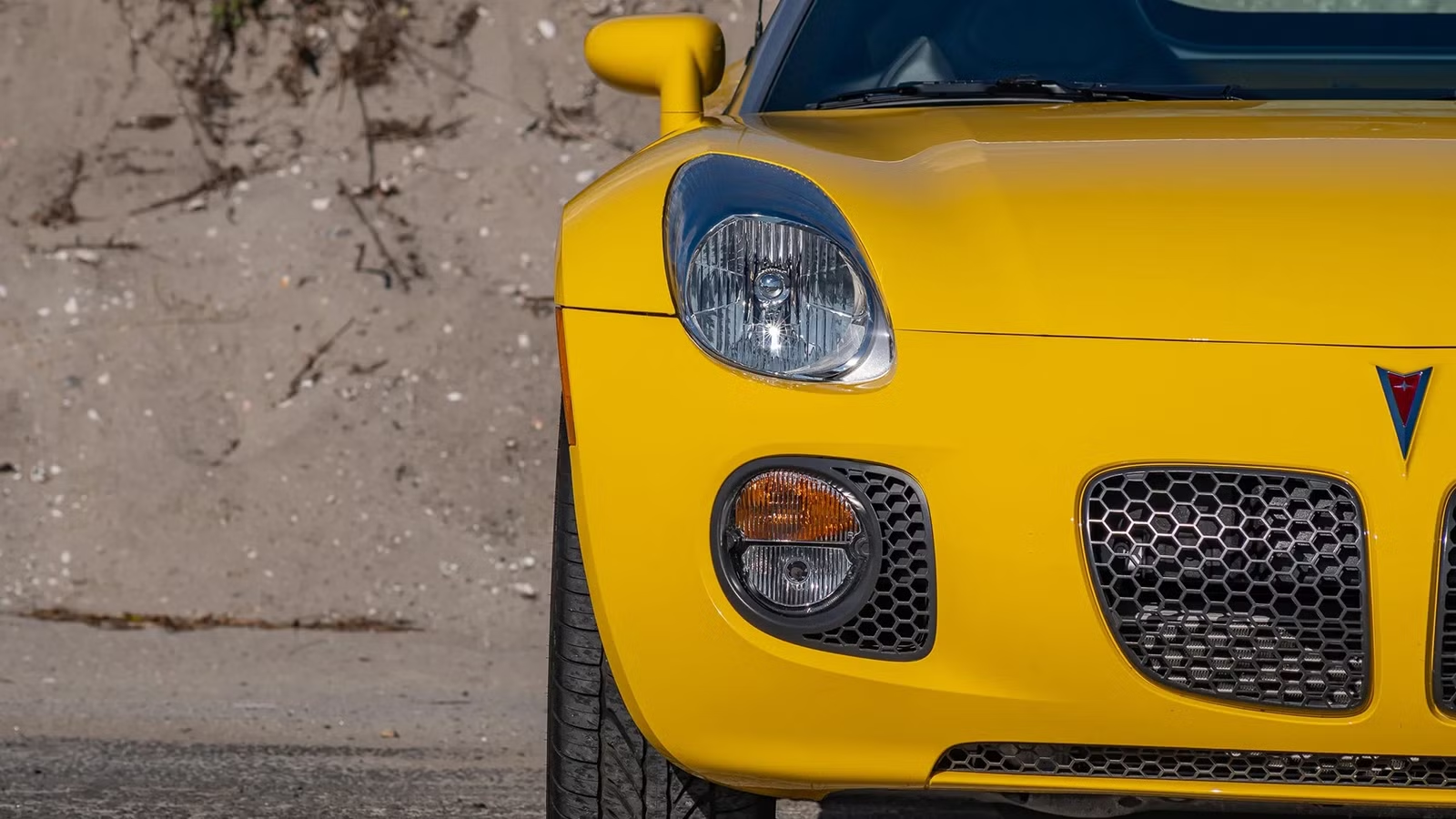
Pontiac‘s final chapter in automotive history was not a victory lap. When General Motors shut down the brand in 2010, enthusiasts experienced the end of an era that gave birth to iconic muscle nameplates like the GTO and Trans Am. Yet in Pontiac’s twilight years, the brand produced a driver-focused roadster, something different from what it was traditionally known for. Today, as the classic icons move out of reach for the average buyer, this two-seater sits in a rare sweet spot for value and performance, with automatic models going for around $18,000 to $20,000 at auction.
The RWD Architecture Built To Fight Import Roadsters

By the mid-2000s, domestic muscle cars had become heavier and lost their dynamic ability; they had strayed from being lightweight cars, and the aim shifted to adding more power to go faster. As a result, these cars became increasingly single-focused, prioritizing straight-line speed and quarter-mile times over twisty back-road driving. Beyond cars like the Chevrolet Corvette, the domestic market had largely abandoned the roadster format.
General Motors executive Bob Lutz concluded that change was needed and envisioned building a lightweight, fun-to-drive roadster from scratch. The aim was simple but difficult to execute properly: build a dedicated, athletic rear-wheel-drive architecture to compete with foreign rivals. The result was the Kappa platform, featuring hydroformed steel frame rails and a rigid center-tunnel structure designed to maximize torsional stiffness without adding unnecessary bulk. At the same time, to manage weight, engineers placed the engine far back behind the front axle line to achieve near 50/50 weight distribution, pairing it with double-wishbone forged aluminum control arms at all four corners and a wide track.
The Solstice GXP: A Sporty Masterpiece In Pontiac’s Twilight Years


The platform peaked when Pontiac launched the Solstice GXP Coupe for the 2009 model year. It was instantly recognizable with its double-bubble removable targa roof structure and sweeping fastback lines. Underneath the hood, the GXP Coupe had serious mechanical firepower for its size and purpose. Under the clamshell was GM’s 2.0-liter LNF turbocharged, direct-injection Ecotec inline-four, producing 260 horsepower and 260 lb-ft of torque.
At the same time, GM was facing financial troubles and was on the verge of bankruptcy, which led to the closure of the Wilmington Assembly plant where the GXP Coupe was built, resulting in a very short run and limited production. The production numbers for hardtop examples remain debated among enthusiasts; a period publication states total production at 1,277, while CarBuzz lists 1,266 units, and Hagerty marketplace data puts total production at 1,025 units. Within those totals, just under 300 manual examples were sold, making it one of the rarest cars to find on the market today.
Solstice GXP vs. Mazda MX-5 Miata

Against its primary benchmark and rival, the third-generation Mazda MX-5 Miata, the Solstice GXP took a different mechanical approach to achieve lightweight performance. The Miata relied on a naturally aspirated 2.0-liter engine that produced 166 to 170 horsepower and did 0 to 60 mph in the mid-6-second range. On the other hand, the GXP’s turbocharged engine produced almost 100 more horsepower and completed 0 to 60 mph in just 5.2 seconds, almost a full second faster from a stop. At the same time, the GXP Coupe offered better real-world drivability, with its stronger mid-range punch helping it exit corners faster.
That said, the Mazda had an ultra-low curb weight of around 2,450 to 2,500 pounds, while the Solstice GXP was a bit heavier at roughly 2,976 pounds. However, Pontiac offset that weight penalty with a wider stance, 18×8-inch aluminum wheels wrapped in 245/45R18 performance rubber, and a standard torque-sensing limited-slip differential. This kept the roadster planted in high-speed corners and maintained dynamic stability on winding back roads.
The 2.0 Turbo With A Five-Speed Auto

Behind the wheel of the GXP Coupe, the turbocharged LNF engine and GM’s 5L40-E five-speed automatic challenged the traditional sports car driving experience. Normally, in a low-torque, naturally aspirated roadster, an automatic transmission can feel dull because of the lack of torque and can often lead to underwhelming acceleration. In the GXP, however, peak torque arrived low in the rev range at just 2,500 RPM.
Out on a winding back road, the five-speed automatic could use that torque curve, hold gears through mid-corner transitions, and let boost build smoothly on exit. It did not require constant downshifts to find momentum. A squeeze on the pedal unleashed instant turbocharged performance. This drivability is one reason clean five-speed automatic models offer a sweet spot in real-world everyday driving and performance at an affordable price of $18,000 to $20,000, all while delivering back-road speeds without the financial premium attached to three-pedal cars.
Why Pontiac’s Final Sports Car Hits The Sweet Spot

The Solstice GXP offered an analog driving experience that is becoming harder to replicate at its price. While clean automatic roadsters remain accessible under $20,000, pristine manual coupes have a much higher price ceiling and can sell for as much as $60,000 at auction for a well-kept, low-mileage example.
Buyers who want maximum performance can look at the factory-sanctioned GMPP Stage 1 Turbo Upgrade with 290 hp and up to 340 lb-ft of torque, or 325 lb-ft for the automatic; the upgrade can be verified by checking for physical Bosch 3-bar MAP sensors on the intake piping, the GM Performance Parts gas door sticker, and dealer VIN records for the ECU reflash.
Lastly, owning a roadster also means accepting some practical trade-offs and requires performing a few pre-purchase checks. The usable cargo space drops from 5.6 cubic feet down to roughly 2.1 cubic feet with the soft top stowed. You should also inspect the rear differential casing for seal leaks, test the top latches, and confirm service records for the direct-injection LNF engine’s high-pressure fuel pump. With these few minor issues out of the way, at current auction values, an automatic GXP remains an unbeatable modern classic bargain that delivers real turbocharged performance in a rare, lightweight RWD package.
Source: Bring A Trailer, Hemmings, Hagerty

Related posts



Latest Post


No Comments