
Yamaha’s Best All-Round Motorcycle Deserves More Credit
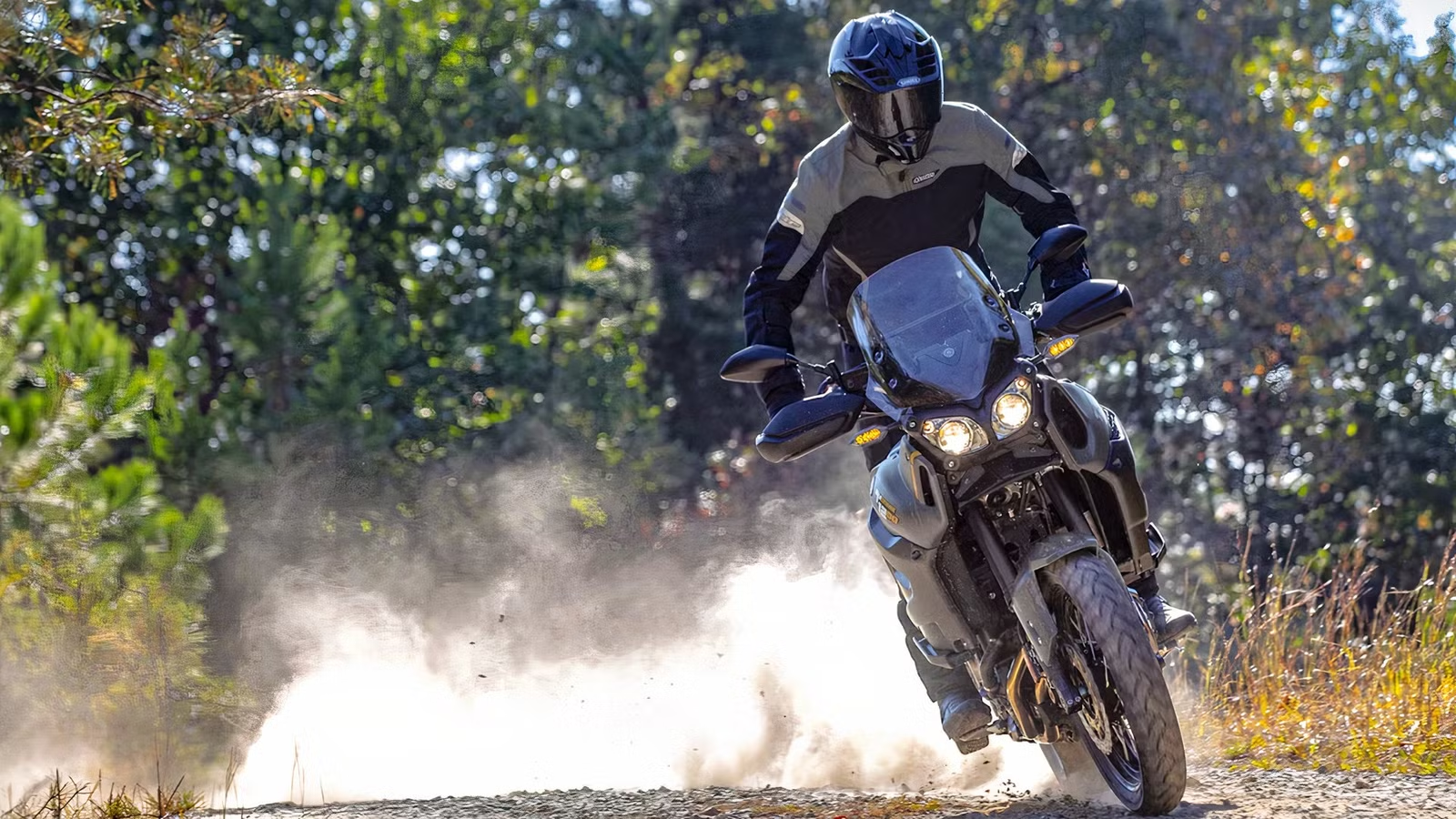
Yamaha’s Greatest Hits Make This One Easy To Overlook

Yamaha has no shortage of motorcycles that have earned cult status. The Tenere 700 became a benchmark for middleweight adventure bikes by keeping things relatively simple, light, and genuinely capable away from pavement. Then there’s the MT lineup, which helped redefine Yamaha’s street-bike identity with torquey engines, aggressive pricing, and machines like the MT-07 and MT-09 that deliver a huge amount of personality without demanding superbike money.

That success may actually explain why one of Yamaha’s most complete motorcycles gets overlooked. The T7 owns the off-road conversation, while the MT range dominates the brand’s fun-per-dollar reputation, leaving less attention for a heavier, more mature machine built around touring, comfort, and long-term practicality. Yet for riders who want one motorcycle to commute, travel, carry luggage, take a passenger, and still wander down a dirt road, Yamaha already built something that arguably combines more of those strengths in one package.
Also, Adventure Bike Arms Race Left Some Great Motorcycles Behind

There’s also another factor. Today’s flagship adventure motorcycles routinely make superbike-adjacent power while packing radar cruise control, semi-active suspension, massive TFT displays, and elaborate electronic rider aids. They’re impressive machines that inevitably make less-equipped ADVs seem unimpressive. Thus, some high-quality machines are overlooked all the time.

But riders who mainly commute, tour, carry a passenger, and occasionally head down an unpaved road don’t necessarily need all of that. A simpler motorcycle that handles those jobs well can be far easier to live with over thousands of miles. That becomes especially relevant when shopping used. Depreciation can turn yesterday’s premium adventure-tourer into a surprisingly affordable motorcycle, while established mechanical hardware can make long-term ownership less intimidating. The Yamaha in context does exactly that.
The Yamaha Super Tenere 1200 Is The Bike Everyone Seems To Forget

That description fits the Yamaha Super Ténéré ES almost perfectly. The final U.S.-market version was the 2024 model, which carried an MSRP of $16,299 when new. Yamaha still lists that model in its archive with the same fundamental package the Super Tenere had refined over years of production: a big parallel-twin engine, shaft drive, electronic suspension, cruise control, spoked wheels, and a distinctly old-school emphasis on durability.
More importantly, depreciation has made the Super Tenere much more interesting. Current U.S. dealer listings show used examples with roughly 15,000 to 17,000 miles around the $9,000 to $10,000 mark. That puts a relatively recent, electronically advanced liter-class adventure-tourer into territory occupied by much smaller new motorcycles.
Its Engine Was Built For Miles, Not Headlines

Power comes from a 1,199cc liquid-cooled DOHC parallel-twin with four valves per cylinder, a 98.0mm bore, 79.5mm stroke, and 11.0:1 compression ratio. The 270-degree crank gives it an uneven firing character closer to a V-twin than a conventional parallel twin, while fuel injection and throttle-by-wire manage delivery. Depending on spec and model-year, output sits at roughly 112 horsepower and 86 pound-feet of torque.
Real-World Touring Remains The Forte

The Super Tenere’s chassis reveals where Yamaha spent its priorities. Up front is a 43mm inverted fork with electronically adjustable compression and rebound damping, while the rear monoshock offers electronic preload and rebound adjustment. Both ends provide 7.5 inches of travel. The suspension system includes four preload configurations, three primary damping settings, and additional fine adjustment, making it easy to compensate for luggage or a passenger without reaching for tools.
That adjustability matters because this is a substantial motorcycle. Yamaha quotes a 584-pound wet weight, a 60.6-inch wheelbase, and an adjustable seat measuring either 33.3 or 34.3 inches high. The riding position is upright, the windshield can be adjusted through 2.3 inches without tools, and a centerstand comes standard. Add cruise control, hand guards, a 6.1-gallon tank, and factory-rated fuel economy of 43 mpg, and the Super Tenere starts looking more like a two-wheeled long-distance appliance in the best possible sense.
It Can Still Perform Off-Road

The Super Tenere isn’t a giant dirt bike, and its weight makes that obvious the moment terrain gets technical. Its wheel setup reflects a more balanced mission, with a 19-inch front wearing a 110/80R19 tire and a 17-inch rear wearing a 150/70R17. Both are mounted to spoked wheels, giving the Yamaha enough rough-road credibility for gravel, fire roads, and mild trail work without compromising its highway manners.
Braking comes from twin 310mm front discs and a 282mm rear disc with ABS and linked braking. Interestingly, applying the rear brake first allows the rider to operate the brakes separately, which is useful when standing on the pegs or managing loose surfaces. The steel chassis also suits the bike’s utilitarian character. It isn’t trying to shave every possible pound, but rather provide predictable behavior while absorbing the abuse associated with loaded touring and imperfect roads.
Buying Used Makes More Sense Than Chasing The Latest ADV

The strongest argument for the Super Tenere may be how little its age matters in normal use. Cruise control, electronic suspension, selectable throttle response, traction control, ABS, adjustable ergonomics, tubeless-capable road-biased adventure wheels, and shaft drive cover nearly everything most riders actually use. You don’t get a modern TFT dashboard, an inertial measurement unit, radar systems, or a quick shifter, but none of those omissions prevent it from crossing states comfortably.
Its long production run also means the platform is thoroughly understood. Yamaha specifies valve-clearance inspections every 26,600 miles on later US models, which is a reassuringly long interval for riders planning serious mileage. On any used example, service history matters more than odometer anxiety. Buyers should verify that fluids, brakes, suspension components, the shaft drive, and major scheduled maintenance have been attended to rather than assuming a low-mileage motorcycle automatically needs nothing.
The Super Tenere Might Be The Most Versatile Yamaha You Can Take Home
Calling any one motorcycle the perfect all-rounder is difficult because versatility always involves compromise. The Super Tenere isn’t especially light, especially powerful, or especially sophisticated by current standards. What it does instead is cover an unusually broad spectrum. It can commute during the week, carry two people across the country, tackle bad pavement and dirt roads, and still provide enough performance to make a mountain road entertaining.
That combination is easier to appreciate now than it was when the bike sat in showrooms for more than $16,000. At roughly four figures to low five figures on today’s used market, the Super Tenere becomes less about competing with the newest adventure motorcycles and more about how much motorcycle you’re actually getting for the money. It’s comfortable, durable, powerful enough, easy to tour on, and built around one of the lowest-maintenance drivetrains in the segment.

Yamaha has produced faster motorcycles, lighter motorcycles, and far more glamorous ones. Yet if the job is simply to own one bike that can handle almost anything a street rider realistically asks of it, a used Super Tenere 1200 remains remarkably difficult to dismiss. It may have spent most of its life standing in the shadow of newer and flashier rivals, but depreciation has arguably made its original formula more compelling than ever.
Source: Yamaha Motorsports

Related posts


Latest Post


No Comments