
Why Toyota Put A Gazoo Racing Badge On Its Best-Selling Family SUV
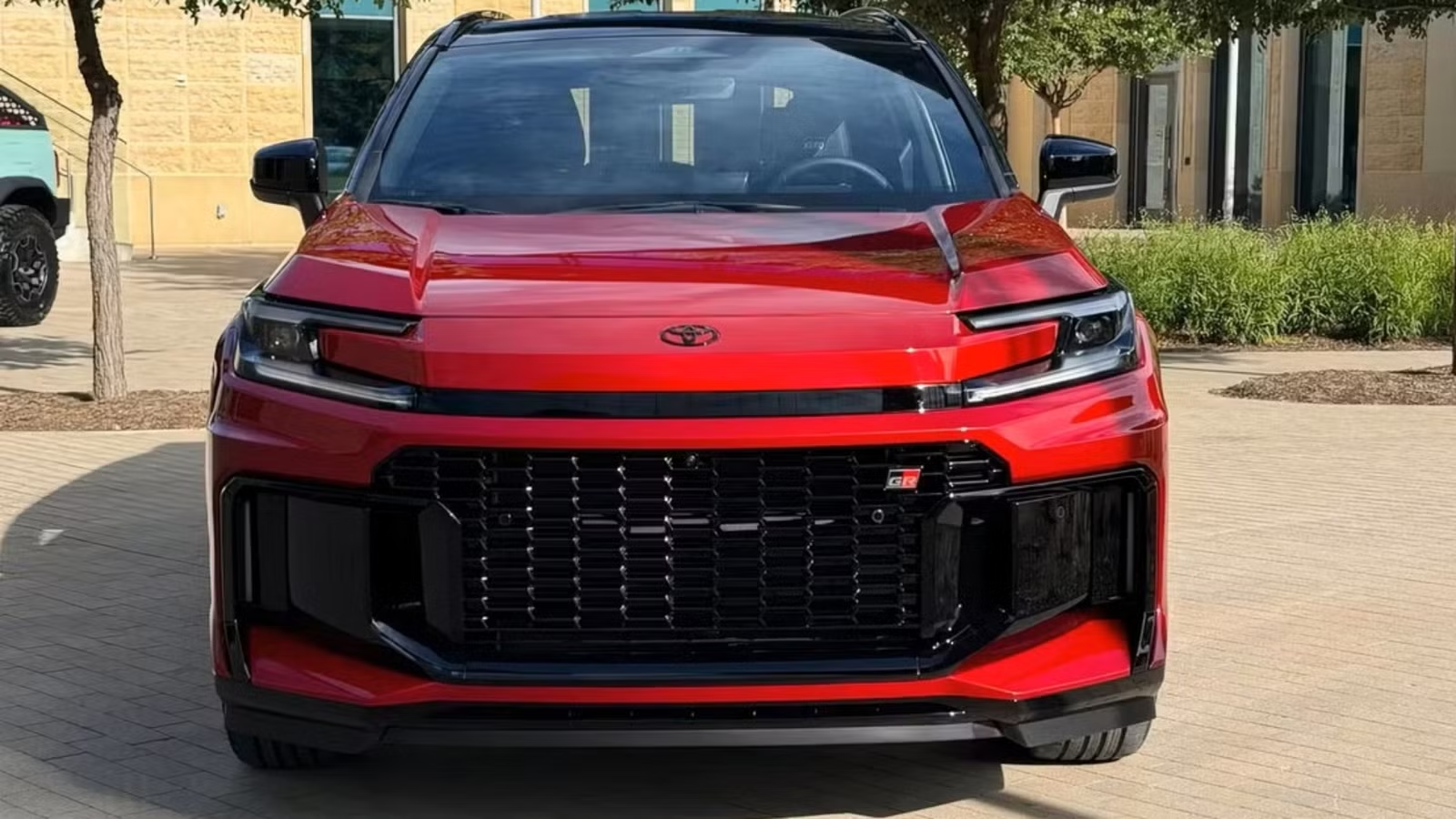
When a performance badge appears on an everyday family vehicle, enthusiasts usually react with equal parts excitement and skepticism. Some see meaningful engineering, while others see clever marketing dressed up in sporty trim. Toyota’s latest move blurs that line more than ever, pairing genuine chassis upgrades with a handful of surprising compromises. The result is a crossover that promises more than sharper styling; it challenges long-held expectations about what the Gazoo Racing name should represent, and whether expanding the brand strengthens its reputation or stretches it too far.
Toyota May Be Redefining What GR Sport Actually Means
GR Sport Has Never Meant The Same Thing As GR

For Americans, the GR Sport name is brand-new, though it has been around since 2017. It was used for several models, including the Harrier GR Sport, Prius PHV GR Sport, Aqua GR Sport, and Hilux GR Sport, among others. The GR Sport name has never meant the same thing as GR, as covered previously. There’s even a GRMN moniker reserved for the most extreme Gazoo Racing products.
Similar to the differentiations between BMW’s M Sport and M products, Audi’s S Line and RS models, and Hyundai’s N Line and N models, Toyota has GR Sport and GR models. This means it’s truly unfair to judge a GR Sport trim as if it were the same as a GR Corolla; the two are not meant to attract the same buyers.
Can It Really Tempt Buyers Away From Luxury Brands?

Buyers looking for luxury branding and trimmings aren’t likely to switch to a Toyota GR Sport model. You won’t find plush, soft surfaces in the Toyota, unlike those offered in BMW and Audi models. It’s still a Toyota, which means value-oriented and packaged as such with some hard plastics on the dashboard and doors, but the GR Sport has unique contrast stitching and high-end upholstery compared to lower, standard trims.

It isn’t likely to target luxury buyers, but it may appeal to shoppers looking at high-end trims of competing SUVs like the Mazda CX-50 Turbo, Honda CR-V Sport Touring, Hyundai Tucson PHEV, and Kia Sportage PHEV. Considering Toyota’s positioning of better steering and handling, this GR Sport model could be the most enjoyable to drive in this group.
Toyota Didn’t Put A GR Badge On The RAV4 By Accident
Why Toyota Needed A Performance Halo For Its Best-Selling SUV

The Toyota RAV4 is the brand’s highest-volume global vehicle, making it the ideal place to introduce something new to the market. Nearly every automaker offers a sporty appearance or performance-oriented package; BMW has M Sport, Audi has S Line, and Hyundai has N Line, to name a few. Toyota has been developing Gazoo Racing trims for various models, including the Yaris (not sold in America) and the Corolla, to complement the already performance-oriented GR86 and GR Supra sports cars.
The RAV4 GR Sport takes a different path, following a smart Toyota strategy. It offers an excellent way to introduce more buyers to the GR Sport lineup while adding an alternative to the traditional top trims. The GR Sport name isn’t intended to replace the performance-oriented GR models, but to bring sportiness to more traditional family vehicles. This raises the question: “Did Toyota legitimately expand the GR philosophy, or simply leverage the badge’s reputation?”
The 2026 RAV4 Is Much More Than A Routine Redesign

The 2026 Toyota RAV4 marks an entirely new generation and takes a turn toward the future with a hybrid-only lineup. This follows along the same path as the Camry, which did the same in 2025. Toyota also created a new front-end design language across the lineup. The three front-end styles are called Core, Rugged, and Sport, but you may find some publications using another term in place of the Sport style. Regardless, they are one and the same.
Most RAV4 trims are powered by the standard hybrid system. It is a traditional system comprised of a 2.5-liter four-cylinder engine and either two or three electric motors. The FWD models have two motors and produce 226 horsepower combined, while the AWD models have three motors and produce 236 horsepower combined. This power is sent to the wheels through an eCVT. The LE trim is rated to tow 1,750 pounds, but other trims can tow up to 3,500 pounds.

There’s also a plug-in hybrid powertrain, which pairs a 2.5-liter four-cylinder engine with three electric motors and a 22.7-kWh battery pack, offering up 48 to 52 miles of electric driving depending on the trim. This system produces 324 horsepower combined, making it the most powerful powertrain offered in a RAV4. This PHEV powertrain comes exclusively with an AWD setup and is the only system offered for the RAV4 GR Sport. This PHEV powertrain matches the regular hybrid’s towing capacity of up to 3,500 pounds.
The Hardware Shows Toyota Took The GR Sport Badge Seriously
This Isn’t Just A Body Kit—Toyota Actually Reworked The Chassis

Gazoo Racing reworked the RAV4 to make the GR Sport model more fun to drive. The greatest improvements are in steering and handling, thanks to these changes. The GR team added specific suspension calibrations, firmer springs and dampers, a 0.6-inch lowered ride height, a reinforced rear suspension crossmember, improved steering calibration, functional brake cooling, a functional rear wing, a front aerodynamics package, and 20-inch wheels with performance summer tires.
These changes might not make the GR Sport model faster in a straight line than the three other trims available with the PHEV powertrain (SE, XSE, Woodland), but they certainly improve handling, making the RAV4 GR Sport more fun to drive. The trim-specific performance calibrations could make driving on a winding mountain road more fun.
The New Plug-In Hybrid Makes The Fastest RAV4 Yet

The 324 horsepower from the PHEV powertrain is the combined output of the engine and three electric motors. The previous-generation RAV4 Prime, with its plug-in hybrid system, was rated at 302 horsepower, making the new generation even more powerful. The use of electric torque in this system allows it to jump off the line much faster than the traditional hybrid model or a gas-powered version from the previous generation. The PHEV system allows the RAV4 to rocket to 60 MPH in only 5.6 seconds, which is impressive for a compact family-oriented SUV. By comparison, the regular hybrid in its AWD form takes 7.1 seconds to complete the same sprint.
The Biggest Compromises Aren’t Hidden—They’re Built Into The Package
The eCVT Keeps The GR Sport From Feeling Like A True Performance SUV

The 2026 Toyota RAV4 GR Sport uses an eCVT, which could make some drivers less than enthusiastic about the SUV being a real GR model. Much like BMW, Toyota has taken to giving its GR-badged vehicles different levels of sportiness and performance. BMW has its M Sport models, which aren’t fully “M” variants with all the power and features, but are more than the standard models. The same goes for Toyota’s GR Sport name, which isn’t a full “GR” model, but adds better steering and suspension features without power and performance upgrades.
The eCVT isn’t the same as a traditional CVT, but it works similarly, and does a fine job of helping the RAV4 PHEV get off the line. An eCVT adds an electric motor and planetary gears to improve efficiency and performance, but if you expect the GR Sport to be significantly more powerful or sporty than other trims with the PHEV powertrain, you may be disappointed. The RAV4 GR Sport isn’t meant to give you the same driving character as a GR Corolla or GR86, but is meant to introduce drivers to a more enjoyable driving experience in a compact SUV.
The Missing Fast Charger May Be The Most Confusing Decision Toyota Made

Other trims equipped with the PHEV powertrain include DC fast charging. The Woodland and XSE models have this feature and can charge the battery pack from 10 to 80 percent in approximately 30 minutes. Strangely, the GR Sport does not include this feature. Instead, you have to use either Level 1 or Level 2 charging only. The Level 2 charger can replenish the batteries in 3.5 hours, which is fine for at-home charging, but the omission of DC fast charging seems odd.
Toyota has not publicly explained why the GR Sport doesn’t have fast charging. It could be a cost issue, a packaging challenge, a way to differentiate the GR Sport from other models, or based on expected customer usage. Still, this seems like a troubling omission considering the flagship positioning of the GR Sport trim.
Did Toyota Strengthen The GR Brand Or Stretch It Too Far?
Even Toyota’s Reliability Story Isn’t Completely Perfect

Currently, there aren’t any major recalls, NHTSA investigations, warranty extensions, or widespread reliability concerns impacting the new GR Sport. There is a very small seat bracket recall affecting only four early-production 2026 RAV4s due to a supplier welding issue, but this is not a platform or trim-specific engineering flaw.
Some Toyota models are also impacted by a panoramic camera recall, but it’s currently unrelated to the RAV4 GR Sport models. No automaker has a perfect reliability record, and neither of these issues should change the overall ownership outlook of the new RAV4 or its more exciting GR Sport trim.
The Verdict: Toyota Expanded The GR Brand—But Not Without Compromise

Toyota chose its best-selling SUV to introduce the GR Sport badge to America because it could expose far more buyers to the Gazoo Racing brand than any niche sports car ever could. The result is a crossover with genuine performance upgrades, including a GR-tuned suspension and a 324-horsepower plug-in hybrid system. It’s the eCVT, the muted engine note, and the lack of DC fast charging that remind enthusiasts it isn’t a full GR model. Instead, think of it as Toyota’s equivalent of a BMW M Sport or Audi S Line package, designed for buyers who want sharper handling and hybrid efficiency without giving up everyday practicality.
Sources: Toyota, Edmunds, NHTSA, Kelley Blue Book

Related posts





Latest Post


No Comments