
Why This Harley-Davidson Engine Has Such A Loyal Following
Motorcyclists have a funny habit of realizing how much they liked something right after it disappears. For decades, one of Harley-Davidson’s smallest and least glamorous engines sat beneath much larger V-twins in the company hierarchy, often treated as a stepping stone rather than something worth keeping forever. Then regulations, changing tastes, and a new product strategy pushed it aside. Almost immediately, what had once seemed outdated started looking wonderfully uncomplicated.
Bigger Has Always Been Better In Harley-Davidson Culture

Harley-Davidson has never been particularly shy about displacement. Bigger engines generally brought more torque, more road presence, more touring ability, and usually a bigger price tag to match. Moving upward through the lineup could therefore look a lot like moving upward through the brand itself. If your motorcycle had more cubic inches than the one parked beside it, there was a decent chance someone at the local bike night considered that progress.
That hierarchy left Harley’s smaller machines in a slightly awkward position. They were cheaper, slimmer, easier to manage, and accessible to riders who didn’t necessarily want several hundred pounds of touring motorcycle underneath them. Those were real advantages, but within a culture so closely associated with enormous V-twins, accessibility could easily be interpreted as compromise. The smallest engines were often judged by what they lacked instead of what they made easier.
The “Beginner Harley” Label Was Both A Blessing And A Curse

That reputation brought plenty of riders through Harley-Davidson’s doors. A lower purchase price and manageable performance made the smaller Sportsters less intimidating than the company’s heavyweight cruisers and tourers. They were motorcycles you could commute on, learn on, customize without feeling precious about them, and actually move around a garage without first joining a powerlifting program.

The problem was that “approachable” slowly became “temporary.” Riders were regularly told they’d eventually want something bigger, and upgrading became part of the expected ownership journey. Instead of being judged as motorcycles in their own right, smaller Sportsters became the Harleys you bought before buying your “real” Harley. That perception stuck for years, even as plenty of owners discovered they had no particular reason to move on.
Motorcycle Engines Got Better At Almost Everything Except Being Simple

The rest of the motorcycle industry wasn’t standing still, either. Liquid cooling became increasingly common, fuel injection grew more sophisticated, ride modes arrived, emissions standards tightened, and manufacturers found ways to extract more power from less displacement. Modern bikes became faster, cleaner, smoother, and easier to live with. On paper, there’s very little reason to complain about any of that.
But progress has a way of changing what riders value. Once nearly everything runs smoothly, meters fuel perfectly, and isolates the rider from mechanical drama, an old-fashioned engine suddenly offers something unusual. Vibration, a low rev ceiling, visible cooling fins, pushrods, and a lumpy exhaust note stop looking like engineering shortcomings and start looking like personality. The less common that experience becomes, the easier it is to understand why riders might miss it.
The 883cc Sportster Evolution Made Simplicity Its Greatest Strength

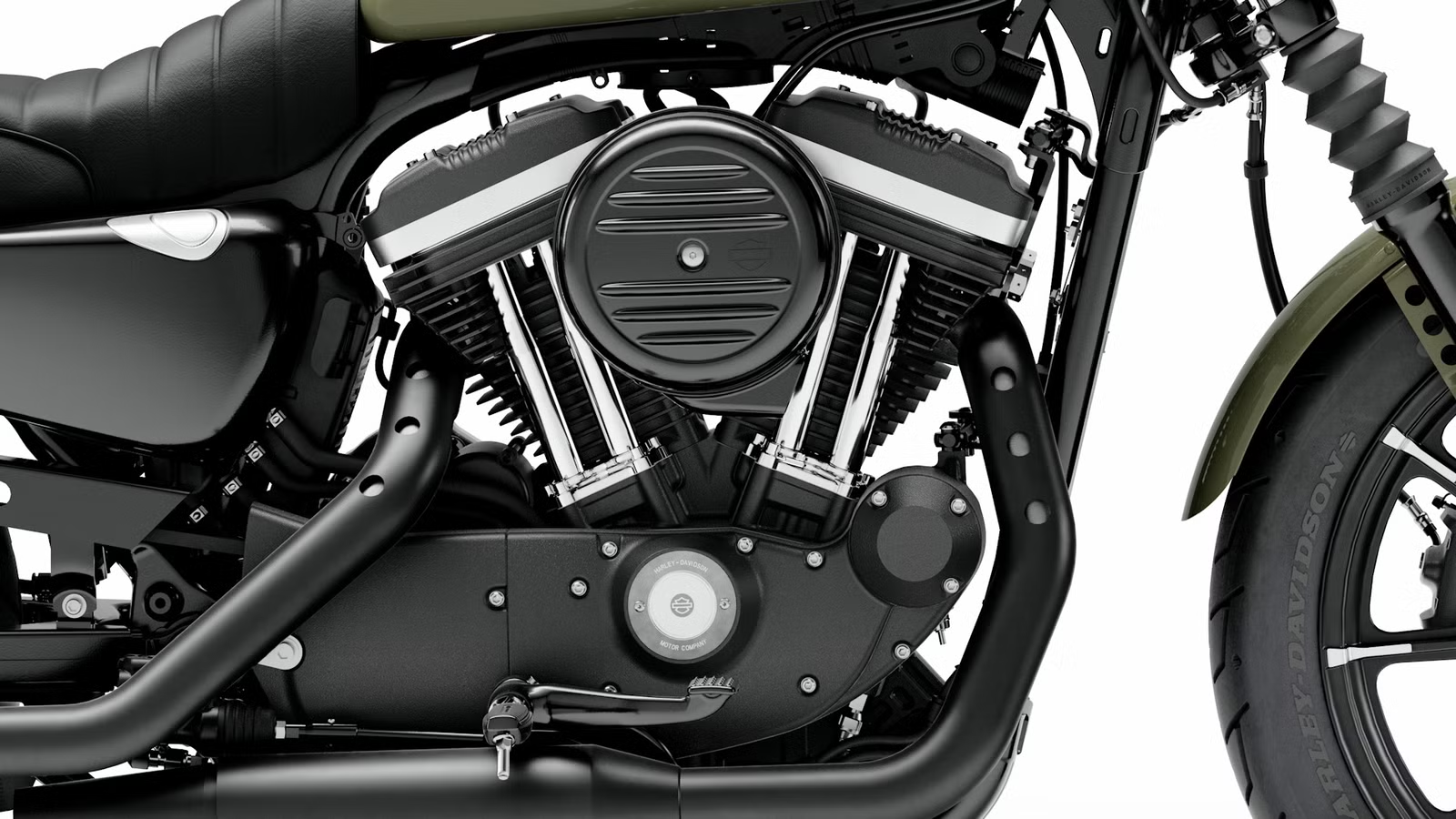
That brings us to the 883cc Sportster Evolution, the engine that powered generations of Harley’s smallest traditional Sportsters. The Evolution Sportster arrived in 1986 as the successor to the Ironhead, using aluminum cylinder heads and cylinders to improve cooling and reduce weight. At its core, though, it stayed wonderfully old-school: a 45-degree, air-cooled, pushrod V-twin with two valves per cylinder and a soundtrack nobody was going to confuse with a Japanese parallel twin.
By its final US model year in 2022, the Iron 883 used the 883cc Evolution with a three-inch bore, 3.811-inch stroke, 9:1 compression ratio, and electronic sequential-port fuel injection. Harley rated it at 54 pound-feet of torque at 3,750 rpm, paired with a five-speed transmission, chain primary drive, and belt final drive. It wasn’t remotely concerned with winning horsepower wars, and that was increasingly the point.
A Platform That Was Deliberately Simple

The rest of the Iron 883 was just as straightforward. It used a tubular steel frame, 39mm fork, preload-adjustable twin rear shocks, a 19-inch front wheel, and 16-inch rear wrapped in Michelin Scorcher 31 tires. A single front and rear disc handled braking, with ABS optional. The bike weighed 564 pounds ready to ride, carried 3.3 gallons of fuel, and returned an estimated 51 mpg.
The final Iron 883 started at $11,249 before freight, surcharge, taxes, and options. That wasn’t especially cheap by the end, particularly considering how much performance other manufacturers offered for similar money. Yet judging it purely as a horsepower-per-dollar proposition misses why the platform lasted so long. Buyers weren’t only paying for output. They were buying a simple air-cooled Harley that still looked, sounded, and behaved much like people expected one to.
It Was Also One Of Harley’s Great Blank Canvases

Then there was customization. Few motorcycles were as happy to be taken apart and turned into something else. Owners built 883s into bobbers, flat-track-inspired road bikes, café racers, scramblers, stripped cruisers, and just about every other variation that could be produced with a grinder, a catalog, and questionable financial restraint. The simplicity of the platform invited modification rather than discouraging it.
The relationship between the 883 and larger 1,200cc Sportsters only expanded those possibilities. Decades of production created an enormous aftermarket, and engine upgrades became part of the culture surrounding the bike. The appeal wasn’t simply that the 883 was inexpensive by Harley standards. It was that owners could start with something basic and gradually make it faster, stranger, prettier, uglier, or simply more personal.
Harley Killed It Just As Riders Started Understanding What Made It Special
Traditional air-cooled Sportsters finally disappeared from Harley-Davidson’s U.S. lineup after 2022. In their place came the new generation of Sportsters powered by the liquid-cooled Revolution Max engine. Machines such as the Sportster S and Nightster are substantially more modern, more powerful, and better equipped to deal with contemporary emissions requirements. From an engineering standpoint, they moved the Sportster name forward by decades.
They also changed what a Sportster was. The Revolution Max motorcycles rev higher, make considerably more power, use more sophisticated electronics, and approach performance in an entirely different way. That isn’t a criticism. It simply means they couldn’t replace the old Evolution experience any more than a modern turbocharged car automatically replaces the appeal of an old naturally aspirated one.
Harley-Davidson Is Bringing The 883 Sportster Back

Harley has apparently heard the message. Under CEO Artie Starrs and the company’s new “Back to the Bricks” strategy, the Sportster 883 is scheduled to return in 2027. Starrs called it the company’s most requested model among riders and dealers, and Harley’s current plan calls for U.S.-market examples to be built in York, Pennsylvania, with pricing targeted around $10,000.
That doesn’t mean Harley is simply pulling the old Evolution tooling out of storage and restarting production. The company hasn’t yet disclosed enough engineering detail to say exactly how the new air-cooled 883 will meet current regulatory requirements, nor whether its engine will be mechanically identical to the old Evo. Those are significant questions, especially because emissions compliance was one of the forces that pushed the traditional Sportster out in the first place.

What Harley has confirmed is arguably more interesting. There’s enough demand for a traditional 883 that bringing one back now makes business sense. After years of telling riders that newer, faster, more sophisticated machinery was the future of the Sportster name, the company is returning to the basic formula that so many people thought they’d outgrown.
Source: Harley-Davidson

Related posts

Latest Post


No Comments