
The 385-HP Oldsmobile That Was The World’s Most Powerful Front-Wheel-Drive Car
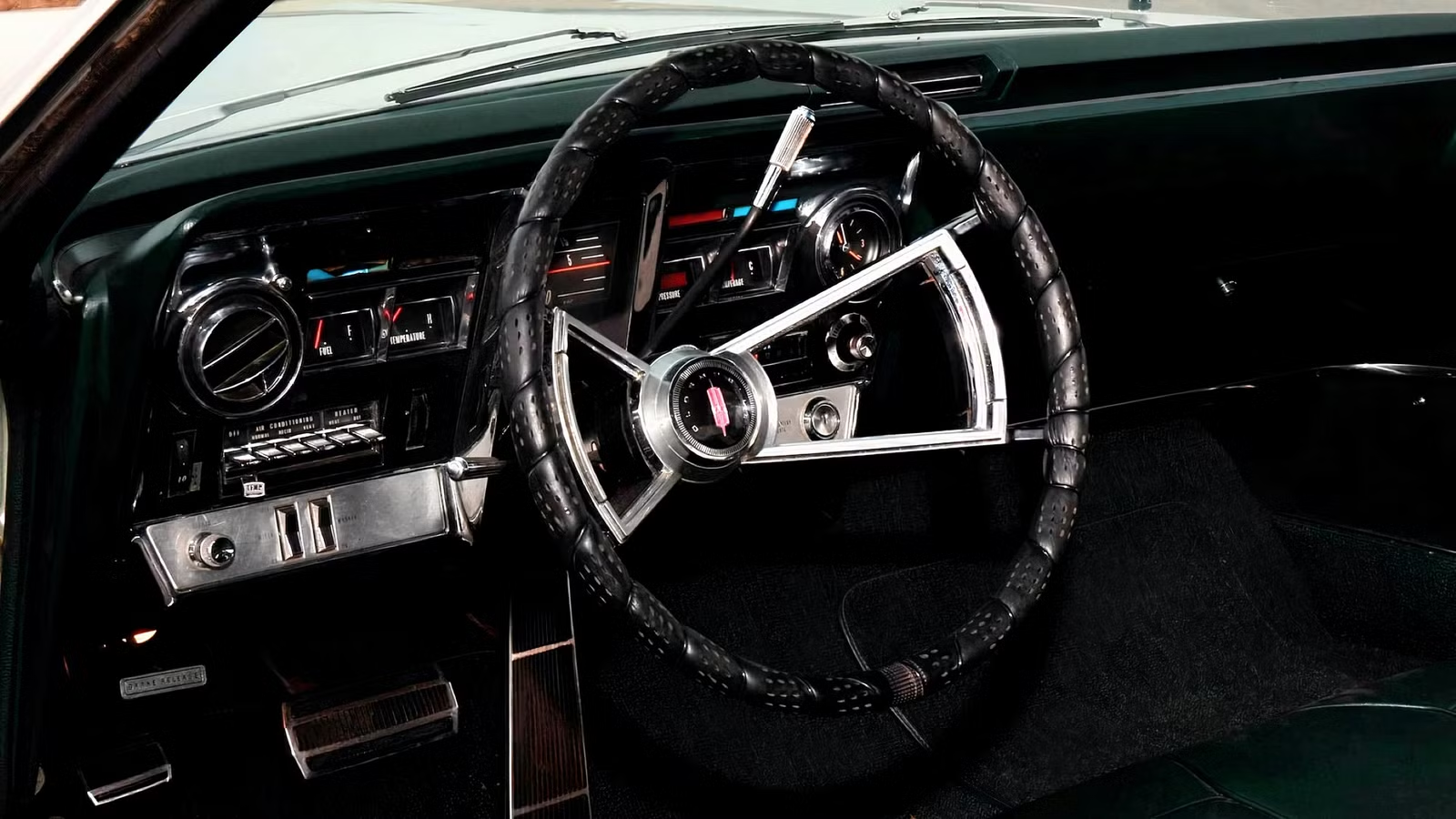
By 1966, the personal luxury coupe had settled into a comfortable formula: long hood, rear-wheel drive, a big V8, and just enough performance to keep the brochure honest. Detroit had worked out how to sell these cars, and the safest move was to keep making them the same way. Oldsmobile disagreed. The division had spent years watching front-wheel-drive technology develop in Europe, convinced that the right engineering could flip every assumption the American market had made about which wheels should do the work.

What arrived in showrooms that year was not a cautious test of the concept. It was the most powerful front-wheel-drive production car anywhere in the world, built by a manufacturer that had just spent seven years and 1.5 million test miles making sure it would hold together.
Front-Wheel Drive Had No Business Making This Much Power
In the mid-1960s, front-wheel drive meant economy cars. It meant the British Motor Corporation’s Mini, a narrow little machine built around packaging efficiency rather than anything resembling performance. It meant the Citroën Traction Avant, a French design that had been solving commuter problems since the 1930s. What it absolutely did not mean was a big-block American V8 sending north of 350 horsepower through the same wheels that did the steering. The engineering consensus was firm: torque steer, traction loss, and mechanical failure would punish anyone who tried.

The problem wasn’t theoretical. Getting serious torque through driven and steered wheels simultaneously demands solutions the industry had never needed to find. Every pound-foot sent to the front wheels fights the geometry that keeps the car pointed straight, and the more torque involved, the worse that conflict gets. European FWD cars stayed well clear of this by keeping their engines small and their outputs modest, which meant the problem was manageable rather than solved. An American automaker wanting to do this with a full-size personal luxury coupe and a displacement figure measured in hundreds of cubic inches was attempting something with no precedent, no template, and no guarantee of a clean outcome.
10 Dirt-Cheap American Luxury Cars That Turn Heads Everywhere They Go
These land-yachts will break necks without breaking the bank.
Seven Years and 1.5 Million Miles in the Making

Oldsmobile’s engineers did not stumble onto a solution. They built one from scratch, over the better part of a decade. The development program behind what became known as the Unitized Power Package ran for seven years, during which its components were driven more than 1.5 million test miles to verify the architecture could survive real-world conditions. That figure was not a marketing number. It reflected genuine uncertainty about whether any of this would work, and the discipline required to answer that question before the car reached a dealer lot.
The key invention was a 2-inch Morse Hy-Vo silent chain, borrowed from heavy industrial applications and adapted to connect the torque converter directly to the gearbox. The three-speed Turbo-Hydramatic was rotated 180 degrees and placed beside the engine rather than behind it, eliminating the conventional driveshaft entirely and allowing the whole drivetrain to sit within an engine bay no larger than a standard rear-wheel-drive car’s. Power then flowed through an offset differential and equal-length halfshafts to the front wheels. The result proved so durable that GM used a virtually unchanged version of the UPP in its popular GMC motorhome line well into the 1970s.
The 1966 Oldsmobile Toronado Was the Most Powerful Front-Wheel-Drive Car on Earth

|
Model |
Engine |
Power |
Torque |
0-60 mph |
Top Speed |
|---|---|---|---|---|---|
|
1966 Oldsmobile Toronado |
7.0-liter V8 (FWD) |
385 hp |
475 lb-ft |
7.5 sec |
135 mph |
|
1966 Buick Riviera |
7.0-liter V8 (RWD) |
340 hp |
465 lb-ft |
7.7 sec |
128 mph |
|
1966 Lincoln Continental |
7.6-liter V8 (RWD) |
340 hp |
485 lb-ft |
10.8 sec |
125 mph |
The car at the center of this engineering program was the 1966 Oldsmobile Toronado, the first American front-wheel-drive production vehicle since the Cord 812 of 1937. Its 425-cubic-inch V8 produced 385 hp at 4,800 rpm and 475 lb-ft of torque at 3,200 rpm, a 10-horsepower increase over the Starfire 425 and 20 hp more than the standard 425 in the Ninety-Eight. Factory test data showed 0-60 mph in 7.5 seconds, a quarter mile in 16.4 seconds at 93 mph, and a top speed of 135 mph from a machine weighing 4,500 pounds. Independent testing returned 8.6 seconds, reflecting real-world traction limits, but either number told the same story.
The closest personal luxury rival at launch was the 1966 Buick Riviera, sharing the new E-body platform but keeping its conventional rear-wheel-drive layout. The Riviera’s base engine produced 340 hp, 45 short of the Toronado’s output, and trailed on 0-60 despite the mechanical simplicity of a traditional drivetrain. The Lincoln Continental appears in the table for context rather than competition: Motor Trend recorded 10.8 seconds to 60 mph for the 1966 coupe, which tells you where its priorities lay. The Toronado was not just the most powerful front-wheel-drive car in the world. It was the quickest of all three.
Motor Trend named it Car of the Year. Car Life gave it its Award for Engineering Excellence. It placed third for European Car of the Year. Testers who expected the front-weight bias to be a handling liability found instead that it gave the Toronado genuine composure in poor conditions and a planted, responsive character that full-size American contemporaries couldn’t match on a back road.
The Unitized Power Package That Oldsmobile Spent a Decade Building

The chain at the heart of the UPP was the detail that made the whole thing possible. A conventional connecting arrangement between the engine and the gearbox couldn’t survive the combination of torque and packaging constraints the Toronado imposed, so Oldsmobile reached for a 2-inch Hy-Vo silent chain of the type used in heavy industrial machinery. Splash-lubricated and running on sprockets inside a sealed carrier bolted to the transmission, the chain transferred drive from the crank-mounted torque converter to the gearbox’s planetary gear sets, with power then exiting through an offset differential and equal-length halfshafts. The whole arrangement allowed the engine to sit longitudinally while the transmission lived beside it rather than behind it, eliminating both the driveshaft and the transmission tunnel in one move.
What that packaging solution delivered in practice was a flat cabin floor wide enough to seat three across the front bench, a low center of gravity relative to the car’s size, and exceptional traction in conditions where rear-wheel-drive cars of similar weight would struggle. It also produced one of the stranger mechanical symphonies of any American car of the era: near silence from the chain itself, combined with the deep, unhurried note of the 425 at idle. Oldsmobile called the whole thing the Unitized Power Package, a name that undersells what it was. It was a proprietary drivetrain architecture with no equivalent in American production, one that the division had developed in isolation and tested more rigorously than most manufacturers tested anything.
1966 Oldsmobile Toronado Values: What the Auction Market Pays Today

|
Model |
Driver |
Good |
Excellent |
Top Result |
|---|---|---|---|---|
|
1966 Oldsmobile Toronado |
$19,688 |
$22,000–$32,000 |
$32,000–$37,000 |
$41,000 |
|
1966 Buick Riviera |
$13,000 |
$19,700–$22,000 |
$36,400 |
$88,000 (GS) |
The auction record over the past eight months tells a more interesting story than the price guide alone. At the top end, a patina survivor with 56,000 miles sold at no reserve in January 2026 for around $41,000. A clean original Florida car brought $32,000 at auction in December 2025, and an Ohio example reached $36,500 the month before. Mid-grade and driver-quality cars settle in the $19,000–$22,000 range, consistent with the price guide’s Good figure of $20,200. The highest the model has ever publicly sold is $49,000, set in 2023.
The Riviera comparison shakes out differently once you look at what actually sells rather than what the guide projects. A highly original base Riviera sold for $13,000 in January 2026, comfortably below what a comparable Toronado makes. Mid-grade Rivieras trade in the $19,000–$22,000 band, roughly level with a good Toronado, and the price guide puts Excellent at $36,400. The Riviera’s ceiling is higher, but only via the Gran Sport variant, which reached $88,000 in its best recent result. In base trim, the Riviera is not ahead of the Toronado in the real auction market. If you want the car that made history and you are not chasing a Gran Sport, the Toronado is the better-value proposition right now, and the gap may not stay this narrow much longer.
The Ford Muscle Car That Was Rarer Than A Boss 429
Technically this rare car is a failed project, but collectors still throw insane amounts of money at it’s massive Big Block V8 power.
The Architecture GM Built for Two Cars and Never Scaled

The UPP’s commercial story turned out to be one of containment rather than expansion. General Motors confined the architecture to the E-body personal luxury segment, which meant two cars in practice: the Toronado and, from 1967, the Cadillac Eldorado, which adopted its own version of the UPP fitted with Cadillac’s V8. The Eldorado’s arrival confirmed that the platform worked and that GM was prepared to invest in it further. What it didn’t confirm was any intention to take the technology into the broader lineup, where the commercial case for FWD would have been far stronger across high-volume mid-size models.
Between 1966 and 1985, General Motors built 2,188,757 vehicles using the UPP. That figure looks significant until you measure it against the corporation’s total output across those two decades, at which point it becomes a rounding error. The architecture that required seven years and 1.5 million test miles to develop, that earned Motor Trend Car of the Year in its debut season, was quietly retired as a footnote. The visible moment the bet was called off came in 1971, when the second-generation Toronado arrived with a longer, squared-off body that mirrored the Eldorado’s conservative brougham silhouette. The original fastback shape, one of the genuinely distinctive American designs of the decade, was gone. What replaced it looked like exactly everything the 1966 car had deliberately refused to be.
5 Muscle Cars That Quietly Became Million-Dollar Cars
These Golden Age muscle cars were once ordinary showroom purchases — and some have since sold for millions at auction.
The Milestone Oldsmobile Stopped Talking About

Oldsmobile initially marketed the Toronado’s front-wheel-drive layout as something worth celebrating. The Pikes Peak campaign that began with pre-production testing in 1965, where Bobby Unser pushed a prototype to within 17 seconds of the stock car class record on a first-ever run, was precisely this kind of statement. The Toronado then won the stock car class outright at the 1966 race, and went on to take class wins in 1968 and 1970. Through the late 1960s, FWD remained a central part of the car’s identity. By the mid-1970s it had quietly ceased to be. The UPP was still fitted, but the marketing had moved on to interior appointments and exterior finish. What had been a breakthrough became a specification listed among others.
The Toronado didn’t fail. It sold 40,963 units in its first year, won the industry’s most visible awards, and introduced an architecture robust enough for motorhome applications a decade later. What it didn’t do was become the template for what followed inside its own corporation. Whether that reflects a missed opportunity or a pragmatic response to sales declining sharply after 1966 is a question the record doesn’t definitively resolve. What it does show is a pattern: a division that built the world’s most powerful front-wheel-drive car, validated it with 1.5 million test miles and a Pikes Peak class win, and then chose not to build the next chapter on that foundation. The collector market is still quietly working out what that decision was worth.
Sources: Hagerty, Classic.com, Mecum

Related posts


Latest Post


No Comments