
Why It Costs 660% More To Change Your Brakes On This Muscle Car Compared To 50 Years Ago
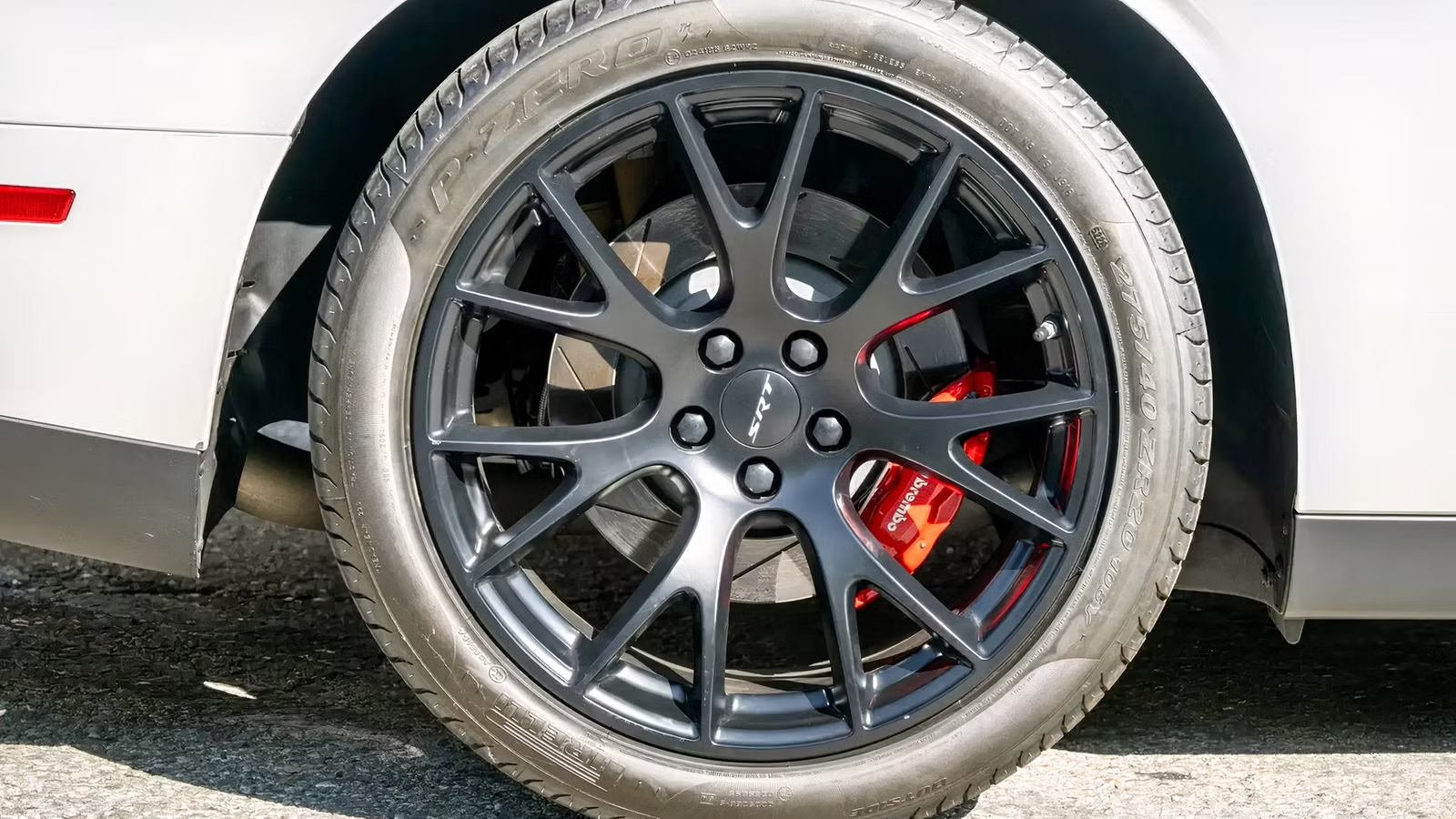
The Dodge Challenger SRT Hellcat has worn the same name for more than half a century, but the cost of stopping one has changed dramatically. A genuine Mopar front brake pad kit for a Challenger SRT Hellcat carries an MSRP of $254, while a set of front pads for a 1974 Challenger costs $33.49. That makes the Hellcat’s front pads nearly 660% more expensive, and there’s a very good reason for it.
The 1974 Challenger’s Brakes Were Much Simpler

The final-year E-body Challenger was a very different car from the supercharged monster Dodge introduced in 2014. It could be equipped with front disc brakes, and the hardware is about as simple as discs get by modern performance-car standards, with a single-piston, slider-type caliper clamping each front rotor. One piston per wheel. That’s it.

The 1974 Challenger used front disc brakes with rear drums, while power assistance was optional on the 318 and required with the 360. The front caliper was a simple single-piston slider-type design, a long way from the six-piston Brembo hardware on the Hellcat. The replacement pads aren’t particularly expensive, either. Advance Auto Parts currently lists a ceramic front pad set for a 1974 Challenger at $33.49, and it’s an OE-fit replacement designed around the original application. Put that next to the Hellcat’s $254 Mopar kit and the modern car’s pads cost $220.51 more per front axle, or about 7.6 times as much. Same badge, same job, wildly different receipt.
The Hellcat Needed A Lot More Brake


Dodge didn’t fit the Hellcat with enormous Brembo brakes simply to make the car look mean behind its 20-inch wheels. The 2015 Challenger SRT Hellcat arrived with a supercharged 6.2-liter Hemi rated at 707 hp and 650 lb-ft of torque, and Dodge estimated its top speed at 199 mph. Up front, six-piston Brembo calipers clamp 15.4-inch two-piece rotors, while the rear gets 13.8-inch rotors with four-piston calipers.
This was not a case of taking the standard Challenger’s brakes and making them slightly bigger. The entire system was designed around the demands of a car with supercar-level straight-line performance, and Dodge highlighted its heat management, thermal capacity, and longevity when the car launched. In other words, the brakes were engineered as seriously as the engine.

Basic science lesson here: brakes turn kinetic energy into heat. A heavier car traveling faster carries much more energy that the brakes have to absorb, and because that energy rises with the square of speed, doubling your speed quadruples the energy. Dodge quoted a 4,439-pound curb weight for the Hellcat, so it needs large rotors and a high-capacity caliper and pad combination that can handle repeated high-energy stops without excessive fade.
Dodge’s own documentation shows how seriously SRT took brake temperatures. Its SRT owner’s guide includes a brake-burnishing procedure for track use and warns that track driving increases operating temperatures in the brake system. The $294 pad kit is only one small part of a much more sophisticated system. And the pads are the cheap part. Mopar currently lists a genuine front rotor for the 2019 Hellcat at $1,415, and the car needs two of them. Go-Parts currently lists an aftermarket front rotor for a 1973-74 Challenger at $92.14, which makes a single Hellcat rotor more than 15 times as expensive.
The Challenger Name Hasn’t Always Meant Expensive Brakes

There’s an even cheaper example further down the Challenger timeline. A front pad set for a 1983 Challenger sells for just $19.99, though that car comes with an important caveat. The second-generation Challenger, sold from 1978 through 1983, was a rebadged Mitsubishi Galant Lambda with a four-cylinder engine, not a development of the 1970-74 E-body. So the 1983 car isn’t a meaningful engineering comparison with the Hellcat. It’s useful for another reason: it shows just how little the Challenger badge tells you about what its brakes cost to maintain. Buy one today and a fresh set of front pads costs less than a tank of gas.
Fifty Years Changed The Challenger’s Brake Job

The interesting part of this comparison isn’t that Dodge somehow decided brake pads should become ridiculously expensive. It’s what happened to the car around them. The 1974 Challenger was a 1970s muscle car with relatively straightforward front disc brakes, while the Hellcat turned the same nameplate into a 707-hp machine with massive Brembo hardware built to handle the heat of a much faster, heavier car.
The $254 Mopar kit is an OEM retail price, and Hellcat owners can shop the aftermarket for replacement pads, as well as alternatives for the car’s expensive rotors and other brake components. Even so, the full picture is hard to argue with. Put fresh pads and two new rotors on the front of each car, using genuine Mopar parts for the Hellcat, and the 1974 Challenger’s parts bill comes to $217.77. The Hellcat’s comes to $3,084, more than 14 times as much, before anyone has picked up a wrench. The Challenger name survived for more than 50 years. The humble brake pad did too. It just became considerably more expensive to make the modern version of the car stop.
Sources: Bring A Trailer, Stellantis, Mopar, Advance Auto, Go-Parts

Related posts
Latest Post


No Comments