
Why Britain Hid a Chrysler V8 in Its Most Innovative GT
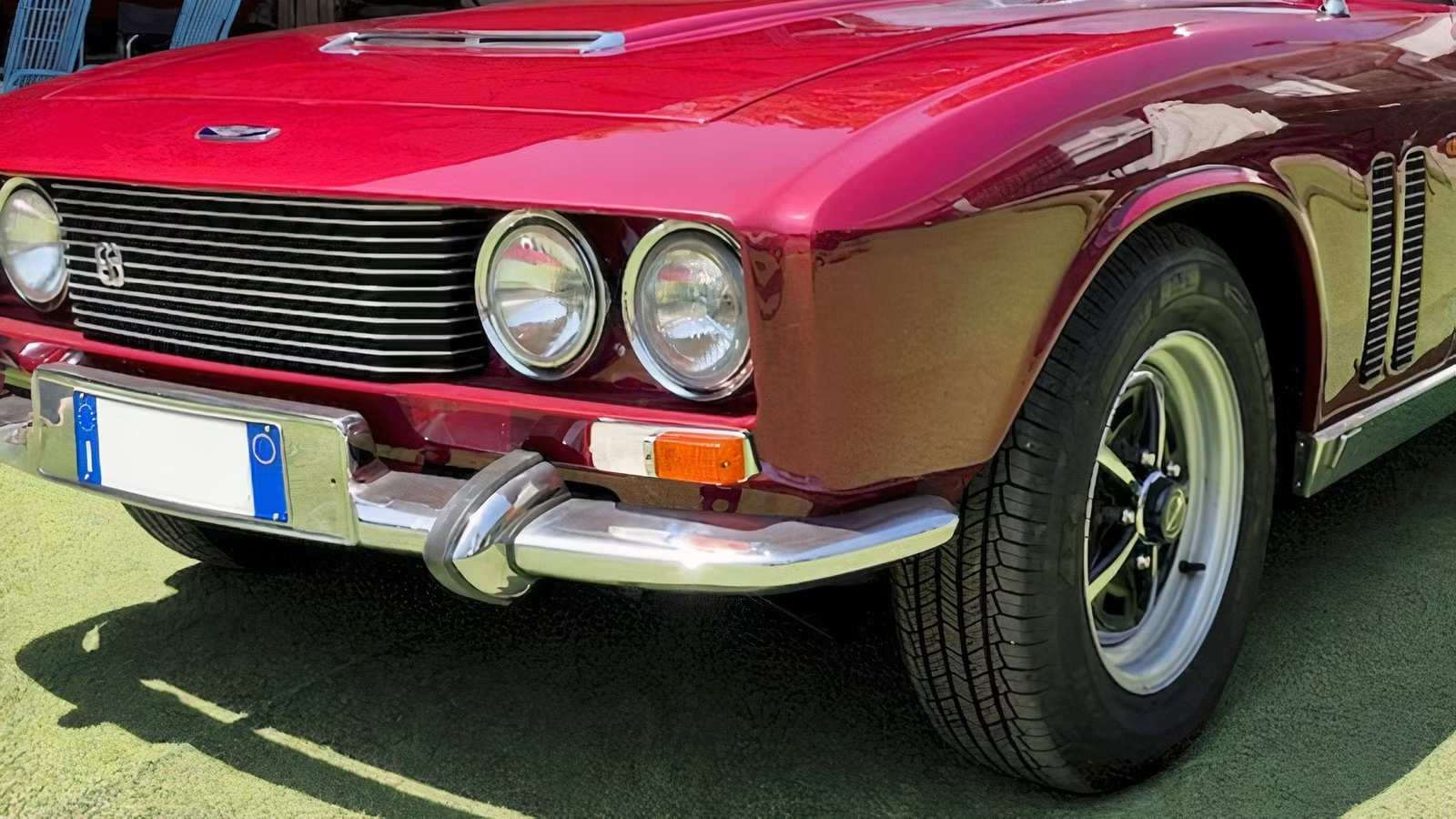
The 1960s gave the automotive world some of its wildest performance cars. American V8 engines found their way into lightweight European machines, creating tire-smoking monsters that could embarrass far more expensive rivals. But one British manufacturer had a different idea – instead of chasing bigger horsepower figures and faster quarter-mile times, it wanted to make all that power easier to control. The result was a luxurious grand tourer with a massive Chrysler V8 and technology that would take the rest of the industry years to embrace. Strangely, few enthusiasts remember it today.
The Shelby Cobra Made V8 Power Famous, But There Was More To Performance

Carroll Shelby knew how to build a fast car without overcomplicating things. His recipe combined the lightweight chassis of the British AC Ace with an American Ford V8, creating the legendary Shelby Cobra in 1962. Early versions used Ford’s 260-cubic-inch engine before graduating to the 289 V8. Eventually, the fearsome 427 arrived with enough muscle to burn tires. Shelby’s Cobras dominated American sports car racing, while the Daytona Coupe helped secure the 1965 International Championship for GT Manufacturers against Ferrari.
However, raw horsepower came with compromises, especially when drivers had to put that power onto the road. The Cobra sent its considerable output to the rear wheels, which demanded respect under hard acceleration. Wet pavement made matters worse, and an enthusiastic right foot could easily overwhelm the available grip. That was hardly unusual during the 1960s – most high-performance road cars relied on rear-wheel drive, and drivers had few electronic or mechanical safety nets.
A Chrysler Big-Block Was Only The Beginning


By the mid-1960s, a small British specialist manufacturer was working on a grand tourer that approached performance from another direction. Its engineers wanted more than a comfortable highway cruiser with enough power to challenge established sports cars. They also wanted sophisticated engineering that could make the vehicle safer and more predictable in difficult conditions. The project brought together expertise from three countries: Italian designers shaped the handsome bodywork, British craftsmen handled the construction, and an American engine supplied the muscle.
The engine came from Chrysler, specifically its 383-cubic-inch (6.3-liter) big-block V8. Unlike Shelby’s lightweight Ford-powered roadster, this machine used its substantial displacement to deliver effortless performance in a more luxurious package. Chrysler’s three-speed TorqueFlite automatic transmission handled gear changes, making the car better suited to relaxed, high-speed touring than constant gear rowing. The transmission was also a proven piece of American engineering, capable of dealing with substantial V8 torque. But the real surprise lay beyond the gearbox.
The Jensen FF Is A Chrysler-Powered GT That Beat Audi To AWD

The mysterious grand tourer was the Jensen FF, introduced in 1966 by Jensen Motors of West Bromwich, England. It shared much of its Italian-designed appearance with the Jensen Interceptor, but the similarities hid major mechanical differences. The body originated with Carrozzeria Touring, while Vignale helped bring the design into production. Under the hood sat Chrysler’s 383-cubic-inch V8, producing approximately 330 bhp in contemporary specifications, paired with the three-speed TorqueFlite automatic. Its combination of American muscle and British luxury made it an appealing grand tourer in its own right. The FF designation, however, revealed its real party trick – those letters stood for Ferguson Formula, the permanent four-wheel-drive technology developed by Ferguson Research.
The Ferguson system used a central differential and transfer arrangement to distribute approximately 37% of the engine’s torque to the front wheels and 63% to the rear. This rear-biased setup maintained much of the familiar character of a powerful rear-wheel-drive car while giving the front tires a useful share of the work. Drivers didn’t have to engage a separate four-wheel-drive mode or wait for the rear wheels to slip before the front wheels received power. All four wheels contributed continuously. The FF also featured a Dunlop Maxaret anti-lock braking system, technology with roots in aviation. It helped reduce wheel lockup under heavy braking, giving drivers another advantage when road conditions became challenging.

These features made the Jensen FF an extraordinary production car for 1966. It combined a powerful American V8, permanent four-wheel drive, anti-lock brakes, and a comfortable grand touring cabin long before that formula became familiar. The famous Audi Quattro didn’t arrive until 1980, a full 14 years later, and although four-wheel drive had appeared in earlier specialized vehicles, the FF helped pioneer its use in a production road car built around luxury and high-speed performance.
The Jensen FF’s Technology Was Even More Impressive Than Its V8

The most important advantage of the Ferguson Formula system wasn’t simply faster acceleration. By sharing engine torque between four tires, the drivetrain could make better use of available traction, particularly on wet or slippery roads. A conventional rear-wheel-drive car asked its rear tires to handle acceleration while also contributing to cornering forces, but the FF spread the driving load more widely, making its considerable power easier to manage. Its center differential also allowed the front and rear wheels to rotate at different speeds during normal driving.
Another clever feature involved the Maxaret braking system. It monitored differences in wheel speeds and adjusted brake-servo assistance when it detected conditions associated with lockup. The system could release assistance and restore it as wheel speeds recovered, producing a pulsing sensation through the brake pedal. Modern electronic ABS monitors individual wheels with far greater precision, but Jensen offered a working mechanical approach decades earlier.

The technology attracted interest well beyond Jensen’s small customer base. Porsche even acquired an FF in 1967 and evaluated its four-wheel-drive system, demonstrating how seriously established engineers viewed the design. Another remarkable development followed in 1972, when British engineering company GKN created the experimental FFF 100. Built using a strengthened Jensen FF chassis and related Ferguson technology, this one-off prototype featured a mighty Chrysler 426 Hemi V8 producing around 600 hp.
Why It Never Became As Famous As The Shelby Cobra

For all its technical achievements, the Jensen FF faced a problem that horsepower couldn’t solve. Its complicated four-wheel-drive hardware occupied valuable space around the transmission tunnel and front drivetrain. The arrangement interfered with the area required for left-hand-drive steering components and controls, making a practical factory left-hand-drive version commercially unfeasible. Jensen therefore built the FF exclusively with right-hand drive, effectively shutting it out of the massive American market. That was a devastating limitation for a car powered by a Chrysler V8, especially when American buyers already loved fast, powerful grand tourers.
Price presented another serious obstacle – the FF cost roughly one-third more than the conventional rear-wheel-drive Interceptor. That was a substantial premium for customers who already had to spend serious money on the standard car. The extra mechanical complexity also increased production costs, while the unusual drivetrain required specialist attention. Jensen ultimately built approximately 320 FFs between 1966 and 1971, compared with thousands of conventional Interceptors.
The Cobra, meanwhile, enjoyed competition victories, American exposure, and a reputation that continued growing through replicas and later interpretations. The Jensen FF never achieved that cultural reach, but its limited success shouldn’t overshadow its engineering contribution. It showed that managing horsepower could be just as important as producing it. The Cobra became famous for making V8 performance thrilling, while the FF helped demonstrate how future performance cars could make that power more usable. In that respect, Jensen was remarkably far ahead of its time.
Source: Jensen, Chrysler, Shelby

Related posts



Latest Post


No Comments