
The Poor Man’s Adventure Bike That Refuses To Stay Dead
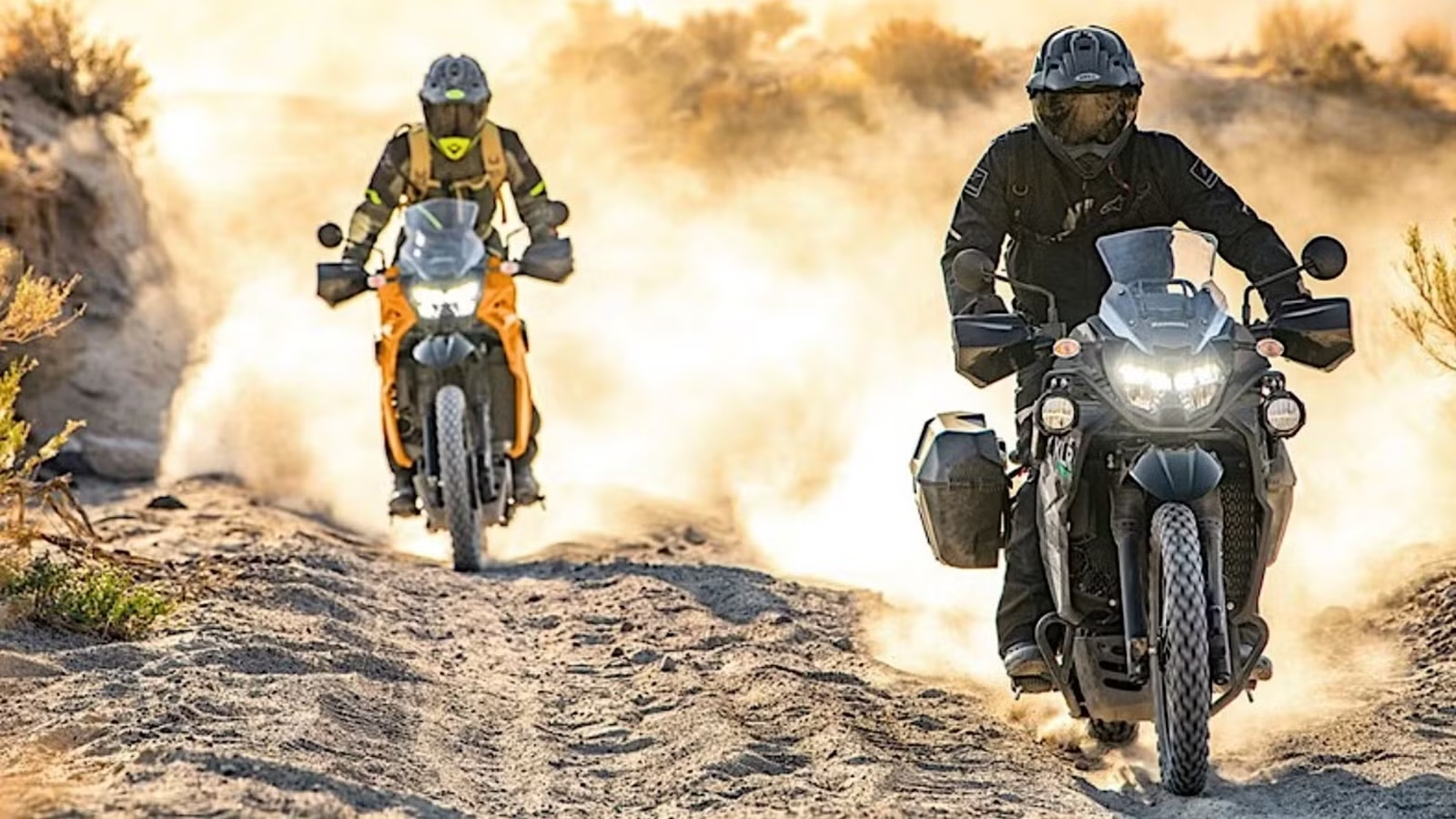
If you step into the market looking for an adventure motorcycle, it won’t take long to realize that ADVs have become seriously expensive. And seriously high-tech, too. Put the biggest names in the ADV world into a UFC-style pound-for-pound ranking and there are plenty of heavy hitters. But the BMW R 1300 GS is still one of the bikes everyone else has to measure themselves against. That said, it demands a fat paycheck too.

The BMW R 1300 GS is right near the top of the ADV food chain, but that comes with a pretty serious price tag. You’re looking at $20,395 for the base model, while Honda’s Africa Twin starts at $15,199. Once you start ticking the optional extras, things can get uncomfortable pretty quickly.
But adventure riding didn’t always come with a premium-bike sticker price. There was a time when an adventure bike was a much simpler proposition. You bought a big single, filled up the tank and went wherever the road, or lack of one, took you. No massive TFT, no radar cruise control, and no riding-mode menu to scroll through. Just a motor, a set of wheels, and enough fuel for a long day out.
A Simple Bike That Just Kept Going


The Kawasaki KLR650 debuted back in 1987 as a straightforward dual-sport motorcycle. At its heart was a 652cc liquid-cooled single-pot motor sitting in a semi-double-cradle frame.
Nothing about that recipe screamed cutting edge. At the same time, manufacturers were already getting pretty clever with their ADVs. BMW had its Paralever system, Honda was putting a V-twin into the Transalp, and Suzuki had a massive 727cc single with twin balancer shafts in the DR 750S Big.
There was plenty of engineering happening around the KLR, even if Kawasaki wasn’t chasing all of it.
The KLR was never interested in winning the traffic-light GP. Its simple powerplant was built to make decent grunt, sip fuel and keep running when the tarmac disappeared. Newer versions get a 6.1-gallon tank too, which is handy when the next fuel station is a long way down the road.
And this wasn’t a completely new recipe for Kawasaki, either. The KLR650 replaced the 564cc KLR600, so Kawasaki already had a proven single-cylinder formula to work with. Instead of reinventing it, the company kept refining what already worked.
The Bike Time Forgot
This is where the KLR650 story gets interesting. Kawasaki basically left it alone for years. The first-generation bike stayed in production from 1987 to 2007 with remarkably few visual changes. The side panels, fuel tank, fenders, radiator shrouds and headlight housing remained largely the same for two decades.
There were some mechanical tweaks, including an extra clutch plate and a bigger clutch basket, but the basic recipe stayed intact. Twenty years is a long time for a motorcycle to go without a major redesign. The KLR just kept doing KLR things.
That finally changed in 2008. Kawasaki gave it new bodywork, a revised fuel tank, rear subframe and seat. The brakes got bigger, too, with a 280mm front disc and 240mm rear, while 41mm forks and a new D-section swingarm improved the chassis. The 652cc single, however, stayed put, still breathing through its 40mm CVK carburetor.
That’s a painfully slow development cycle by modern standards. But it was also part of the KLR’s charm. Owners knew the bike inside out, parts were easy to find and there was usually someone who had already figured out how to fix whatever went wrong.
Why Riders Trust It

The KLR650’s reliability isn’t down to some magical engine component. It’s mostly because there just isn’t a whole lot to go wrong. The older bikes used a Keihin CVK-40 carburetor, while even the newer versions keep the electronics fairly simple by modern ADV standards.
That matters when you’re hundreds of miles from home. There aren’t layers of sensors and rider aids between you and that big single. With an estimated 186,000 KLRs built over the years, there’s also a huge pool of owners, mechanics and aftermarket specialists who have already dealt with most of the bike’s common problems.
Of course, the KLR isn’t bulletproof. Ask any owner, especially of a pre-2nd Gen bike, and the “doohickey” will probably come up sooner or later. It sounds like some harmless little part, but it’s actually the balancer-chain adjuster lever, and it became one of the KLR’s most notorious weak points. The stock lever and spring could fail, potentially causing serious engine damage. Thankfully, the problem has been known for years and there are plenty of stronger aftermarket replacements.
Beyond that, the KLR is about as straightforward as adventure bikes get. Parts are cheap and widely available, the big thumper makes steady torque instead of chasing big power, and basic maintenance is simple. Add the large fuel tank, tough chassis, and lack of complicated electronics, and even roadside repairs are often possible with a basic toolkit.
That’s basically the KLR ownership experience. It’s not perfect, but it’s simple, well understood and easy to keep running.
The Adventure Bike For Everyone Else

The KLR650 earned the “poor man’s adventure bike” nickname for a reason, and it’s not really an insult. The 2022 model started at $6,699 in the US, with ABS adding another $300. For 2026, the base bike is $6,999, or $7,299 with ABS.
Now look at what’s sitting on the other side of the showroom. The BMW R 1300 GS starts at $20,395 without addons, while Honda’s Africa Twin starts at $15,199. The BMW is almost three times the price of a basic KLR, and even the Honda costs more than twice as much.
But you don’t even have to go that high up the ADV ladder to spend considerably more than you would on a KLR. The Aprilia Tuareg 660 starts at $12,499 for 2026, while the Kawasaki Versys 650 LT ABS is $10,399 before destination charges. The Triumph Tiger Sport 660 starts at $10,445, too. The Aprilia is the most serious off-road bike of this bunch, while the Versys and Tiger Sport lean more toward road riding and touring. Even so, all three cost considerably more than a base KLR650.
Of course, those bikes give you more power, more technology and a much longer list of electronic toys. The BMW will run rings around the KLR in plenty of situations. But that’s not really what the KLR is trying to do.
Its 652cc single makes a modest 40 hp, but provides plenty of usable grunt for cruising, carrying luggage, and getting down dirt roads. There are no huge horsepower numbers to chase and no endless menus to scroll through. For someone who wants a proper adventure bike without spending new-car money, that’s still a pretty convincing proposition.
It Refused To Stay Dead

Then, after more than three decades, the KLR650 disappeared. Kawasaki sent it to retirement after the 2018 model year, closing the book on a 32-year run. Stricter emissions regulations played a big part, and the old carbureted engine was getting harder to keep compliant. For three years, there was no KLR650. A lot of people assumed that was it. Apparently, KLR owners didn’t get the memo.
In early 2021, Kawasaki announced the KLR650 was coming back for 2022. The basic recipe stayed familiar, but the important bits were brought up to date. The carburetor was replaced by fuel injection, ABS became available, and Kawasaki added new bodywork, a larger front brake disc, an adjustable windscreen, an LCD display, and a more powerful alternator.
What it didn’t do was turn the KLR into a 100-hp technology showcase. The single-cylinder engine stayed, and so did the basic philosophy behind the bike. Kawasaki could have reinvented it completely. Instead, it fixed what needed fixing and left the character alone. In a motorcycle world chasing more power, more modes and more electronics, there was still enough demand for a big, simple single to bring the KLR650 back from the dead.
Why It Still Makes Sense

The KLR650 has never been the motorcycle you buy because its spec sheet makes everything else look silly. You buy it because you understand it.
It’s relatively cheap, mechanically straightforward and built around a formula that’s been proven for decades. Load it up, ride it across a state, turn onto a dirt road when the opportunity appears, and if something goes wrong, there’s a good chance you can figure it out yourself.
That’s a pretty old-school way of looking at adventure riding. And maybe that’s exactly why the KLR650 has survived.
The ADV market has moved toward bigger engines, bigger screens and bigger price tags. The KLR went the other way. It stayed stubbornly simple. After all these years, that might be the KLR’s biggest trick.

Related posts


Latest Post


No Comments