
The First Production Motorcycle With Factory Traction Control
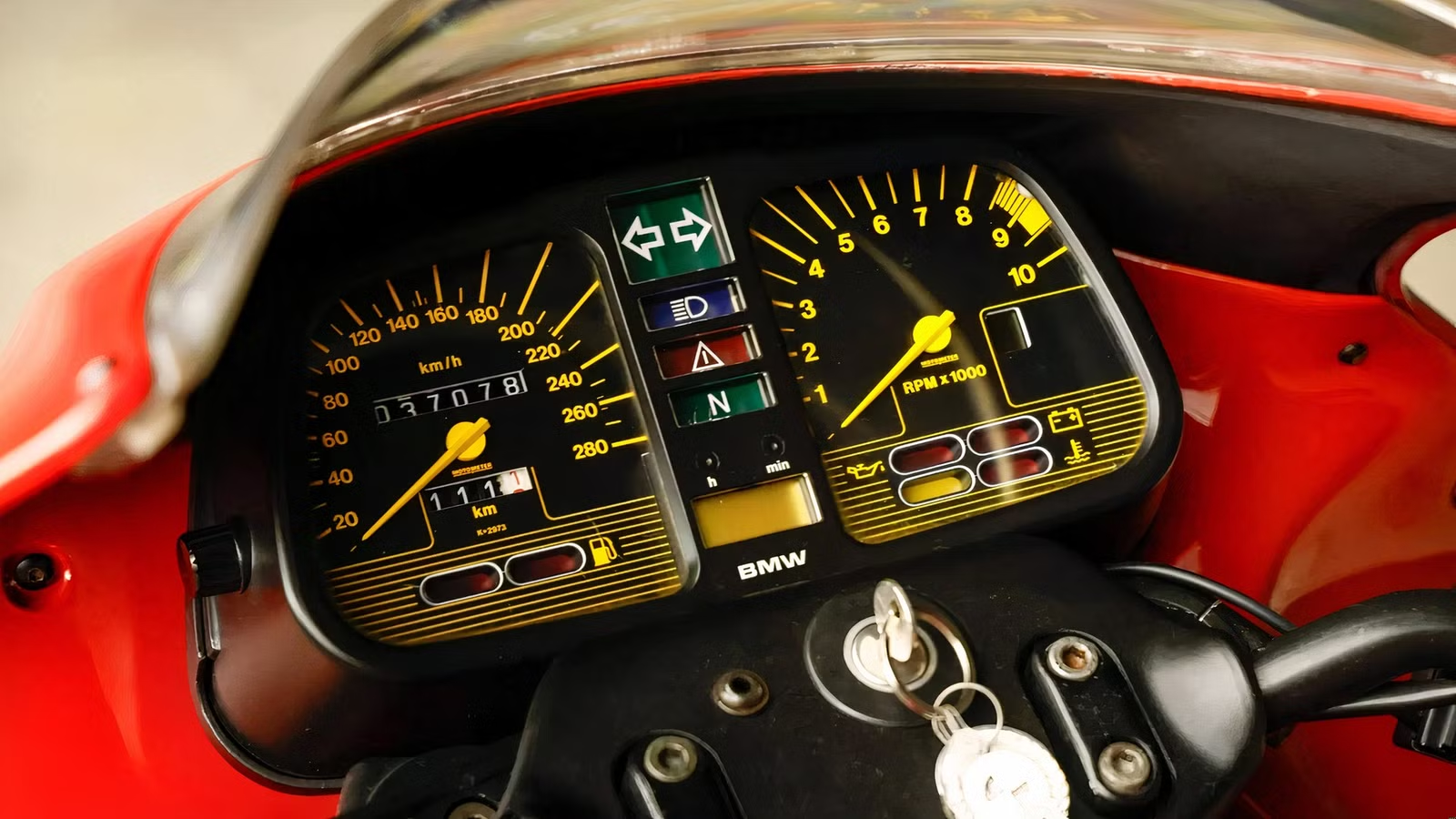
A lot of modern motorcycles are filled with electronic aids for improved safety and convenience — quickshifters, ABS, and multiple ride modes tailored to different conditions, among many others. These are all great, making one’s life easier out on the road while also reducing the intimidation factor for newer, less experienced riders. Today, we want to focus more specifically on traction control, which uses sensors to detect when the rear tire loses grip and reduces power sent to the wheel to prevent things from getting out of hand. On a practical level, that means automatic throttle adjustment, delayed ignition timing, and reduced fuel delivery, all governed with pinpoint precision through your bike’s ECU.
Motorcycle Traction Control Is Older Than Most People Realize

We tend to associate traction control systems (and rider aids in general) with machines released from the early 2010s onward, and it is true that widespread adoption only took place around then. But certain technologies have been pioneered on a small scale much earlier, albeit in a more rudimentary fashion than what ultimately became the industry standard. For instance, the BMW K 100 became the world’s first motorcycle equipped with ABS back in 1988, a setup developed in collaboration with Bosch long before the advent of modern electronics like Inertial Measurement Units (IMUs) on bikes. And anti-lock braking wasn’t the only thing Motorrad dabbled in at the time; its sights were also set on traction control.
Bavarian Tourers Were Fertile Ground For Innovation In The Late ‘80s

The Germans were deeply invested in the touring game and had been for some time, while also bringing a breath of fresh air into their lineup with the K-Series in 1983. It all started with the aforementioned K 100, powered by a longitudinal inline-four which earned it the “Flying Brick” moniker. The smaller, three-cylinder K 75 arrived two years later, whereas the company’s tried-and-true airhead boxers pushed on with models like the Hans Muth-designed R 100 RS and, of course, the groundbreaking R 80 G/S. But let’s stay focused on the K-Series, as that’s the vehicle through which we were introduced to traction control for the very first time in ’88.

The Rare Sportbike From The ‘90s That Collectors Quietly Obsess Over
A rare ’90s homologation special hid in plain sight, but collectors know why this road-legal racer is becoming impossible to ignore.
The BMW K1 Was Buff On The Outside, But Highly Sophisticated Underneath

From a cosmetic standpoint, the K1 was an absolute behemoth with one hell of a presence out on the road. And despite being rather hefty at around 515 pounds curb weight, it offered performance to match those imposing looks. Power came from a liquid-cooled 987cc inline-four, complete with Bosch EFI and sixteen valves operated by dual overhead cams. The engine was capable of producing 100 hp at 8,000 rpm and 74 lb-ft of torque at 6,750 revs, resulting in a factory-rated top speed of 150 mph. What’s more, the K1 could finish the quarter-mile sprint in 11.4 seconds at 119.8 mph and go from zero to 60 mph in 3.9 ticks.
Those numbers are pretty impressive, for sure, and all that power was contained by dual 305-millimeter (12-inch) brake discs with four-piston Brembo calipers at the front. Out back, the Beemer employed a single 285-millimeter (11.2-inch) rotor, but what made its braking system much more interesting was the availability of optional ABS. It was the same Bosch setup that debuted on the K 100 a bit earlier — heavy and primitive by today’s standards, but a true novelty back in the late 1980s. The motorcycle’s suspension is said to have been surprisingly well-behaved, too, comprising Marzocchi telescopic forks up front and BMW’s proprietary Paralever setup at the back.
Technical Specifications
|
Engine |
Liquid-Cooled Inline-Four |
|
Displacement |
987cc |
|
Valvetrain |
DOHC, 4 Valves Per Cylinder |
|
Horsepower |
100 HP @ 8,000 RPM |
|
Torque |
74 LB-FT @ 6,750 RPM |
|
Suspension |
Front: Marzocchi Telescopic Forks Rear: Paralever Monoshock |
|
Brakes |
Front: Twin Discs With Brembo Four-Piston Calipers (Optional ABS) Rear: Single Disc With Brembo Single-Piston Caliper (Optional ABS) |
|
Dry Weight |
515 LBS |
|
0-60 MPH |
3.9 Seconds |
|
Quarter-Mile |
11.4 Seconds |
|
Top Speed |
150 MPH |
As for the K1’s unmistakable bodywork, it was made with aerodynamics in mind and not for visual impact alone. Now, regarding that pioneering traction control system we’ve mentioned earlier, it had no IMUs or modern electronic wizardry to rely on. It instead monitored front and rear wheel speeds through the motorcycle’s ABS sensors, intervening as soon as the rear wheel spun faster than its front counterpart. The whole affair might’ve been basic compared to what we have today, but it still offered a glimpse at a new era of motorcycle safety. There is, however, a fair bit of confusion regarding which bike was actually the first to adopt this technology.
The First Mass-Produced Motorcycle To Use A Factory V4 Engine
This engine almost killed the V4 layout entirely, until it was reworked to perfection.

You’d be forgiven for thinking that traction control actually debuted on the Honda ST1100 Pan-European for the 1992 model year. A lot of people will tell you that’s the case, but thorough research reveals the ST1100 to have been the second in line after the earlier K1. And, just like BMW’s system, the tech implemented by Honda was nowhere near as advanced as the traction control functions found on today’s motorcycles. It did pave the way for more refined technologies to be developed later on, though, which was also the case for those early ABS implementations on tourers like the K1 and ST. So credit is due to the Japanese and, primarily, the Germans for experimenting with these technologies so early on, long before the industry caught up and they eventually became mainstream.
Honda’s Six-Cylinder Motorcycle Vintage Riders Worship
Honda’s wild six-cylinder superbike still stops vintage riders cold.
The Electronic Revolution’s Opening Act

In many ways, BMW’s K-Series at the tail end of the eighties was a sort of prologue to all the electronic innovations that followed much later on. Newer riders may tend to take all these assists for granted nowadays, sometimes forgetting how much more punishing motorcycles could be before these aids existed. Although an analog experience is appreciated by many, it did take more skill to ride without making costly mistakes back in the day. Modern electronic aids made bikes safer and far less intimidating to beginners, even if they sometimes get in the way of that mechanically authentic experience we could never get enough of. They keep countless riders out of trouble on a daily basis, which compensates heavily for any drawback.
And as for the BMW K1, a little under 7,000 copies were made before the end of production in 1993. Clean examples tend to perform decently at auction today, commanding something in the region of $10k and sometimes more. They won’t cost you an arm and a leg, though, and we’d say it’s worth experiencing what this old-school Bavarian sport-tourer has to offer for the sake of curiosity. You would also be getting that sweet German reliability to sweeten the deal even more, so be sure to keep an eye out for tidy K1s changing hands on websites like Bring a Trailer. And in case being the center of attention is your thing, this Beemer is sure to get you noticed on the road, especially with that red and yellow color scheme.
Sources: BMW Group, Cycle World, RevZilla, MCNews, Motorcyclist, Bring a Trailer

Related posts

Latest Post


No Comments