
VW ID.3 GTI vs Honda Civic Type R: RWD Electric Hot Hatch Revealed
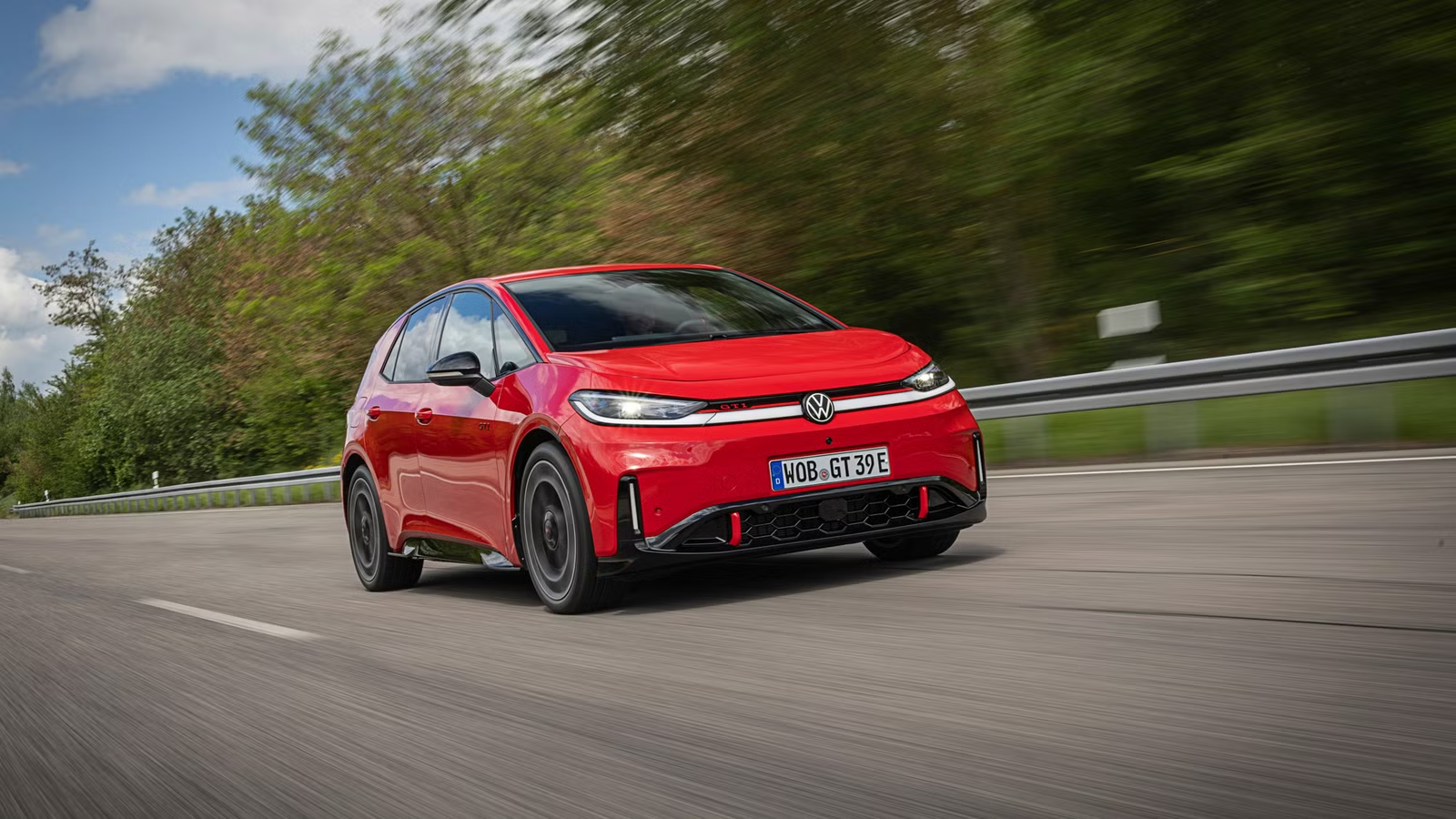
Volkswagen revealed the ID.3 GTI on Tuesday, and the numbers alone make it a statement: 322 horsepower, 402 lb-ft of torque, rear-wheel drive, and a 5.6-second 0–62 mph time. That makes it the most powerful production car to ever wear the GTI badge — edging the Golf GTI Edition 50’s 321 hp by exactly one horsepower — and the first GTI in the nameplate’s 50-year history to send power to the rear wheels instead of the front.

The target is obvious. Honda’s Civic Type R — the reigning benchmark of the FWD hot hatch segment — makes 315 horsepower and 309 pound-feet from a turbocharged 2.0-liter inline-four, hits 60 mph in 5.5 seconds, and rows its own gears through a six-speed manual. The ID.3 GTI is quicker on paper only in the loosest sense; the real fight isn’t about tenths of a second. It’s about which powertrain philosophy owns the next generation of performance hatchbacks.
The Numbers Stack Up Closer Than You’d Expect
Put the two cars side by side and the gap is razor-thin. The ID.3 GTI’s single rear-mounted electric motor produces 322 hp and 402 lb-ft of torque — that torque figure available from a standstill, as it always is with an electric motor. The Civic Type R’s K20C1 turbo four makes 315 hp and 310 lb-ft, with peak torque arriving higher in the rev range. The Type R reaches 60 mph in 5.5 seconds; the ID.3 GTI needs 5.6. VW electronically caps the GTI’s top speed at 124 mph.

On raw acceleration, Honda holds a slight edge. But the ID.3 GTI’s torque advantage at low speeds — and the instant-on delivery that comes with electric power — means the real-world feel of the two cars will diverge considerably. VW is betting that 402 lb-ft arriving the moment you press the accelerator is a more visceral experience than a turbocharged engine building to its peak. Whether that translates to a more satisfying hot hatch is a question that won’t be answered until someone drives them back to back.
GTI Mode, Launch Control, and the Superclark Interior
VW didn’t just slap a GTI badge on the ID.3 GTX and call it a day — though the powertrain itself carries over from that now-discontinued model. The ID.3 GTI gets a dedicated GTI driving mode, activated by a physical button on the steering wheel, that dials the motor, throttle response, steering, and adaptive dampers to maximum attack simultaneously. GTI mode also turns the cabin lighting red and activates a synthesized engine sound designed to mimic the Golf GTI experience. Launch control comes standard on every ID.3 GTI.
Inside, the GTI-specific Superclark tartan seats rework the classic checkered pattern into a single-intersection design per seat, paired with red contrast stitching throughout the cabin. A 10.25-inch digital instrument cluster replaces the smaller unit from the old GTX, paired with a 12.9-inch central touchscreen. Physical steering wheel buttons, a proper volume knob, and dedicated window switches address the criticisms that plagued earlier ID.3 interiors. Optional kit includes massage seats, a panoramic roof, and a 480-watt Harman Kardon audio system. The GTI rides on 20-inch Wörthersee alloy wheels — named for the Austrian lake that hosted VW’s legendary GTI festival — with 225-section tires standard and 235s available as an upgrade.
The Philosophical Split: Electric RWD vs. Turbocharged FWD

The ID.3 GTI’s rear-wheel-drive layout isn’t a choice VW made so much as a consequence of its platform. The ID.3 rides on the MEB architecture, which is rear-motor biased. The smaller ID. Polo GTI, by contrast, uses the newer MEB+ platform and drives the front wheels — more aligned with GTI tradition, minus the combustion engine. VW is now fielding two electric GTIs with opposite drivetrains, which says something about how much the badge’s meaning has stretched.
The Civic Type R, meanwhile, represents the opposite end of the spectrum: a purpose-built FWD performance car with a helical limited-slip differential, adaptive dampers, and a six-speed manual that Honda has no plans to replace. A facelifted FL5 is expected before the end of 2026, and the Civic Type R HRC — a race-derived variant developed through Honda’s Super Taikyu endurance program — is reportedly targeting a 2027 launch at around $45,600. Honda is doubling down on the traditional formula at precisely the moment VW is abandoning it.
The ID.3 GTI also brings 373 miles of WLTP range from a 79-kWh battery, with DC fast charging from 10 to 80 percent in about 29 minutes at up to 183 kW. That’s a genuinely practical daily-driver number — more than the Type R will ever offer, obviously — and it reframes what a hot hatch can be when it isn’t constrained by a fuel tank.
American Gearheads Will Have to Watch From the Sidelines

The ID.3 GTI goes on sale in Europe in spring 2027, with presales opening early next year. Pricing hasn’t been confirmed, but the outgoing ID.3 GTX Performance cost the equivalent of roughly $62,000 in the UK — placing it above the Golf GTI and even the Golf R. The GTI will likely land at a similar or higher figure, which puts it in a very different value conversation than a Civic Type R that starts around $46,895.
None of that matters for US buyers in the near term, because the ID.3 GTI isn’t coming stateside. VW’s American EV lineup is limited to the ID.4 crossover and the ID. Buzz van, and there’s no indication that’s changing soon. The gas-powered Golf GTI and Golf R remain available here, and they’re staying. For enthusiasts on this side of the Atlantic, the ID.3 GTI is forbidden fruit — a preview of where the segment is heading in Europe while the US market continues to run on turbocharged FWD and six-speed manuals. The hot hatch is bifurcating, and for now, the two halves are on different continents.

Related posts




Latest Post


No Comments