
VTEC’s North American Debut Was A Forgotten Supercar
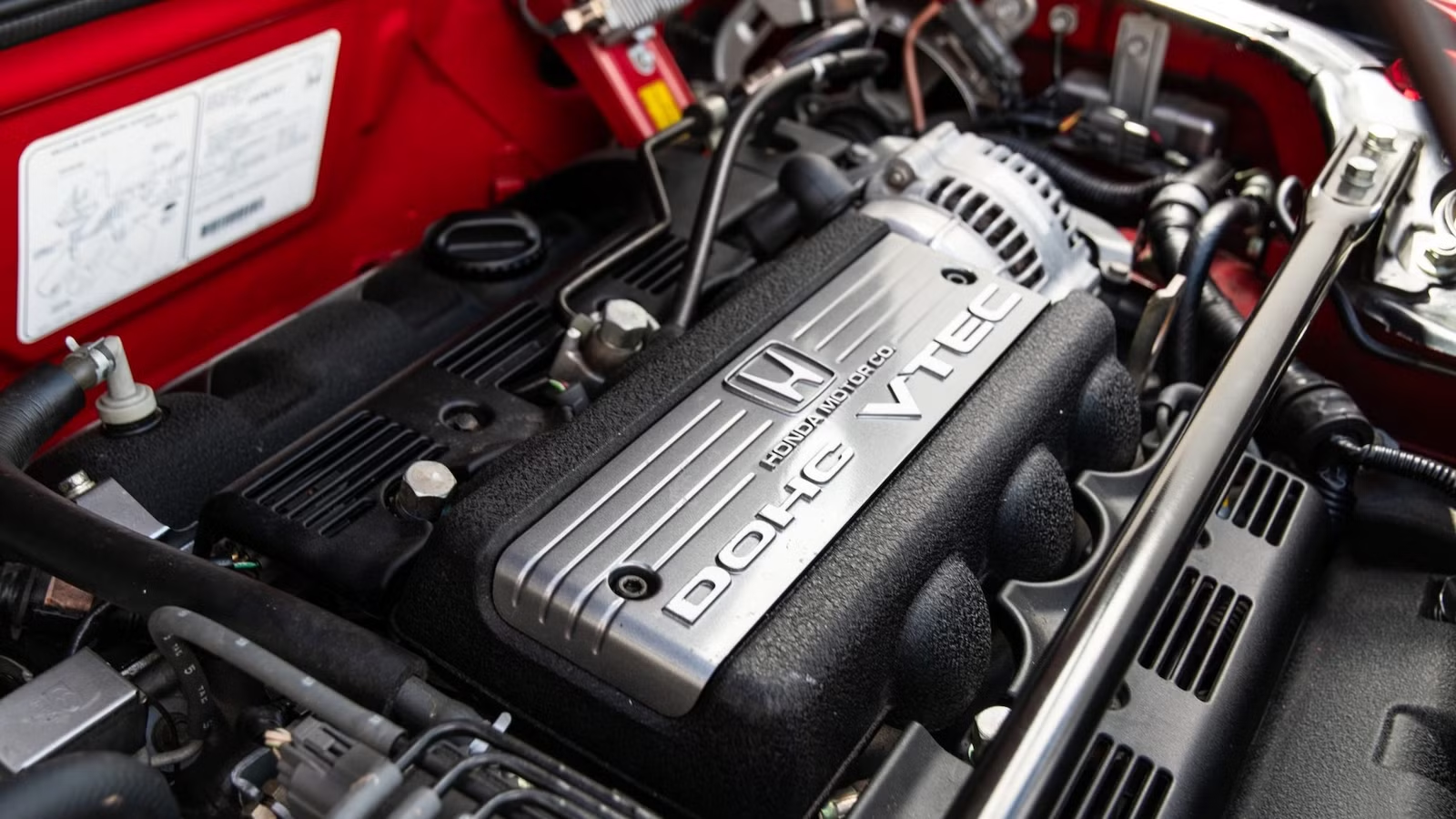
For a certain generation of gearhead, four letters trigger a Pavlovian response: VTEC. Honda’s variable-valve-timing tech transformed humble Civics and Integras into high-rpm heroes, launched a thousand tuner builds, and eventually became shorthand for an entire era of Japanese performance. But America didn’t meet the technology in an economy car equipped with a fart can and a laptop. Honda chose something far more exotic for VTEC’s North American debut: an aluminum supercar engineered to make Ferrari nervous.
VTEC Gives Hondas Two Engines Under One Hood

For much of automotive history, camshaft design was a tug-of-war. A valve profile optimized for a high-revving engine generally hurts low-rpm torque, while tuning for low-speed performance costs horsepower at the top of the tachometer. Do you build a motor for racing or for everyday traffic? Then along came Honda.
Early DOHC VTEC used three cam lobes and three rocker arms for each pair of valves: two outer lobes with low-speed profiles and a more aggressive center profile with greater lift and duration for high-rpm breathing. At low rpm, the outside rockers operate the valves. But once the computer commands the changeover, oil pressure moves a locking pin, tying all three rockers together so the valves follow the larger center lobe.
Honda launched the first production DOHC VTEC engine in the Japanese market in the 1989 Integra XSi, where the 1.6-liter B16A produced 160 hp at 7,600 rpm. The technology soon spread through Integras, Civics, Preludes, Del Sols, and eventually the 240-hp, 9,000-rpm S2000. Gearheads took notice. By the 2000s, the Civic Si was a speed icon. But it wasn’t the iconic Civic that debuted VTEC to the U.S. market.

The Acura NSX Debuted Honda’s VTEC In North America To Put Ferrari On Notice

On February 9 1989, Honda revealed the mid-engine Acura NS-X Concept. The production Acura NSX reached U.S. dealerships in August 1990 as a 1991 model. It marked VTEC’s North American debut.
The NSX spec sheet was exotic enough to make Ferrari as uncomfortable off the track as Honda’s F1 cars had made it on the track. Behind the seats sat the all-aluminum 2,977-cc C30A, a naturally aspirated 90-degree DOHC V6 making 270 hp at 7,100 rpm and 210 lb-ft at 5,300 rpm with the five-speed manual. Its redline began at 8,000 rpm, thanks to titanium connecting rods that reduced reciprocating mass. Fuel cutoff came at 8,300 rpm. A variable-volume induction system worked alongside VTEC to broaden the torque curve. The manual car weighed just 3,010 pounds.
Period testing put 0-60 mph at 5.9 seconds. Acura estimated a 168-mph top speed.
The NSX also used an aluminum unit body, forged or cast aluminum suspension pieces, and an F1-style double-wishbone layout; the five-speed version did without power steering. The cabin offered nearly 312 degrees of total outward visibility, and the low cowl and canopy-like greenhouse were deliberately engineered to fix the blind spots common to mid-engine exotics. Engineers even used a Cray supercomputer for finite-element and stress analysis of the aluminum structure.
Honda Had To Stretch The NSX Just To Fit VTEC

The NS-X Concept unveiled in Chicago in February 1989 still used a SOHC V6 shared with the Acura Legend. So no VTEC. Honda president Tadashi Kume fired the prototype up before its press conference, then asked his engineers why the company’s new flagship lacked Honda’s new VTEC system. They explained that VTEC had been planned for a four-cylinder application only. Kume pushed them to develop a VTEC V6.
Adding VTEC to the NSX required much more than a cylinder-head transplant. The eventual C30A kept the C-series 90-degree bank architecture but became a bespoke 2,977-cc DOHC VTEC engine with separate intake and exhaust camshafts, titanium connecting rods, direct ignition, and a resonance-based variable-volume intake system. VTEC itself added 20 hp to the NSX calibration.
The new DOHC VTEC cylinder heads were wider than the prototype’s SOHC heads. To fit the engine, Honda was forced to lengthen the wheelbase and increase both front and rear overhangs before production. The finished U.S. car rode on a 99.6-inch (2,530-mm) wheelbase.
And the tinkering wasn’t over: Ayrton Senna judged the prototype insufficiently rigid during testing at Suzuka, prompting Nürburgring development that ultimately increased body rigidity by 50% over the preliminary design.
America May Have Forgotten The Supercar, But It Fell In Love With The Engine
When the NSX hit U.S. showrooms, it created enormous demand. Cars with low-$60,000 sticker prices changed hands for around $95,000, with buyers paying premiums of 50% or more. Then the fever broke. U.S. NSX sales fell from 1,940 in 1991 to 1,154 in 1992 and just 652 in 1993. By 1998, sales had fallen to 303. In 2001, just 182 were sold.
To say VTEC outlasted the NSX would be an understatement. The tech trickled down into cars normal enthusiasts could afford. The 1992 Integra GS-R became Acura’s second VTEC model with a 160-hp 1.7-liter B17, the Civic Si gained VTEC that same model year, and the Prelude, Del Sol, Integra Type R, and S2000 kept pushing the formula further. Young drivers who could never afford an NSX could pick up a used Civic, raid the parts catalog, and chase high-rpm thrills without breaking the bank. America may have forgotten the NSX, but it never forgot that feeling when the VTEC kicks in.
Sources: Acura, Formula 1, Honda

Related posts


Latest Post


No Comments