
V8 Engine Comeback: Ram Hemi, Corvette, Mustang Lead The Charge
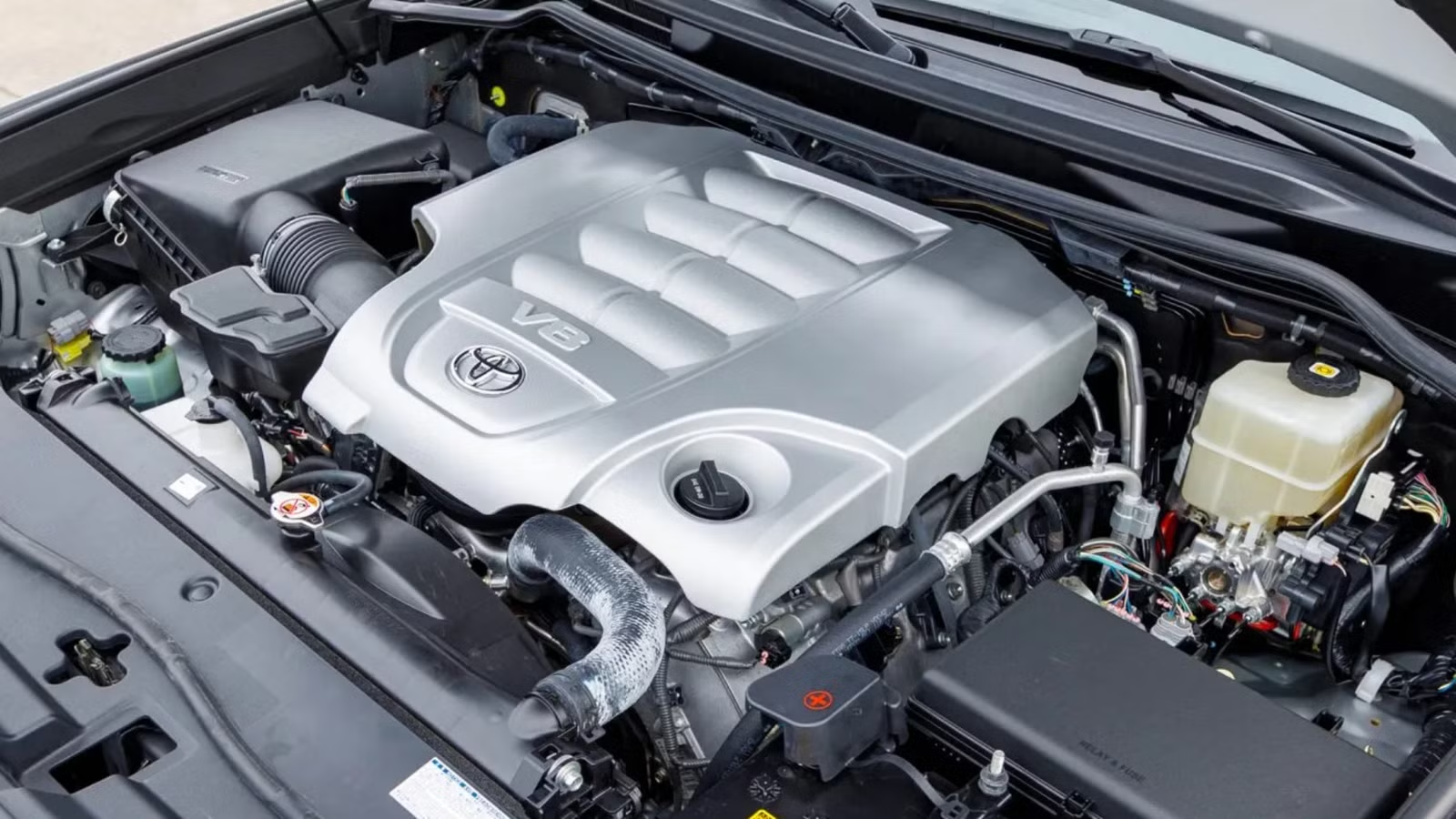
The industry spent the better part of three years telling gearheads to get used to turbocharged sixes and four-cylinders. Turns out, the gearheads weren’t listening. As of this week, Ram CEO Tim Kuniskis has publicly admitted that dropping the Hemi in 2023 was a mistake — and the 2027 Ram 1500 Rumble Bee, arriving with three V8 options, is the clearest sign yet that the eight-cylinder isn’t going anywhere.

The reversal is real and it’s industry-wide. Mercedes-Benz engineered a brand-new 530-horsepower V8 for the updated S-Class.
GM never stopped pouring resources into the V8 powering every Corvette rolling out of Bowling Green. And according to MotorTrend Detroit editor Alisa Priddle, 40 percent of everyone buying a Ram right now is still opting for a Hemi. The models that refused to abandon the format didn’t just survive — they’re now the ones the rest of the industry is scrambling to catch up with.
Ram’s Hemi Admission: ‘We Learned The Hard Way’

Kuniskis didn’t mince words when speaking to ABC News. Dropping the Hemi in favor of the turbocharged Hurricane inline-six wasn’t the problem — the problem was taking away the choice. “It wasn’t so much that people didn’t like the T6, they hated the fact that we didn’t give them a choice,” he said. “That’s what we learned the hard way … and that was the impetus to bring back the Hemi.”
The 2027 Ram 1500 Rumble Bee is the correction. It arrives with a 5.7L Hemi V8, a 6.4L “392” Hemi V8, and the full 6.2L supercharged Hellcat Hemi — three distinct V8 flavors, zero V6 options. The Ram 1500 TRX SRT is also making its return with the 6.2L Hemi under the hood. The Hurricane six stays in the lineup on the Ram 1500 RHO, but it’s no longer the only answer. Kuniskis made his own position clear: “I love performance, I love V8s, I love supercharged V8s. Power and capability will always outweigh fuel economy.”
The Models That Never Blinked

While Ram was walking back its decision, a handful of nameplates never needed to. The Mustang GT kept its 5.0-liter Coyote V8 through every regulatory headwind. The Corvette — now in ZR1X form with a twin-turbocharged, hybridized 5.5-liter V8 producing 1,250 horsepower — remained GM’s flagship statement that displacement still matters. Scott Bell, vice president of Global Chevrolet, put it plainly: “We hear from our customers that V8s deliver three things that remain deeply valuable: capability, character and confidence. The feel, sound and performance V8s provide are authentic to the experience many customers want when hooking a trailer up to their Silverado or dropping the top on a Corvette.”
On the truck side, GM kept V8s available across the Silverado, Sierra, Tahoe, and Suburban. Ford made sure nearly every F-150 configuration could be built with a V8. The Dodge Durango never abandoned it either. These weren’t sentimental decisions — they were commercial ones, and the demand data backs them up.
What The Numbers Actually Say

V8s now account for 9.3 percent of U.S. vehicle sales in 2026, according to Edmunds — compared to 20.4 percent for six-cylinders and 64.7 percent for four-cylinders. That raw share looks modest until you consider what those buyers are actually choosing, and why. Ivan Drury, director of insights at Edmunds, told ABC News that fuel economy has never been the primary driver for this segment: “Consumers are still willing to go this route of eight cylinders, even if prices are killing you at the pump. Larger engines still matter, especially for large truck buyers.”
Drury’s read on where things are headed is equally direct: “The V8 is looking a lot better today than two, three years ago. It will soldier on longer than expected and these new V8s are vastly superior” — particularly on efficiency. The V8s being built now meet modern emissions standards and close the fuel-economy gap with the sixes they were supposedly being replaced by. Priddle’s MotorTrend observation that 40 percent of Ram buyers are still choosing a Hemi isn’t a niche data point. That’s nearly half a truck buyer base refusing to be moved.
Luxury And Performance Segments Never Left The Format

Lamborghini Urus SE front end
The premium end of the market barely flinched. Mercedes engineered a new V8 producing 530 horsepower and 553 lb-ft of torque for the updated S-Class, citing emissions compliance and power delivery as the twin goals — proof that building a modern V8 and meeting regulations aren’t mutually exclusive. The Mercedes-Maybach S 580 gets the same engine, with U.S. buyers also having access to a V12 in the S 560.
Luxury SUVs tell the same story. The Range Rover, Land Rover Defender, Porsche Cayenne, Cadillac Escalade, BMW X7 M60i, Bentley Bentayga, and Lamborghini Urus all kept V8s in their lineups. On the sports car side, the Mustang, Corvette, and exotics like the McLaren 750S, Aston Martin Vantage, and Ferrari Amalfi continue setting records with supercharged and turbocharged V8s. The format wasn’t dying — it was consolidating into the segments where it mattered most, and those segments happen to be exactly where enthusiasts and truck buyers live.
The brands that held the line — Ram with its Hemi comeback, GM with its Corvette and truck commitments, Ford with the F-150 and Mustang GT — are positioned to reap the reward of a decision that looked stubborn a few years ago and looks prescient now. Enthusiasts knew the V8 wasn’t finished. It just needed the rest of the industry to catch up.
Source: ABC News

Related posts



Latest Post


No Comments