Toyota’s Fastest-Growing Family Vehicle Isn’t An SUV
8 minutes reading
Sunday, 6 Sep 2026 23:45 0 53 autotech
Car manufacturers continue to heavily prioritize SUV and crossover lineups in 2026 in a bid to meet widespread consumer demand. However, recent commercial indicators reflect an unexpected surge in a traditional family vehicle configuration. Toyota’s August sales report reveals double-digit volume expansion for this functional, hybrid-powered alternative, alongside consistent year-to-date trajectory gains.
By outperforming conventional industry shifts, the model proves that dedicated family haulers remain exceptionally competitive. Practicality and efficient execution continue to secure strong market relevance against a backdrop dominated by conventional, three-row SUV options.
The U.S. MPV and minivan sector demonstrates a steady core demand despite experiencing a severe reduction in consumer choices over the past two decades. Automakers systematically abandoned the segment to prioritize three-row crossovers and SUVs, reducing a market once populated by over a dozen competing nameplates to just a few remaining entries. However, this contraction created a highly concentrated pool of buyer demand. Modern buyers prioritize raw interior volume, sliding door accessibility, low step-in heights, and optimized fuel economy over fashion-focused crossover styling.
The current customer base primarily consists of pragmatic, multi-child families who require maximum interior utility, alongside road-tripping retirees seeking accessibility and long-distance comfort. Fleet operators, rideshare platforms, and non-emergency medical transport providers also bolster ongoing sales. Highly efficient hybrid powertrains and available all-wheel-drive systems keep these specialized vehicles exceptionally relevant. Consequently, the surviving vehicles generate high assembly plant utilization rates and yield stable profit margins for the manufacturers that remain committed to the traditional multipurpose platform.
Toyota Goes All In On Hybrid Efficiency
Craig Cole | TopSpeed
Toyota’s multi-pathway electrification strategy in the U.S. centers on the belief that hybridization is the most effective tool for immediate, large-scale carbon reduction. Prioritizing hybrid electric vehicles has successfully helped American consumers. This direction balances a desire for better efficiency with a hesitation toward charging infrastructure and range anxiety.
This approach has worked remarkably well in its favor, as evidenced by 2026 sales figures so far. Toyota’s electrified models now account for over half of the brand’s total U.S. volume. It effectively showcases how battery resources required for one long-range EV can instead power multiple hybrids. Toyota has framed its conservative EV rollout as a mathematically superior environmental strategy, resulting in better resale values and keeping its lineup accessible to the average buyer.
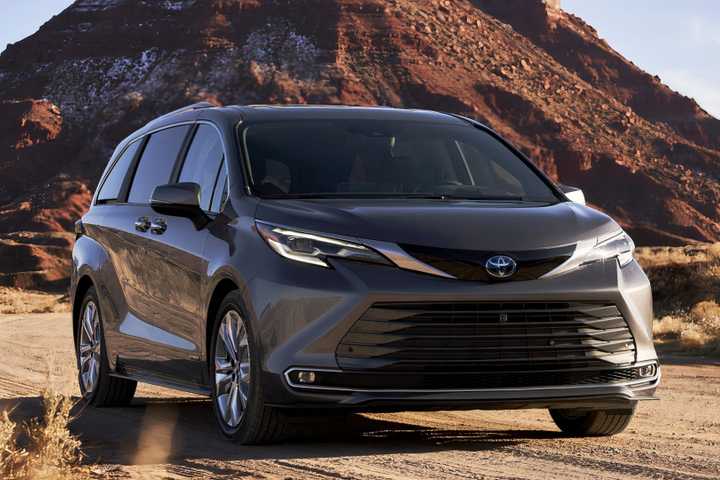
The Toyota Sienna’s Success Continues Well Into 2026
The 2026 Toyota Sienna posted solid sales in August 2026 by delivering 10,133 units, which reflects a 29.1 percent volume increase compared to August 2025. This performance brings its calendar year-to-date total to 74,992 units, marking a 10.2 percent increase year-over-year. While the Sienna maintains a positive growth trajectory, its absolute volume remains lower than established SUV nameplates.
The Toyota RAV4 recorded 34,232 units in August 2026 and 219,472 units year-to-date, despite experiencing volume drops of 19.1 percent for the month and 31.7 percent year-to-date. Meanwhile, the Toyota Grand Highlander logged 9,991 units in August 2026 and 96,917 units year-to-date. Although the Grand Highlander saw a 23.5 percent volume decline in August 2026, its year-to-date figure reflects an 8.5 percent total increase compared to the same period in 2025.
The Toyota Sienna Remains A Dominant Force
The minivan segment in the U.S. has drastically shrunk in recent years, but it has also evolved into a high-stakes battle of specialization. As of 2026, only four brands offer this type of vehicle, with the Sienna being the most dominant option by a massive margin. Starting at $40,420 for the LE trim, the Sienna is a value leader, especially when you consider its long-term fuel savings.
Toyota’s strategic decision to transition the Sienna to a hybrid-only platform started in 2021, and was the driving force behind its Beyond Zero carbon neutrality goals. The Japanese brand’s desire to provide a clear competitive advantage in efficiency led to the eventual elimination of the traditional V‑6. In doing so, Toyota successfully addressed the primary consumer complaint regarding minivans and their poor fuel economy. This bold move transformed the van from a standard family hauler into a modern efficiency statement, solidifying its position in a market increasingly wary of rising fuel costs.
Toyota’s Well-Rounded HEV Drivetrain
The 2026 Toyota Sienna features the Hybrid Synergy Drive system, consisting of an Atkinson-cycle 2.5-liter Dynamic Force four-cylinder engine. In isolation, this produces 189 horsepower and 176 pound-feet of torque. Toyota pairs this with two permanent magnet synchronous electric motors in front-wheel-drive models, or three in Electronic On-Demand All-Wheel Drive configurations. These bring the total system output to a net 245 hp.
Power is managed by an electronically controlled Continuously Variable Transmission, which trades the mechanical shifts of a traditional automatic for seamless acceleration. While it isn’t the fastest in its class, an AWD Sienna Limited can sprint from 0 to 60 MPH in 7.5 seconds. Toyota limits its top speed to 117 MPH.
Class-Leading Consumption Figures
The 2026 Toyota Sienna sets the benchmark for efficiency in the minivan segment. The EPA estimates a class-leading 36/36/36 MPG result on its city/highway/combined cycle for front-wheel-drive models. Opting for all-wheel drive across trims like the Woodland Edition or Platinum results in only a marginal dip to 35/36/35 MPG.
With its 18-gallon fuel tank, the Sienna offers a massive cruising range of approximately 630 to 648 miles per fill-up, significantly reducing the frequency of gas station visits compared to V-6 rivals. Based on current 2026 fuel averages of $4.39 per gallon, it costs roughly $3.05 to drive 25 miles and approximately $79.00 to fill the tank from empty. Over a five-year ownership period, the EPA estimates the Sienna can save owners upwards of $5,235 in fuel costs compared to the average new vehicle.
Ownership Costs Remain Low
Data from major automotive analysts suggests a strong balance between high initial value and class-leading operational savings when evaluating the long-term financial commitment of the 2026 Toyota Sienna. According to Edmunds’ True Cost to Own calculator, a base Sienna LE is projected to have a five-year ownership cost of $52,210, while the top-tier Platinum trim climbs to roughly $64,488 due to higher financing and insurance premiums.
CarEdge estimates that a Sienna will cost about $47,621 over its first five years, noting that depreciation remains the largest factor at roughly $19,282. This is significantly offset by the vehicle’s excellent residual value. Kelley Blue Book reinforces this with a five-year Cost to Own estimate of $61,026, placing it in the top 25 percent of its segment for affordability. To keep the vehicle running, RepairPal estimates an average annual maintenance and repair cost of just $554, which is notably lower than the $647 average for the minivan segment.
The Sienna Continues To Win Favor From The Public
Mainstream and affordable cars at 2026 Detroit Auto Show.Tom Murphy | TopSpeed
According to J.D. Power, the Sienna sits with a 78/100 consumer-verified rating. This includes 76/100 for quality and reliability, 74/100 for the driving experience, 85/100 for resale, and 78/100 for the dealership experience.
According to iSeeCars, the Toyota Sienna range sits with an 8.6/10 overall score. It awards the van 8.1/10 for reliability, 8.6/10 for retained value, and 9.0/10 for safety. The publication indicates that the model benefits from an 11.8-year or 168,547-mile average lifespan with a 32.7-percent probability of reaching 200,000 miles. It also suggests that on average, the van will lose $15,129 or 38.6 percent of its value over five years and 60,000 miles, which is substantially less than the bulk of its rivals.
While it remains a massively popular option in Toyota’s catalog, the Sienna currently holds a 3.5/5 average score on the Edmunds Consumer Review section. It gains a lot of praise for its fuel efficiency, generous interior space, and driving experience. It has drawn criticism for quality inconsistencies.
More Than Enough Space For The Whole Family
The 2026 Toyota Sienna features a spacious three-row cabin designed to maximize occupant comfort and storage versatility. Front-row occupants receive 40.1 inches of headroom and 40.3 inches of legroom. Second-row passengers get up to 39.9 inches of headroom, or 39.3 inches with a sunroof, paired with 39.9 inches of legroom, which expands significantly when utilizing the available super-long-slide captain’s chairs.
Third-row occupants retain practical proportions, with 37.4 inches of headroom and 38.7 inches of legroom. Cargo capacity starts at 33.5 cubic feet with all seats in position. Folding the 60/40 Split and Stow third-row seat expands cargo volume to 75.2 cubic feet behind the second row. The total available storage space reaches 101.0 cubic feet with the second row folded forward and the third row stowed.
Base Trim Engine
2.5L Dynamic Force I4 Hybrid
Base Trim Transmission
CVTi-S CVT
Base Trim Drivetrain
Front-Wheel Drive
Base Trim Horsepower
245 HP @6000 RPM
Base Trim Torque
176 lb.-ft. @ 4400 RPM
Base Trim Fuel Economy (city/highway/combined)
36/36/36 MPG
Base Trim Battery Type
Nickel metal hydride (NiMH)
Make
Toyota
Model
Sienna
Sources: Toyota, the EPA, J.D. Power, iSeeCars, and Edmunds.









No Comments