
Toyota Is Making A Powertrain Bet No Rival Has Tried
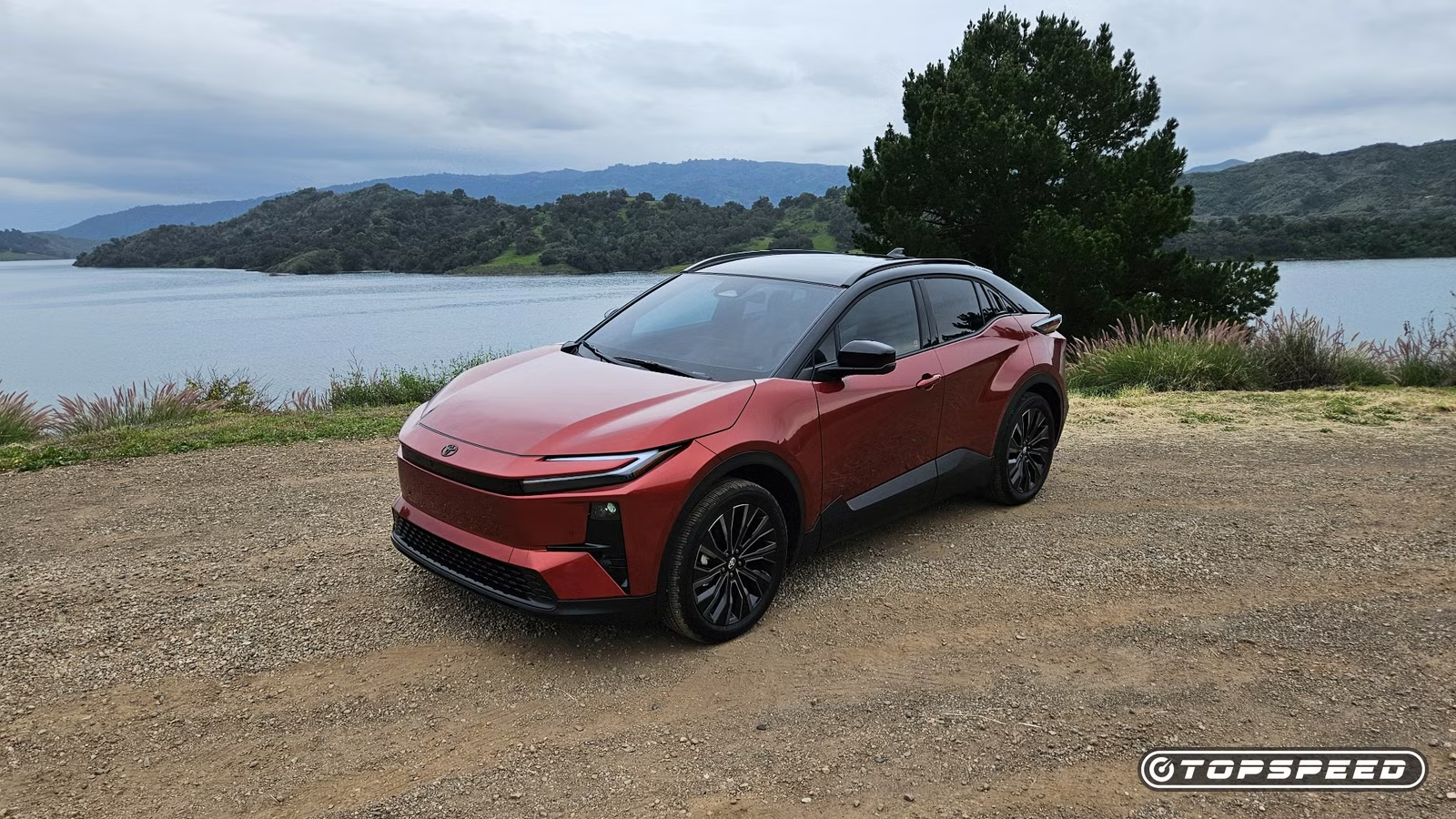
Roughly $55 billion. That is the size of the EV rollback charges announced by Stellantis, Ford, General Motors and Volkswagen’s Porsche arm, and it landed in a matter of months. Toyota is not on that list. Instead of picking a winner, the world’s biggest carmaker has spent years funding cleaner combustion, hybrids, range extenders, batteries and hydrogen at the same time. It looks messy, expensive, and faintly old-fashioned. It also looks increasingly like the smartest hedge in the industry. Nobody else is attempting all five at scale. Here is how the bet works, and where it could still go wrong.
The One-Powertrain Gamble That Could Leave Automakers Exposed

On paper, going all-in on battery power made sense. Regulators were tightening, investors rewarded bold electrification targets, and a single-technology strategy promised huge economies of scale. Stellantis, for one, aimed for every car it sold in Europe to be electric by 2030, with half of its US volume following. The trouble with one big bet is that it needs several things to go right at once. That means government policy, charging infrastructure, battery supply, and customer appetite. When one of those moves, the whole structure shifts. In America, several moved together. Washington let its US$7,500 consumer tax credit expire at the end of September 2025, and EV sales fell by roughly 40 percent the following November.
The bills followed quickly. Ford took a US$19.5 billion write-down tied to resetting its electric business. Stellantis then announced €22.2 billion in charges, the largest of any automaker so far. Volkswagen absorbed about US$6 billion through a restructuring at Porsche that delayed or killed several planned electric models. Much of that money was not paper losses. Stellantis alone expects around US$7.7 billion in cash payments over four years, largely to compensate suppliers for canceled orders.

None of this proves that electric cars have failed. Analysts were careful to say the charges do not signal a general collapse of the EV market, and Chinese brands have kept growing in the same period. The mistake was concentration. Factories, supply chains and marketing were built around one outcome arriving at one pace. One investor called the EV reversal possibly the biggest capital allocation mistake in automotive history, and predicted at least US$100 billion in eventual write-downs.

That is what exposure looks like: plants tooled for products with no buyers, contracts that cost money to cancel, and engineering teams reassigned mid-program. It leaves every strategist with the same uncomfortable question. What happens if the future arrives late, early, or in a different shape than the spreadsheet assumed?
Toyota’s New Engines Keep Combustion Alive For A Low-Carbon Future

The most radical thing about Toyota’s new engines is how modest they look. The family is three inline-four units including a naturally aspirated 1.5-liter, a turbocharged 1.5-liter, and a turbocharged 2.0-liter. They were unveiled in 2024 at a joint conference with Mazda and Subaru, and their headline trick is shrinking. The turbocharged 1.5 is meant to cover the territory of Toyota’s 2.5-liter naturally aspirated engine while being 20 percent smaller in volume and 15 percent lower in height. The 2.0-liter turbo is about 10 percent smaller in volume and height than the 2.4-liter turbo it replaces.
Why spend billions on combustion while rivals pare it back? Because a smaller engine is a packaging tool as much as a cleaner one. A lower hood line cuts aerodynamic drag, and Toyota expects that to deliver about 12 percent better fuel economy in sedan-class vehicles. There is also a regulatory angle. Toyota says its current engine would need its power cut by around 30 percent and rely on expensive catalysts to meet coming European and US emissions rules, whereas the new design keeps its output.

The real pitch is fuel flexibility. The engines are designed to run on gasoline but also on carbon-neutral fuels such as liquid hydrogen, synthetic fuel, and biofuel. Toyota’s argument, as one report summarized it, is that the enemy is carbon emissions rather than the engine itself. Paired with electric assistance, the naturally aspirated 1.5 is targeted at around 95 horsepower and 88 pound-feet on its own, with a 41-horsepower electric system taking combined output past 136 horsepower. What sets Toyota apart is the combination. A rival can develop a clean combustion engine. Very few can also fund the hybrid, hydrogen and battery programs that make that engine one option among several.
The Hydrogen Bet Expands From Fuel Cells To BMW’s Next Generation

In 2028, a BMW will roll out of an Austrian factory carrying a fuel cell that Toyota helped design. BMW’s third-generation hydrogen system will be manufactured at its Steyr plant from 2028, and BMW and Toyota are jointly developing the powertrain system for passenger vehicles. BMW has confirmed that its iX5 Hydrogen will enter series production that year, and its development chief has described it as the first fuel cell production model in BMW’s history.
The technology has moved on since the pilot fleet. The new stack is about 25 percent smaller than the one in the 2023 iX5 pilot cars, with the same power, and its footprint is roughly comparable to a typical four- or six-cylinder engine and its ancillaries. That partnership has deep roots. BMW and Toyota agreed to share diesel and hybrid technology back in 2011, and BMW built a hydrogen i8 a year later.

It is tempting to call Toyota the “Intel Inside” of hydrogen, but that undersells the arrangement. This is co-development, with each company aiming to keep its own identity. BMW and Toyota fuel cell models are meant to keep distinct brand characteristics. The benefit is shared cost. The core cell technology creates synergies for both commercial and passenger applications, which spreads the development bill over more vehicles.
Toyota’s own third-generation system shows where the volume is expected to come from. Compared with the previous generation, it offers twice the durability, 20 percent better efficiency, and significantly lower cost. It was designed to run for about 621,000 miles in heavy-duty trucks. Scania will run 40 trucks with Toyota’s 400-horsepower system from early 2027, and IVECO is building a fuel cell truck with a target range beyond 560 miles. Toyota has also used motorsport since 2017 to develop hydrogen combustion engines.
Hydrogen still has a chicken-and-egg problem. BMW itself told one publication that hydrogen pump prices must reach parity with diesel for its car to succeed commercially. Toyota has sold only about 28,000 Mirai fuel cell cars since 2014, which shows how slowly passenger demand has grown. The bet is that trucks, buses and a premium partner can finally supply the scale that passenger cars alone never did.
Range-Extender EVs Add Another Bridge Between Hybrids And Battery Power

The company that made hybrids mainstream does not yet sell a range extender. Toyota has no such vehicle in its lineup, nor a dedicated platform for one. That is about to change, at least according to reporting from Nikkei Asia. The plan is to start producing a range-extender model in China in April 2027, reaching around 200,000 units a year by the end of 2027 and about 400,000 by 2028. Toyota has not publicly revealed which vehicle will lead the charge, so treat the numbers as reported targets rather than confirmed ones.
The technology sits neatly between two things Toyota already builds. A range extender is essentially a battery-electric car with a small petrol engine that acts as a generator and does not drive the wheels directly. It drives like an EV day to day but removes range anxiety on long trips. That makes it, as one outlet counted, Toyota’s fifth electrified powertrain, alongside battery-electric, plug-in hybrid, hybrid, and fuel-cell.

The reason is China. Toyota’s sales there had fallen about 20 percent through July, compared with the same period a year earlier. Extended-range models are popular because they sidestep charging worries, and because the government excluded plain hybrids from new-energy tax credits. They can also carry higher prices and better margins than pure EVs, which matters in a market where battery-only cars are locked in a brutal price war. A Toyota executive put it plainly: competition is intensifying as the market fixates on battery EVs, triggering price wars.
Toyota is not leaving battery cars behind in China. It launched the GAC-developed bZ3X in 2025 alongside the bZ5, which uses BYD and FAW technology. The range extender simply adds a rung to the ladder. Is Toyota late? Yes. Hyundai, Ford, Stellantis and Nissan are already in the race, and Motor1 noted that Toyota was late to battery EVs and is now arriving late to range extenders too. It is also China-focused for now, with no sign yet that the technology will spread to other markets. But arriving late with a proven engine and manufacturing muscle is a very different position from arriving early with an untested plan.
A Five-Way Powertrain Strategy Designed To Outlast A Single EV Future

Put the pieces together and the shape of the bet is clear: cleaner combustion engines, hybrids and plug-ins, range extenders, batteries, and hydrogen, all running at once. Each is a hedge against a different failure. Slow charging rollout favors hybrids and range extenders. Scarce battery materials favor hydrogen and combustion. Cheap renewable fuels would favor the new engines. If pure battery power wins outright, Toyota has that program too.
The financial contrast is where the strategy earns its argument, though it needs careful reading. Toyota did not have a record profit year. For the year to March 2026, operating income fell 21.5 oercent to ¥3.77 trillion, and the margin slipped to 7.4 percent from 10.0 percent. That is roughly US$24 billion, on record revenue of ¥50.68 trillion. The main culprit was not electrification at all. US tariffs removed about ¥1.38 trillion, roughly US$9 billion, from operating income, and North America swung to an operating loss.

Set that beside the rivals. Ford’s US$19.5 billion, Stellantis’s €22.2 billion, Porsche’s roughly US$6 billion, and General Motors’ billions in charges are all costs of reversing an EV bet. The comparison is not like for like, since operating income and one-off write-downs are different measures. Even so, the direction is telling. Toyota’s pain came from trade policy and currency. Its rivals’ pain came from their own product strategy.
Toyota is not immune to what comes next. The company warned that its break even volume has risen sharply because of investment in people and future technology, plus tariffs, and it forecasts operating income of ¥3 trillion for the year to March 2027, a third consecutive decline. Running five programs is expensive, and shareholders will eventually ask which ones deserve to survive.

There are unresolved questions inside the strategy as well. Hydrogen still lacks stations, synthetic fuels lack supply, and the range extender arrives late to a crowded market. None of the five is guaranteed to pay off. But that is the point of a hedge. Toyota is not claiming to know which technology wins. It is paying to avoid having to know. For buyers, the practical result is choice — acompany that will still be selling and supporting hybrids, plug-ins, combustion cars, and electric ones, whichever way regulators and markets turn. In an industry that just spent US$55 billion learning the cost of certainty, that looks less like conservatism and more like risk management.
Sources: Toyota U.S., Motor1, CarScoops, Nikkei Asia, Electrek

Related posts




Latest Post


No Comments