
Top 10 Best New Cars We Saw In 2026
Car enthusiasm isn’t going anywhere – it’s evolving. 2026 has brought first-time EVs from blue‑chip badges, a few high‑stakes halo cars, and fresh platforms that aim to reset what daily drivers and performance machines can do. There’s real variety here: compact coupes, big luxury SUVs, a mid‑size adventure EVs, and not one but two exotic supercars rewriting the spec sheet. Enthusiasts get more choices, more tech, and more personality – without losing the focus on driving.

The challenge? The news cycle is noisy, and plans slip. This list cuts through that. Every pick has either alredy been launched already or has a clear, on‑the‑record 2026 timeline from the brand or widely cited primary reporting. You’ll see what each car promises, why it matters to drivers, and the key tech that backs it up. If something is still TBD, that’s flagged – no guesswork here.
Alfa Romeo Giulia
Alfa Romeo’s driver’s car returns on Stellantis’ STLA Large architecture, and the timing is official: Giulia follows the new Stelvio with a 2026 introduction. The shift under the skin is dramatic. STLA Large supports both hybrid and full-electric layouts, and Alfa has stated its intention to move toward an EV-led lineup. That means the Giulia will evolve beyond its current longitudinal ICE setup while preserving the brand’s quick steering and light-on-its-feet character that fans have always valued.

What matters to enthusiasts is the platform’s headroom. STLA Large is engineered for high-voltage powertrains and fast-charge rates, with packaging that keeps weight and battery mass low in the chassis — the right recipe for preserving response and ride control. Combustion-powered variants are also confirmed, so the Giulia won’t be EV-only from the start. Expect a cleaner cabin with modern software, but heritage cues should survive: tight seating position, good sightlines, and that purist Alfa driving stance. The headline is simple — Giulia stays a driver’s car, with the hardware to keep it relevant well into the electric era.
BMW Neue Klasse Sedan

BMW’s next chapter begins in Munich in summer 2026. The first Neue Klasse model — a 3 Series-sized electric sedan — kicks off production there, confirming the timeline after years of concepts and test mules. BMW hasn’t committed to a final name yet, but the formula is clear: new e-motor technology, new battery chemistry, a lighter electrical architecture, and a fresh UI designed to declutter the cockpit without dulling the drive.
Enthusiasts should pay attention because Neue Klasse targets the classic BMW balance: steering precision, rear-biased dynamics, and real-world efficiency. BMW has highlighted more efficient e-motors and high-voltage packs engineered for better range and repeatable performance. The sedan sets the benchmark for the entire family that follows — including the next X3-class EV. Think of it as a reset of the sport-sedan playbook for the electric age: same mission, sharper tools.
Bugatti Tourbillon

A new Bugatti doesn’t just move the bar — it welds it higher. The Tourbillon pairs a naturally aspirated 8.3-liter V16 with three electric motors for a combined 1,800 hp. The spec is outrageous, but the execution is artful: analog watch-inspired controls, a fixed-hub steering wheel that keeps the gauges in view, and a carbon-intensive structure with 3D-printed components. Production is capped at 250 units, with customer deliveries scheduled for 2026.
Beyond the numbers, the real story is how Bugatti blends feel and fury. The naturally aspirated V16 promises razor-sharp throttle response and a spine-tingling soundtrack, while the e-motors deliver seamless torque fill and all-wheel traction. The 24.8-kWh battery provides meaningful electric running for quiet city use; the rest of the time, it feeds a top-speed target north of 270 mph (with the Speed Key). This is a technical statement piece, but it’s also a driver’s machine — one that keeps emotion front and center in an electrified world.
Ferrari EV

Ferrari’s first battery‑electric model isn’t a styling exercise — it’s a production car with a firm start line. The company has confirmed that customer deliveries begin in October 2026. The new EV will be built in Maranello’s “e-building,” a flexible facility designed for ICE, hybrid, and electric models alike. Ferrari plans a phased reveal: the “technological heart” comes first, followed by the full car ahead of launch.
For the tifosi, the question is character. Ferrari understands that an EV must still feel like a Ferrari — instant response, fine control, and feedback that invites commitment. Expect a sharp focus on weight management, low rotational inertia, and power electronics tuned for precision rather than straight-line numbers. These priorities likely explain why Ferrari recently had access to one of the world’s fastest EV prototypes for development reference at its factory. Personalization remains central to the brand, and the new facility was built with exactly that in mind. This one matters well beyond Maranello — it sets the tone for how top-tier performance brands approach the electric era.
Genesis GV90

Genesis has real momentum, and the GV90 is its full-size, three-row electric flagship. Production is slated to begin around mid-2026, and the design language draws from the Neolun concept: minimalist surfacing, a lounge-like cabin, and show-car details evolved for the real world. Expect the brand’s latest EV platform and fast-charging hardware, along with driver-assist technology that prioritizes best-in-class polish over gadget overload.
The GV90 plays a different game than an outright performance SUV — but enthusiasts should still take notice. Genesis has demonstrated a strong ride-and-handling balance in recent models, and the GV90 scales that up with silent cruising, strong straight-line pace, and brake-by-wire calibrated to feel natural underfoot. If Genesis can deliver crisp steering and composed body control at this size, it will arrive as a legitimate alternative to the EQS SUV, Escalade IQ, and Range Rover EV.
Honda 0 Series Electric Sedan

Honda used CES 2025 to pull the cover off the 0 Series and put firm timing behind it: the 0 Saloon arrives first in North America in 2026, with a companion 0 SUV close behind. The program centers on “Thin, Light, and Wise” — shorthand for smart packaging, disciplined weight control, and software that adds genuine value without clutter. Honda also announced its new ASIMO OS and a Renesas-developed SoC to run it, laying the groundwork for a responsive UI, advanced driver assistance, and over-the-air growth.
Why it matters: Honda built its reputation on lightweight engineering and honest, responsive chassis tuning. The 0 Series aims to carry that DNA into the EV age — lower mass, clean aerodynamics, and a driving position set up for engagement. That’s exactly the right approach for making an electric sedan interesting to people who care about how a car moves, not just range figures or screen size.
Honda Prelude

Honda is bringing back the Prelude as a 2026 model, and it isn’t a nostalgia play. The coupe uses Honda’s two-motor hybrid system and — crucially — hardware borrowed from the Civic Type R’s front end, including the dual-axis strut layout that eliminates torque steer and sharpens turn-in. Honda has confirmed U.S. timing and positioned the car as a grand-touring sport coupe rather than a track-day weapon.
Enthusiasts should expect balance. The hybrid setup targets quick throttle response and smooth power delivery, while the front-end geometry, wider tracks, and stout braking hardware inspire confidence on fast roads. Honda’s goal reads like the best Preludes of old: a car you choose to drive for no reason at all, because it simply feels right in your hands and feet. Manual purists may grumble, but if the chassis tuning is on point, this Prelude will win converts the moment it arcs into its first corner.
All you need to know about the new Prelude is here
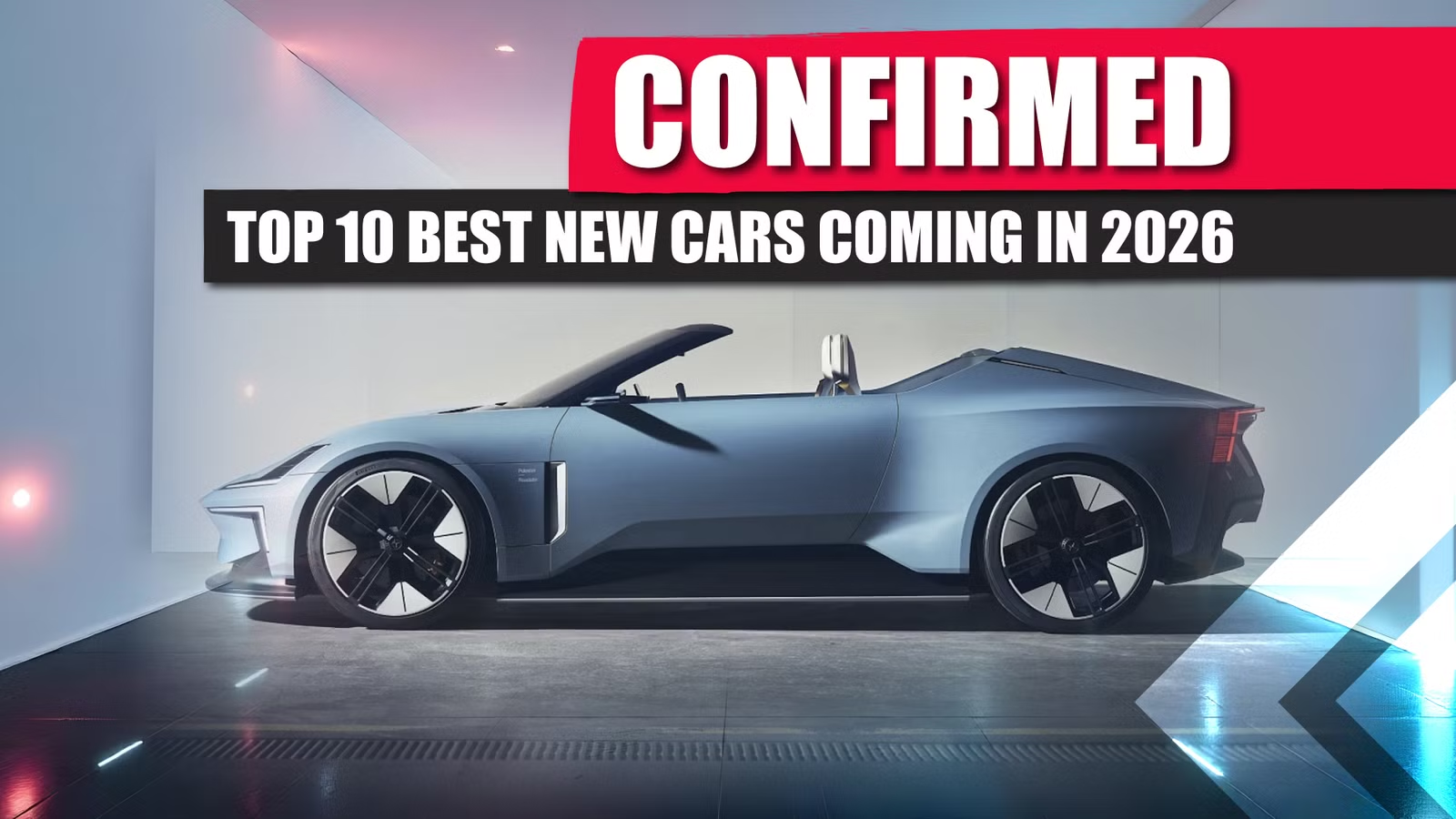
Polestar 6

The show-stopping O₂ concept becomes the Polestar 6 — and the brand didn’t hedge on timing. Polestar has confirmed the electric roadster launches in 2026, with early build slots already spoken for. The car rides the company’s 800-volt performance platform, targeting serious output with dual-motor all-wheel drive and the crisp pedal feel that made the Polestar 5 prototype so impressive during testing.
A proper roadster lives and dies by feel. EVs have instant torque, but the great ones also communicate through the chassis. Polestar is chasing exactly that. The brand’s recent development work shows genuine progress: linear controls, composed body motions, and stable braking. If the 6 keeps weight in check and nails steering weight and precision, it has every chance of becoming the EV driver’s open-top of choice — quick, composed, and happy to rack up miles.
Porsche Cayenne EV

Porsche’s electric lineup expands with the Cayenne EV. After teasers and prototype appearances at hill climbs, Porsche has signaled a full reveal ahead of sales beginning in 2026. The Cayenne EV slots above the Macan EV and shares key 800-volt technology, advanced chassis systems, and the brand’s now-familiar philosophy: fast charging, strong repeatable performance, and braking that blends regenerative and friction forces seamlessly.
Why it’s a big deal: the Cayenne defined the performance SUV segment for two decades. An electric version has to carry that torch with control and endurance. Expect Porsche Active Ride-style body control, stout dual-motor configurations, and thermal management tuned for back-to-back hard runs, not just a single glory pull. If it drives like a Porsche first and an EV second, it will set the class benchmark from day one.
Rivian R2

Rivian’s R2 aims straight at the heart of the enthusiast’s daily: mid-size footprint, useful range, genuine off-pavement capability, and the clever packaging that made R1 models cult favorites. Rivian moved production to its Illinois plant to accelerate the program and confirmed a first-half-2026 delivery window — a decision that trimmed billions in capital expenditure and put the program on a tighter, more executable path.
The R2 matters because it promises the R1’s personality at a price and size that more buyers can actually live with. Expect punchy acceleration, thoughtful ride tuning, and the modular gear-storage solutions that make active weekends effortless. Rivian’s software and UI have matured considerably, and the company continues to expand charging access and refine trip planning in its app. If Rivian nails efficiency and keeps the suspension calibration honest, the R2 could become the default do-everything EV for drivers who genuinely care about how a vehicle feels.

Related posts



Latest Post


No Comments