
This Used Sports Car Has Porsche DNA Without Porsche Prices
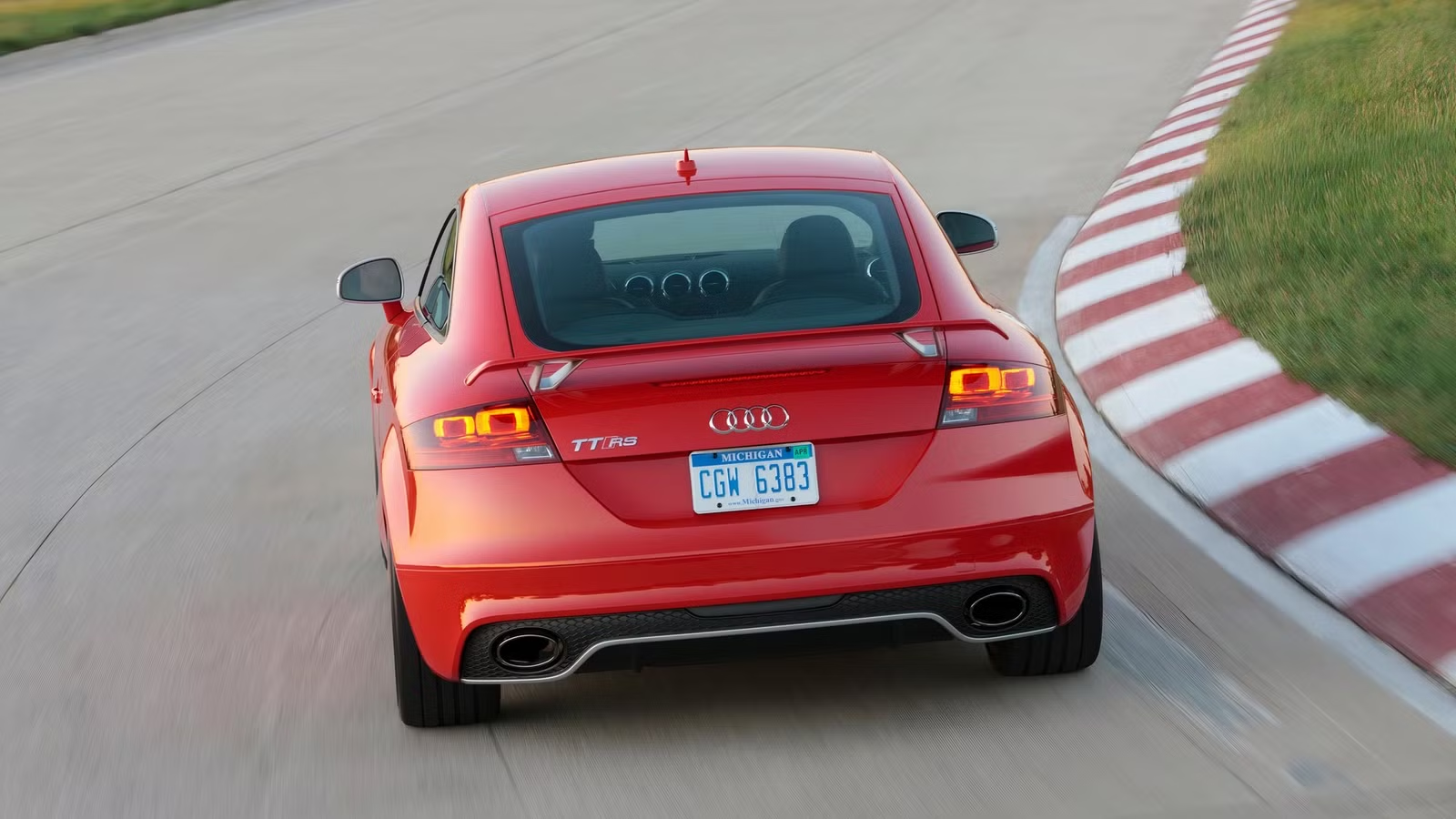
Porsche has spent decades convincing buyers that real driver involvement needs a crest on the hood. The used market tells a more nuanced story. Plenty of rival cars deliver comparable pace, a more distinctive soundtrack and far better everyday manners, yet they change hands for tens of thousands of dollars less. One compact coupe, built from 2016 to 2023, goes further than most. It out-accelerates entry-level Porsche sports cars and keeps company with the quicker ones, while asking a fraction of the money. Here is where it wins, and where it doesn’t.
The Five-Cylinder Engine Gives The Audi TT RS A Character Porsche’s Flat-Four Can’t

The Audi TT RS runs a 2.5-liter turbocharged five-cylinder that makes 394 horsepower and 354 pound-feet of torque. Peak torque arrives at 1,950 rpm and holds to 5,850 rpm, and power stays on tap to roughly 7,000 rpm. The five-cylinder layout, with its 1-2-4-5-3 firing order, produces an off-beat warble that sits between a four’s rasp and a six’s smoothness. Audi has built five-cylinder engines since 1976, and the Quattro rally cars made the sound legendary.

Porsche’s 718 Cayman and Boxster went the other way in 2016. The base car’s 2.0-liter flat-four makes 300 horsepower and 280 pound-feet, and the 2.5-liter in the S makes 345 horsepower and 310 pound-feet. Both are quick and beautifully balanced, but the boxer-four’s flat, thrummy note divided enthusiasts from the start. The Audi’s engine adds more than character: it makes 50 horsepower more than the 718 S and nearly 100 horsepower more than the base car, and it pulls harder through the mid-range where real roads are driven.
Quattro Grip Makes Its Performance Accessible Beyond The Racetrack


Power means little if you can’t use it, and this is where all-wheel drive earns its keep. Audi’s quattro system can send most of the drive rearward, and the TT RS pairs it with launch control and a seven-speed S tronic dual-clutch gearbox to reach 60 mph in a claimed 3.6 seconds. A 718 S with Porsche’s PDK gearbox needs roughly four seconds, and the base car takes around 4.5.
The advantage isn’t only in the numbers. A rear-drive Cayman on cold, wet pavement demands respect and a measured throttle foot. The Audi simply goes, in rain, on cold mornings and out of damp corners, and it makes that pace feel repeatable rather than frightening. The trade-off is feel. The Porsche’s steering is more communicative and its mid-engine balance more engaging, while the Audi leans towards understeer at the limit. A track-day purist will notice, but most owners will spend their time on public roads, where traction and torque count for more than steering purity.
The TT RS Delivers Serious Performance Without Sacrificing Daily Usability


The TT RS is a hatchback underneath the sports-car shape based on the VW Group’s MQB platform. The cargo area holds about 12 cubic feet and grows to roughly 25 cubic feet with the rear seats folded, and the rear seats, though tight, take a bag or a child seat. The Cayman offers about 15 cubic feet across two separate compartments, but nothing folds and nothing fits a bulky item.
Inside, the Virtual Cockpit puts navigation and performance data directly ahead of the driver, and the cabin quality still feels a class above. A switchable sport exhaust lets you keep things quiet in the neighborhood and loud on the open road. The EPA rates the car at 23 mpg combined, which is achievable on a gentle cruise and nowhere near what you’ll see when you use the engine properly. The TT RS has no manual option, which will disappoint some. But the dual-clutch S tronic unit is lightning quick and well-matched to the engine, and it makes slow traffic bearable too.
Used Prices Reveal Where The TT RS Has An Advantage Over Porsche Rivals

Based on mid-2026 U.S. listings, used Audi TT RS asking prices run from about $40,000 to $70,000. Early cars with higher mileage sit at the bottom, while low-mileage later examples fetch the most. A 2018 car with 35,000 miles was asking $44,995, a 2018 with 44,000 miles was at $51,099 and a 2021 with 19,000 miles was at $47,998. Only a 2019 with just 4,000 miles pushed towards $69,900.
By way of comparison, a 2018 718 Cayman starts around $38,998, but that’s the 300 horsepower base car. A 2018 Cayman S was listed at $49,899, roughly the price of a comparable TT RS but with 50 horsepower less. A 2018 Cayman GTS was asking $77,995, so the Audi undercuts it by about $27,000 to $33,000 while matching its output. Newer Porsches climb faster, though: 2019 S models ask around $69,400, and 2021 base cars sit in the mid $60,000 range. A 2021 TT RS costs around $48,000, which means the Audi saves $12,000 to $19,000 over a Cayman of the same year while delivering 100 horsepower more than the base car.
Porsche still wins on residual strength and on the quality of the driving experience. But for buyers chasing performance per dollar, the Audi’s advantage is large and measurable, and with the TT line discontinued in 2023, supply of these cars is now fixed.
Five-Cylinder Heritage, Practicality And Performance Make The TT RS A Compelling Used Buy


So who should buy one? The ideal TT RS owner wants a single car that handles a daily commute, a weekend mountain pass and a family airport run, and values engine character and all-weather pace over steering feel. If that’s you, the Audi delivers more speed, more sound, and more practicality than any Porsche you can buy at the same price.
Go in with your eyes open. The S tronic gearbox and the quattro coupling both need regular fluid services, typically at around 40,000 miles, and a full service history matters more than low mileage. Check for signs of aggressive tuning, because these engines respond eagerly to software tunes and not every owner has been gentle. Budget for tires and brakes too, as a 400 horsepower car chews through both.
Skip it if you need a manual gearbox, want the sharpest possible handling or plan to spend most weekends on a circuit. A Cayman remains the better driver’s car in the purest sense. For everyone else, the TT RS is the used sports car that proves Porsche performance doesn’t have to come with lofty Porsche prices.
Sources: Audi, Porsche, Kelley Blue Book, The EPA

Related posts



Latest Post


No Comments