The Plug-In Hybrid Sedan That Barely Uses Fuel During The Week
12 minutes reading
Sunday, 12 Jul 2026 12:00 0 90 autotech
Crossovers may have invaded dealership lots and set up camp in suburban driveways, but sedans continue to put up a brave resistance. As family-market segments were overwhelmed by SUVs and their mutated suburban raiders over the past decade, traditional three-box, four-door resistance fighter ranks dwindled, but they were never completely wiped out, thanks to inherent sedan traits of personal space, solid road manners, and energy efficiency.
Their positive traits were further enhanced when electrification was added to the mix, and particularly the ability to charge an onboard battery to handle most everyday commuting while keeping the interior free of engine grinding and transmission jostling. The ideal win-win is full-electric power to never have to worry about powertrain roughness or gas stops, but for those not quite ready to give up the gas tank, there are plug-in hybrid sedans that can run on electricity alone for a few days or maybe even a week.
Charging port of 2023 Toyota RAV4 Prime with visible plug-in hybrid badgeToyota
For many drivers, daily mileage is predictable—whether you’re dropping off the kids at school and then running errands around town before picking them up again, or driving to the office and back home. In both cases, modern PHEVs can cover much of the distance on electricity alone. The difference lies in the type of vehicle used. Most daily family errand running is handled by a crossover that can be loaded up with people or cargo, with the versatility to easily switch between the two, whereas the daily commute is usually a time for quiet, personal reflection in a cozy and calm sedan cabin.
The thing to remember also becomes part of the “driving” routine—plugging in during downtime, either overnight at home or during the day at the office—with the benefit being that drivers may never use a drop of gasoline during the week. The ICE then becomes part of the routine for long trips, where drivers don’t have to plan battery top-ups at roadside DC fast-charging stations (and most experts say they shouldn’t). In those cases, sedans really shine with their ability to stretch their legs through aerodynamic high-wind-resistance cruising.
How Sedans Work Well For Efficiency
2020 Mercedes-AMG C63 sedan rear driving shotMercedes
The lower rooflines and lighter weights of sedans help maximize both electric and gasoline efficiency by helping the vehicle move through the onrush of wind. When your main concern is slicing through the wind, a sedan’s characteristic body traits come in handier, regardless of whether crossovers may offer better command of the road and cargo versatility. Plain and simple, taller bodies require more energy to move through the air, especially at highway speeds where aerodynamic hindrances become more noticeable.
2007-2008 Audi RS4 Sedan Red Side View DrivingAudi
The sedan body style works more efficiently when there isn’t a lot of stop-and-go driving because it enables the vehicle to go farther on its onboard energy. That applies to gasoline and to electricity, so an aerodynamic vehicle uses less gasoline or less electricity and is able to go farther (though it can be argued that regenerative braking helps improve electric range, so more stop-and-go is sometimes more beneficial to city efficiency). Beyond aerodynamics, a sedan’s lower ride height also improves stability and reduces energy losses associated with taller structures and heavier suspension needs.
The Luxury Of Using Less Fuel Without Thinking About It
2025 Kia Sorento PHEV ExteriorLyndon Conrad Bell | TopSpeed
Perhaps the most appealing aspect of a high-range PHEV is how little attention it demands once integrated into the daily vehicular routine. Drivers don’t need to drastically change driving habits that come from years of ICE driving, nor do they need to monitor charging stations as EV drivers do. Instead, PHEV owners get a vehicle that prioritizes electric operation and then seamlessly transitions to gasoline once electric capacity dips below 10%. It’s a different set of priorities from the traditional plug-and-play qualities of ICEs and hybrids, but one that works just as well.
Driving thrives on convenience. Vehicles that simplify driving tend to be chosen more often, and plug-in sedans tend to gain favor by saving on energy and inconvenience, as well as on monthly fuel bills, and still allowing their drivers to just get in and drive (well, unplug, then get in and drive). To go about their daily driving, full and mild hybrids rely on using as little gasoline as possible, but efficient PHEVs rely on using as little gasoline as possible. And nothing beats this sedan’s ability to go days or even the entire workweek without using a drop of gasoline.
The 2026 Mercedes-Benz S 580e 4Matic Offers 48 Miles On Electric Range
Front three-quarters shot of a black Mercedes-Benz S580e L. Mercedes-Benz
Among plug-in hybrid sedans, the 2026 Mercedes-Benz S 580e 4Matic stands atop the electric-range podium with an EPA-rated electric-only range of 47 miles, edging out some well-established four-door PHEVs. That’s the kind of electric usability buyers can really use to cut down on their annual driving costs, and beyond that, the S 580e offers worry-free long-distance road-trip capability of nearly 500 miles before topping up its 17.7-gallon fuel tank.
Many PHEVs still function primarily as gasoline vehicles with the ability to travel around town on electricity alone, but the S 580e approaches the concept differently—an electric range that’s long enough to make gasoline avoidance during the workweek realistic for commuters with home charging units. With the average daily travel distance in the U.S. pegged at 42 miles according to Axios, the plug-in Mercedes S-Class sedan could theoretically handle one full day of travel on a single charge of its 22.7-kWh battery.
Plug-In Capability Enhances The Car’s Traditional Sedan Virtues
Front three-quarters shot of a Mercedes-Maybach parked indoorsMercedes-Maybach
The Mercedes-Benz S-Class has long been regarded as one of the world’s premier sedans, long before Mercedes adjusted the “S” label to designate the brand’s largest size for sedans and SUVs, and the 2026 S 580e 4Matic leans into the inherent strengths of sedans—sleek, well-balanced proportions that promote aerodynamic efficiency, a low-slung body that enables planted driving, and a spacious center box that endows roomy comfort for passengers.
Rear 3/4 view of a Mercedes-Benz S580eMercedes-Benz
The latter benefits directly from the 2026 Mercedes-Benz S 580e 4Matic’s electric range, whose silent operation adds to the calm serenity of the cabin better than the best Lexus insulation can block out engine noise. Luxury buyers expect technological sophistication to enhance comfort, and the 48 miles of quiet driving provide the serenity and isolation they willingly pay for. With a fully charged battery, the plug-in S-Class can do that every day, during every commute. And with routine charging, it can provide that quiet ambience for the entire week.
It Demands Little Compromise From Its Owner
2021 – 2026 Mercedes-Benz S-Class Sedan exteriorMercedes
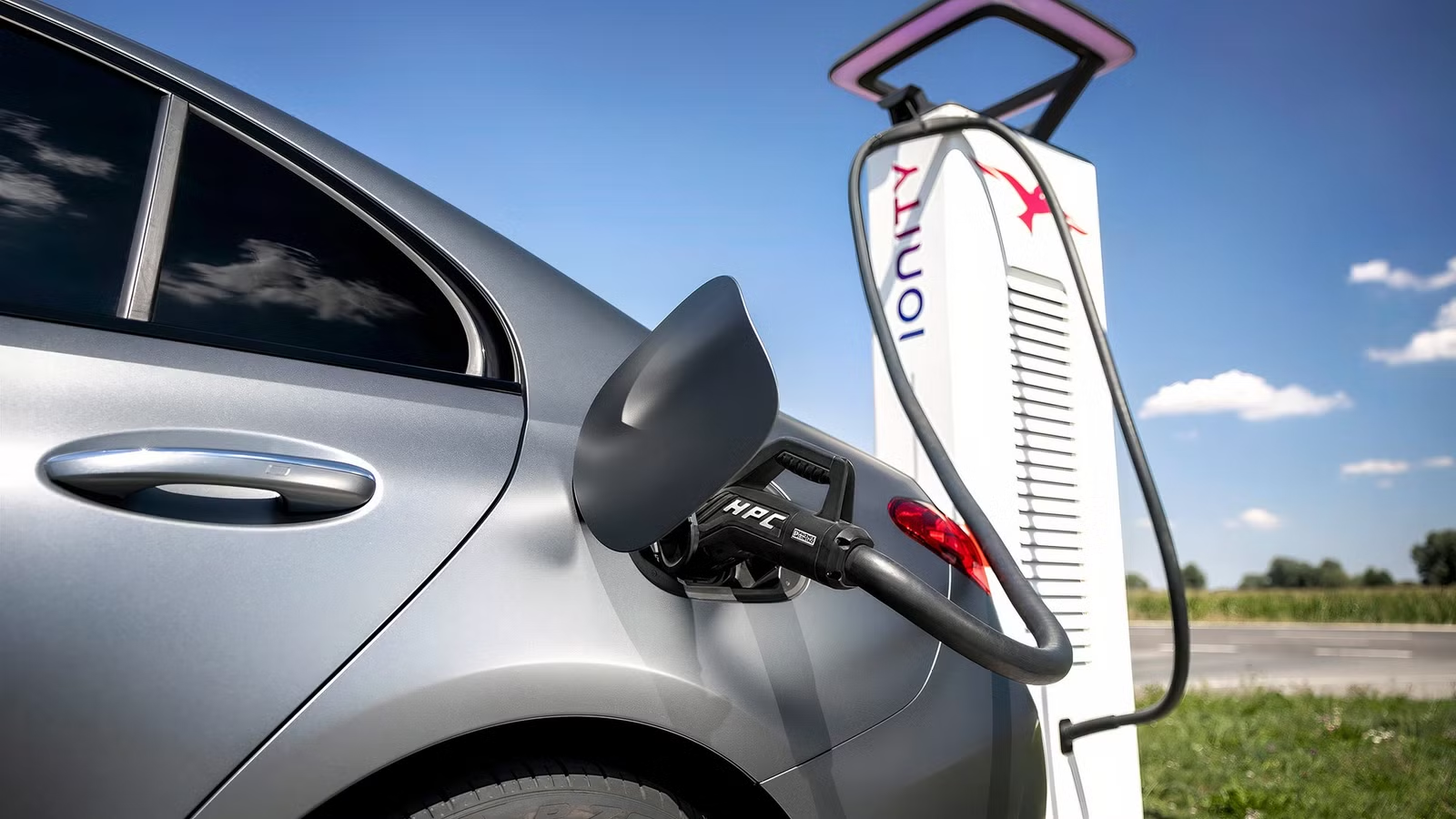
Probably the most important trait for owners of the 2026 Mercedes-Benz S 580e 4Matic is how effortlessly it goes about its tasks, requiring very little sacrifice from its owner to attain its long driving range. All that’s needed is to plug the car in overnight, either to a Level 2 home charging unit (240V) for three hours, or into a standard 120V outlet for about eight hours. Fast charging at a DC roadside charging station is not recommended for PHEVs, primarily because they aren’t equipped to handle the superfast charging speeds, so you’re basically spending to charge at a Level 2 rate.
A Mercedes S580e parked in front of a building. Mercedes
Depending on how it’s used during the day, the 48-mile range on a full battery should be enough to handle most daily driving chores, but if you want to be sure you have enough charge for the trip home from the office, plugging it into a standard outlet during the workday will almost assuredly get the battery back up to full. The S 580e is able to handle DC fast charging, but at a 60-kW rate for 20 minutes for the 22.7-kWh battery to attain an 80% charge, whereas the EQS electric sedan takes 30–35 minutes for its 118-kWh battery to attain an 80% charge at 200 kW.
How It Delivers Class-Leading Electric Range
Front 3/4 view of a Mercedes-Benz S580eMercedes-Benz
The foundation of the 2026 Mercedes-Benz S 580e 4Matic’s performance, or that of any PHEV, is a large battery pack, but there are things to be done to eke every mile out of every kW. And you also have to balance battery size with packaging, which is critical in a sedan because you lose either cargo or passenger space that can’t be as easily hidden as in a wagon bodystyle, like an SUV. The PHEV S-Class integrates the various electrification hardware without dramatically compromising overall volume, to retain its flagship sedan character.
Front end of a Mercedes-Benz S580eMercedes-Benz
Charging capability is equally important but often dismissed in a PHEV. Forbes reports that PHEV owners often prioritize gasoline driving, relishing the added performance boost while treating driving on electricity alone as a “bonus.” Even with its documented performance enhancements, the S 580e’s electric-only driving is a core part of its ownership experience, theoretically offering the utopia of a gasoline-free week simply by plugging it into a wall at the end of the day.
Range, Efficiency, And Daily Usability
2025 Mercedes-Benz S580 badgeMercedes
S 580e 4Matic
S 580 4Matic
EQS 580 4Matic
Starting Price
$130,400
$130,700
$123,900
Powertrain
3.0-liter turbo inline-6 + 1 motor
4.0-liter twin turbo V-8 mild hybrid
2 electric motors
Transmission
9-speed automatic
9-speed automatic
Direct drive
Power
503 hp
496 hp
536 hp
Torque
553 lb-ft
516 lb-ft
633 lb-ft
Driveline
All-wheel drive
All-wheel drive
All-wheel drive
Battery Capacity
22.7 kWh
—
118 kWh
Fuel Tank Capacity
17.7 gallons
20 gallons
—
Electric Range
48 miles
—
371 miles
Overall Range
470 miles
400 miles
371 miles
Electric Efficiency Combined
63 MPGe
—
93 MPGe
Gasoline Efficiency Combined
23 mpg
20 mpg
—
Energy Consumption Per 100 Miles
53 kWh + 4.3 gallons
5.0 gallons
36 kWh
Cost To Drive 25 Miles
$1.99
$6.81
$1.34
The result of the 2026 Mercedes-Benz S 580e 4Matic’s engineering is overall EPA-rated efficiency that surpasses both other Mercedes S 580 variants, with the others having their own strengths that eclipse the 580e. Like the EQS 580, it is able to cover drivers’ daily driving routines on electricity alone, provided the battery is fully charged and ready to go each morning. It is also able to handle occasional long-distance road trips, stopping less often to fill up on gasoline than the S 580. And in both cases, it behaves as you would expect the flagship Merc sedan to.
How The Charging Routine Enables A No-Fuel Work Week
Mercedes-Benz S63 SE Performance chargingMercedes-Benz
The 2026 Mercedes-Benz S 580e 4Matic succeeds because it fulfills the promises of both a plug-in hybrid and a sedan: meaningful electric driving range without sacrificing unrestricted mobility and flagship sedan comfort. It uses a sedan’s natural efficiency advantages, such as aerodynamics and a hunkered-down stance, while avoiding the compromises associated with EV ownership, such as detailed long-distance trip planning.
2026 Mercedes-Benz S 580 4MATIC front 3/4 driving shotMercedes-Benz
Traditional hybrids are excellent for fuel economy in city driving, and mild hybrids like the Mercedes-Benz S 580 offer a modicum of fuel savings while maintaining expected performance, but neither rarely, if ever, eliminates gasoline use beyond low-speed parking lot navigation. The Mercedes-Benz S 580e 4Matic not only allows driving on electricity alone at regular urban speeds but encourages it over days, with a simple end-of-day routine of topping up the battery.
It Could Drive All Week Without Using A Drop Of Gasoline
2025 Mercedes-Benz S580 front 3/4 shotMercedes
The 2026 Mercedes-Benz S 580e 4Matic is the best example of a plug-in hybrid sedan that can act like an EV over days and even a week of regular driving, without using a single drop of gasoline. Rather than offering symbolic electric-only driving, like many PHEVs, it embraces electric range as the ideal, using its gasoline reserves if they may be needed. By following an end-of-day charging routine, S 580e owners can realistically avoid filling up on gasoline during the workweek.
2021 – 2026 Mercedes-Benz S-Class Sedan exteriorMercedes
Sedans are inherently better aerodynamically than the current go-to family vehicle, the SUV, and they sell a different vehicular mindset—personal space and calmness. Both those ideals are enhanced in a plug-in sedan that can be a sanctuary during commutes and a serene highway cruiser on extended trips. The flagship Mercedes S-Class is the epitome of comfortable cruising, but if it’s a bit too rich for your blood, or if you’re seeking more performance, there are alternatives that can also cut your gasoline use down to zero during the week.
The 2026 Toyota Prius PHEV Goes A Lot Farther Overall And Saves A Lot More Money
Toyota
An apples-to-oranges comparison, but for buyers seeking the same long-electric-range priority in a more accessible car, the 2026 Toyota Prius PHEV pursues many of the same goals: maximizing electric driving capability while retaining unrestricted gasoline peace of mind. The Prius leans into the efficiency, low-operating-cost philosophy that has epitomized the compact car since its introduction 26 years ago, and though it doesn’t go as far as the S 580e on electricity alone, it goes a lot farther once the ICE takes over, and saves a lot more money doing it.
The 2026 Mercedes-AMG E 53 Hybrid Offers Performance Without The Need For Gasoline
2025 Mercedes AMG E53 sedan front 3/4Mercedes-AMG
Using the same powertrain as the S 580e, the 2026 Mercedes-AMG E 53 Hybrid offers a substantial electric-only driving range in a high-output executive sedan. Many buyers will choose to exploit its superb performance credentials, but for commuters with predictable mileage, it also delivers stylish work trips, errands, and dinner runs without using a single drop of fuel over several days, just by plugging it into a wall at night. The E 53 Hybrid leans into low-slung aerodynamics, balanced handling, and long-legged highway composure to enhance the already revered Mercedes E-Class.
Base Trim Engine
3L AMG I6 Hybrid
Base Trim Transmission
9-speed automatic
Base Trim Drivetrain
All-Wheel Drive
Base Trim Horsepower
442 HP
Base Trim Torque
413 lb.-ft.
Base Trim Fuel Economy (city/highway/combined)
21/31/24 MPG
Base Trim Battery Type
Lead acid battery
Make
Mercedes-Benz
Model
S-Class Sedan
Sources: Mercedes, the EPA, Axios, Forbes, Edmunds








No Comments