
This Performance Shop Can Turn Your LS V8 Into a V12
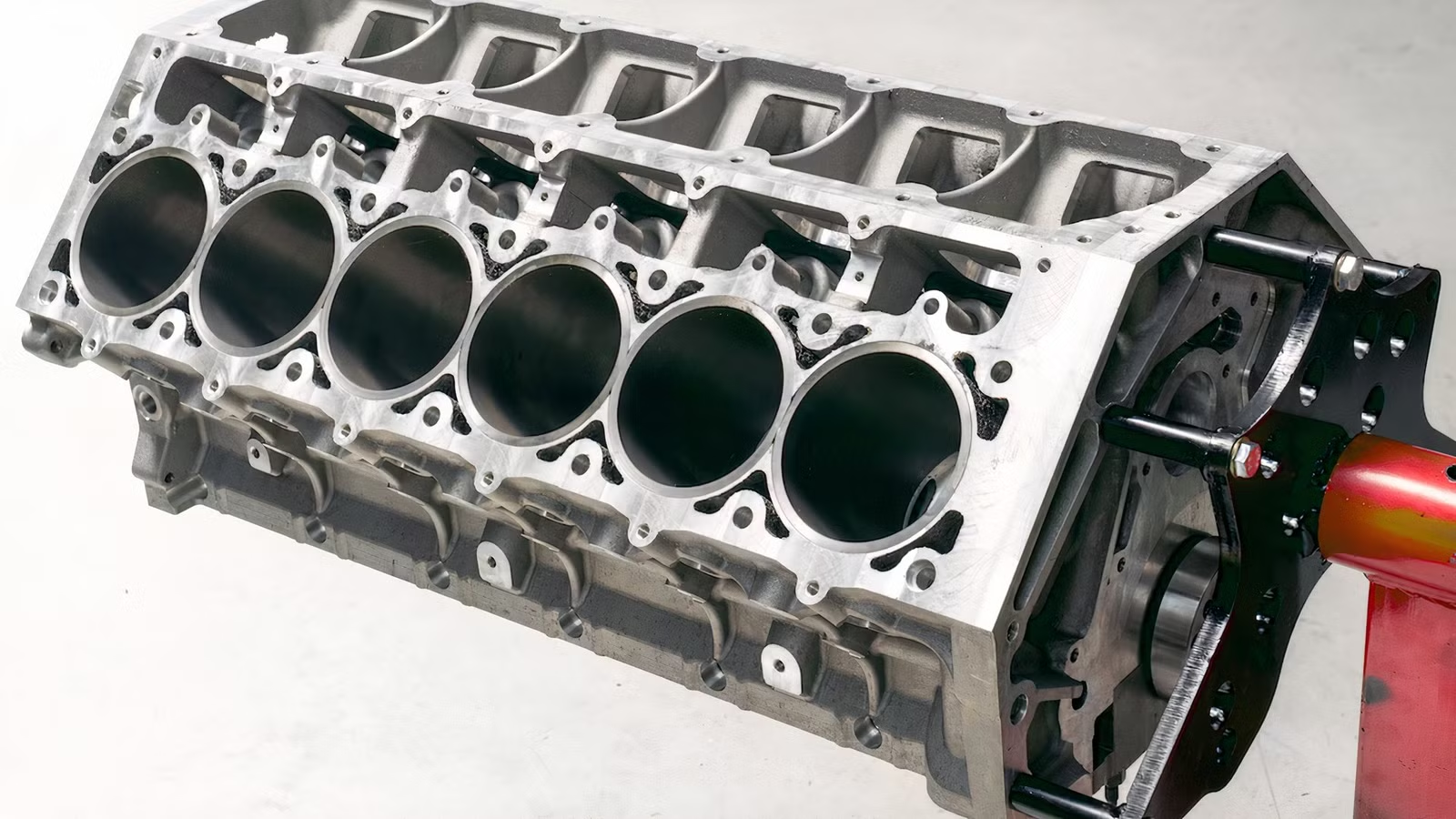
It’s hard not to feel like you’ve seen it all when it comes to restomod engine builds. You take an GM LS V8, slap some turbos or a big blower on top, maybe a shot of nitrous, blow the whole budget doing all of that, and leave the interior stripped out to the floorboards. It’s getting a little monotonous, and a little sprinkle of something different in the engine department would be like a breath of fresh air. Surprisingly, that breath can come from the same LS block under the hood of most restomods, plus a few cylinders.
Why Standard LS Swaps Are Getting Too Predictable

Walk down any row at a car show or scroll through build threads for five minutes, and you’ll trip over a dozen turbocharged LS swaps making four-digit horsepower. Don’t get us wrong, GM’s small-block V8 earned its stripes through cheap parts and compact packaging, not to mention a billion-dollar cottage industry catering to the aftermarket for these engines.
The LS is the logical default for everything from drift Miatas to classic muscle restomods. Yet when every high-dollar custom build relies on the exact same eight-cylinder recipe, even a 1,000-horsepower twin-turbo setup barely makes your head turn anymore. It’s the equivalent of having A5 Wagyu for dinner every night; even the good stuff starts to feel mundane if you have a heaping portion of it daily.
It’d be easy to say there’s nothing left that can be done to an LS that can really get you excited. On the face of it, every avenue of small-block V8 tuning has already been mapped out to the last decimal place. Well, what if that’s not the case just yet? What if there were someone out there who’s done something to an LS block we’ve genuinely never seen before? Maybe we’re wrong, but maybe, just maybe, someone has the answer: by adding four extra cylinders.

How You Stretch a Pushrod V8 Into Twelve Cylinders
Stretching a 90-degree pushrod V8 into a twelve-cylinder isn’t as simple as welding two junkyard blocks together. That said, that’s more or less how the earliest proof-of-concept prototypes started life roughly a decade ago. To make a twelve-cylinder small-block viable for serious street and strip builds, the block and cylinder heads had to be cast from scratch as unified, one-piece aluminum components while preserving factory LS geometry with a few small changes.
First, you’d have to pick which LS block to cast. Rather than inventing an entirely new block architecture from a blank sheet, you could build around the proven 4.4-inch bore spacing and 9.24-inch deck height of an aluminum LS3. Packing two extra cylinder bores onto each bank should theoretically add just under nine inches to the block’s overall length, leaving the twelve-cylinder roughly as long as a classic inline-six and keeping stock LS1 front accessory mounts and GM bellhousing bolt patterns.

Up top, custom one-piece aluminum cylinder heads would need to blend high-flowing LS7-style port geometry with standard LS3 valve lengths and head-stud spacing. A normal cast iron crankshaft would be woefully insufficient, so a billet steel unit would be an absolute necessity. Because it’d still be a 90-degree pushrod engine, the exhaust note would have a sharp bark to it, not the high-rpm scream of a European V12. It would be great if someone could pull it off. Well, a group in Australia actually did.
Meet the Race Cast Engineering V12LS Conversion Kit

Based out of Melbourne, Race Cast Engineering is one of the few performance outfits on Earth both skilled and insane enough to turn that theoretical exercise into a real, off-the-shelf conversion kit you can actually bolt into a restomod. Their flagship V12 LS engine builder kit takes all the theory above and executes it in a way that can be sold and shipped to the masses. Starting with a 564-cubic-inch (9.2-liter) base displacement via a 3.622-inch stroke, all the way up to 607 cubic inches (9.94 liters) if you opt for their 3.9-inch stroker crank, those extra four cylinders only make the fully-dressed block weigh 421 lbs,or less than a cast-iron LS truck block.
Inside, that billet steel crankshaft rides in seven equal-sized 55-millimeter main bearings and utilizes an odd-fire 30/90-degree firing order that essentially functions like two inline-sixes sharing a crank, preserving neutral primary and secondary balance while giving the exhaust note its unmistakable, raspy bark. Depending on cam selection and induction, naturally aspirated builds comfortably produce 750 hp on a mild street tune.

On the high end, that number jumps to 900 hp and 800 lb-ft of torque while accepting standard LS valves, rockers, clutches, bellhousings, starters, and front accessory hardware. This LS V12 is nothing short of an engineering marvel, but it doesn’t come without considerable costs.
Costs, Facts, and Figures

With a base builder kit price hovering around $56,600 (roughly $38,000 USD), the V12LS is the exact opposite of a junkyard budget botch job. Because Race Cast Engineering supplies it strictly as an unassembled alloy builder kit with the block, crank, heads, cams, and valve covers, that sticker price is just the entry fee.
Once you factor in custom pistons, connecting rods, bearings, valvetrain components, intake manifolds, and a standalone ECU that can handle the odd-firing V12 configuration, you’re talking about a six-figure build by the time you have a running, driving car with a full interior. Still, for an LS build that breaks convention and actually turns heads at car shows, that’s a very fair price.
Source: Race Cast Engineering

Related posts


Latest Post



No Comments