
This Old-School Japanese Muscle Bike Still Looks Ready To Start A Bar Fight
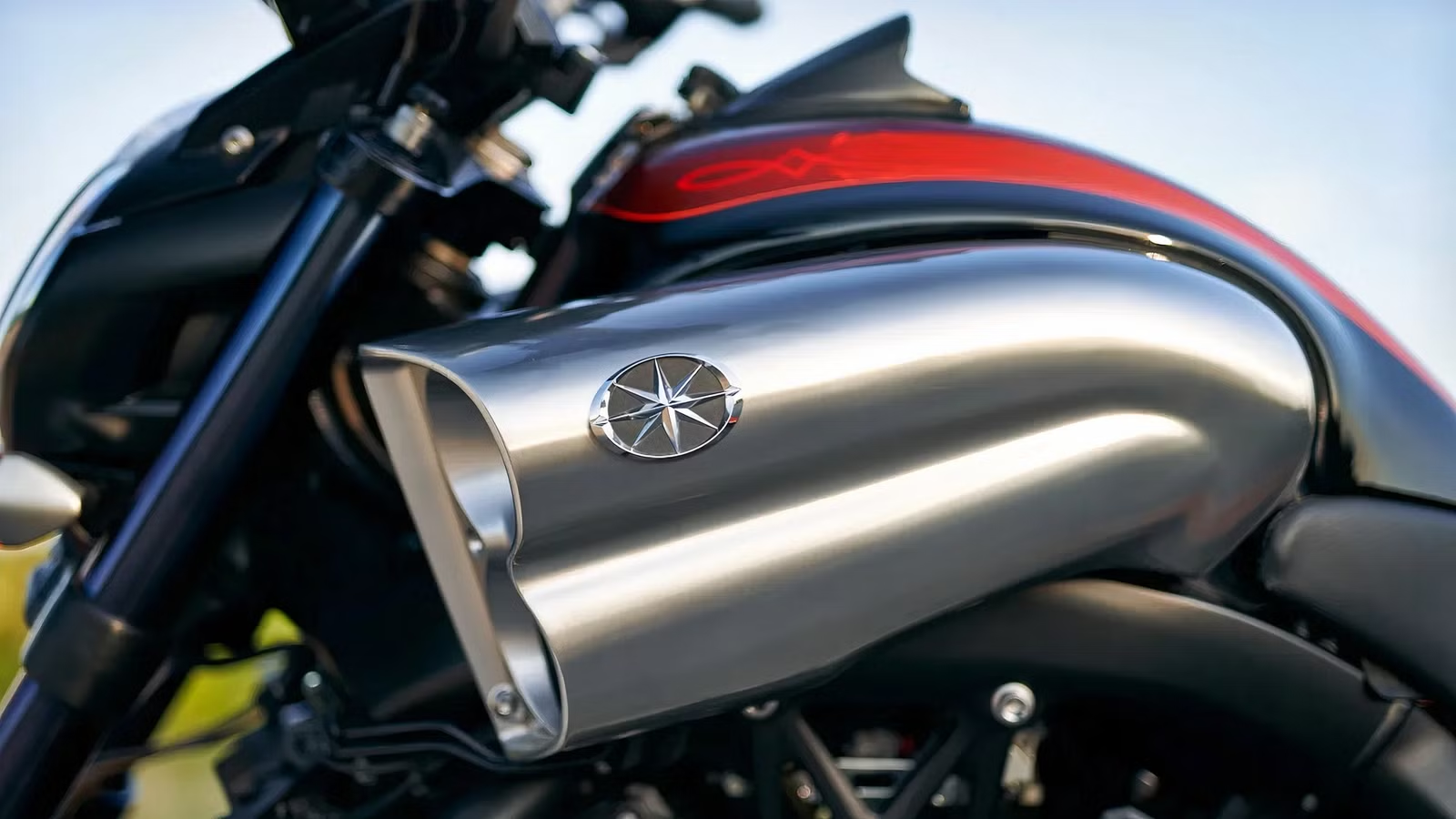
A motorcycle inspired by Mississippi drag racing was never going to grow up sensible. Yamaha wanted something built around acceleration, attitude, and the kind of mechanical excess American riders already understood from Detroit.

They had a crack at it, and what came out looked like a muscle car had somehow lost two wheels. There were lots of ways to describe it, including (but not limited to) broad, unapologetically mechanical, and way more interested in the next stoplight than the next apex.
The 1980s Had Fast Bikes, But Not Enough Muscle
Motorcycles were getting seriously quick by the middle of the 1980s. Japanese manufacturers were pushing sport bike performance harder every year, and outright speed was becoming easier to find. Despite that there was still a gap for those who wanted something different from a race-bred machine. Straight-line acceleration could be its own form of entertainment, particularly in the USA, where drag racing and muscle car culture had already made that argument pretty convincingly.

Yamaha saw an opportunity there. Instead of chasing another razor-sharp superbike, it could build a Japanese muscle bike around one very simple question: how hard could a big engine shove a rider toward the horizon? The answer didn’t require delicate handling or racetrack bodywork. It required a large motor, a substantial rear tire, and enough visual aggression to make the intention obvious before the engine even started.
Big V4, Big Personality

Coverage at the time made clear that this motorcycle was meant as a performance statement for Yamaha. By 1988, the U.S. price sat at $5,899, which bought something much stranger than a conventional cruiser. It had a big V4, shaft drive, and a personality built around acceleration rather than top-speed bragging rights.
As mentioned earlier, plenty of motorcycles from the era could go fast. This one wanted you to feel the shove, hear the intake noise, and know exactly where the engineering budget had gone.
Japan Built This Bruiser With Detroit On The Brain

The idea took shape after Yamaha project leader Akira Araki spent time in the United States and encountered American Drag Racing culture. One particularly influential sight involved riders racing across a bridge over the Mississippi River. The appeal was easy to see: start here, finish there, and find out who got across first.
That fed directly into the new Yamaha project. Development work passed through Yamaha’s GKDI design office in Santa Monica, California, where American hot rods and Muscle Cars helped influence the motorcycle’s proportions. Rather than imitate a Harley-Davidson cruiser or soften a Japanese sport bike, Yamaha was chasing the two-wheeled equivalent of a big-engine street machine.
The Big Ask

You can see that thinking immediately in the bodywork. Huge side scoops sit beside what appears to be the fuel tank, although the actual fuel tank is mounted beneath the seat. The long 62-inch wheelbase and chunky 150-section rear tire give the bike a planted, rear-heavy stance. Even standing still, it looks as though somebody’s already staged it at a drag strip.
The design was unusual enough to cause some uncertainty inside Yamaha, but American dealers understood the joke immediately when the bike appeared at a Las Vegas convention in October 1984. Their reaction helped validate the idea, and the motorcycle reached U.S. buyers the following year. America had asked for big attitude from its performance machines for decades, and Yamaha just decided to answer in Japanese.
The Yamaha VMAX Turned A V4 Into A Blunt Instrument

This all leads up to the 1985 Yamaha VMAX, and the heart of the whole thing was a 1,198cc liquid-cooled 72-degree V4. Its basic architecture came from the Yamaha Venture Royale touring bike, which was hardly the obvious starting point for something that would become one of Japan’s best-known muscle bikes.
Yamaha substantially reworked the engine for its new job. Bigger valves and hotter camshafts helped transform the touring V4 into something so much angrier. Full-power versions were rated at around 143 hp at 8,000 rpm, while Yamaha’s own crankshaft claim has also been quoted at 145 hp. Either way, those were serious numbers in 1985, especially in a motorcycle shaped more like a bruiser than a contemporary sport bike.
Wet weight was around 631 pounds, so nobody was going to confuse the original Yamaha VMAX with a featherweight superbike. That weight actually suited its personality perfectly. The bike felt substantial because, well, it was substantial, and the engine had enough muscle to make the mass feel far less important once the throttle opened.
Power went through a five-speed transmission and shaft drive, another clue that Yamaha wasn’t trying to build a conventional sport bike. The upright bars and mid-mounted foot controls also gave riders a relatively natural position. You didn’t need to fold yourself into a racing crouch to access the performance. You sat upright, twisted the throttle, and discovered why the rear tire probably deserved its own expense account.
V-Boost Was Where The Trouble Really Started

The original Yamaha VMAX had one trick that became central to its reputation: V-Boost. Yamaha connected the intake tracts between paired cylinders using servo-operated valves. As engine speed rose beyond roughly 6,000 rpm, those valves began to open, allowing each cylinder to draw through two carburetors instead of one.
By around 8,000 rpm, V-Boost was fully open. What you got was an extra rush higher in the rev range, giving an already muscular V4 another layer of urgency. There was no turbocharger hiding under the bodywork and no complicated modern electronics managing the experience. Yamaha found a mechanical way to make the engine feel like it had discovered another set of lungs.
Straight And Narrow

That straight-line performance was phenomenal. The first-generation Yamaha VMAX could cover the quarter-mile in roughly 10.89 seconds, while a full-power late-1980s example could run to about 140 mph. Those figures help explain why the VMAX became such a big deal in America. The motorcycle behaved like a Japanese interpretation of a classic muscle car: hit the throttle hard, hang on, and leave the finer points of chassis balance for another conversation.
There were certainly finer points worth discussing. The early bike used a tubular-steel frame, 40mm front forks, and twin rear shocks. Hard riding could expose brake dive, high-speed instability, and the limitations of asking a relatively traditional chassis to keep a 143 hp V4 completely in line. The VMAX was happiest when the road straightened and the rider stopped asking philosophical questions about corner speed.
Four Decades Later, It Still Looks Like Bad News

The first-generation Yamaha VMAX stayed in the catalog for more than two decades with relatively modest development, which says plenty about how well Yamaha understood the original concept. People wanted that shape, that V4, and the feeling that every commute contained the possibility of undeniable danger.
Yamaha eventually reinvented the VMAX for 2009 with a new 1,679cc 65-degree V4 rated at 197 hp and 123 lb-ft of torque. The newer Yamaha muscle bike gained an aluminum frame, stronger brakes, and ABS, while keeping the basic idea centered on huge acceleration. Quarter-mile performance was around 10.86 seconds, with top speed near 143 mph.
Power Mover

But there are plenty that still hail the 1985 Yamaha VMAX as the version that cemented the legend. It was conceived with America in mind, influenced by U.S. drag-racing culture, and designed with the same engine-first mentality that made Detroit muscle cars such enduring icons. Yamaha effectively helped define the Japanese muscle bike long before the segment became crowded with modern power cruisers.
Four decades later, it’s not a stretch to suggest the Yamaha VMAX has still got it. It still looks ready to light up its rear tire, pick a fight with the next stoplight, and make perfectly responsible adults wonder how expensive a bad decision could really be.
Sources: Cycle World, Bennetts, Old Bike Barn, MCN.

Related posts
Latest Post


No Comments