
These Gorgeous Italian Sport Bikes Make Japanese Superbikes Look Underdressed
By the early 90s, a general pattern had emerged in sport bike design. While there were obviously little tweaks here and there, fully faired motorcycles were starting to all look pretty similar, with aerodynamic efficiency and cooling primary design functions. With the notable exception of the Italian brands.

Ducati was still in a state of financial flux at the time, but somehow found a way to introduce a motorcycle that would quite literally reshape motorcycle design as we knew it. After that, we got one impressive model after another from all the Italian brands. All stunning, but not always reliable.
Buying a used motorcycle always has an element of risk attached (more so when it comes to exotic Italian motorcycles!), so please do your research, and proceed with caution. The motorcycles on this list go from oldest to newest.
8
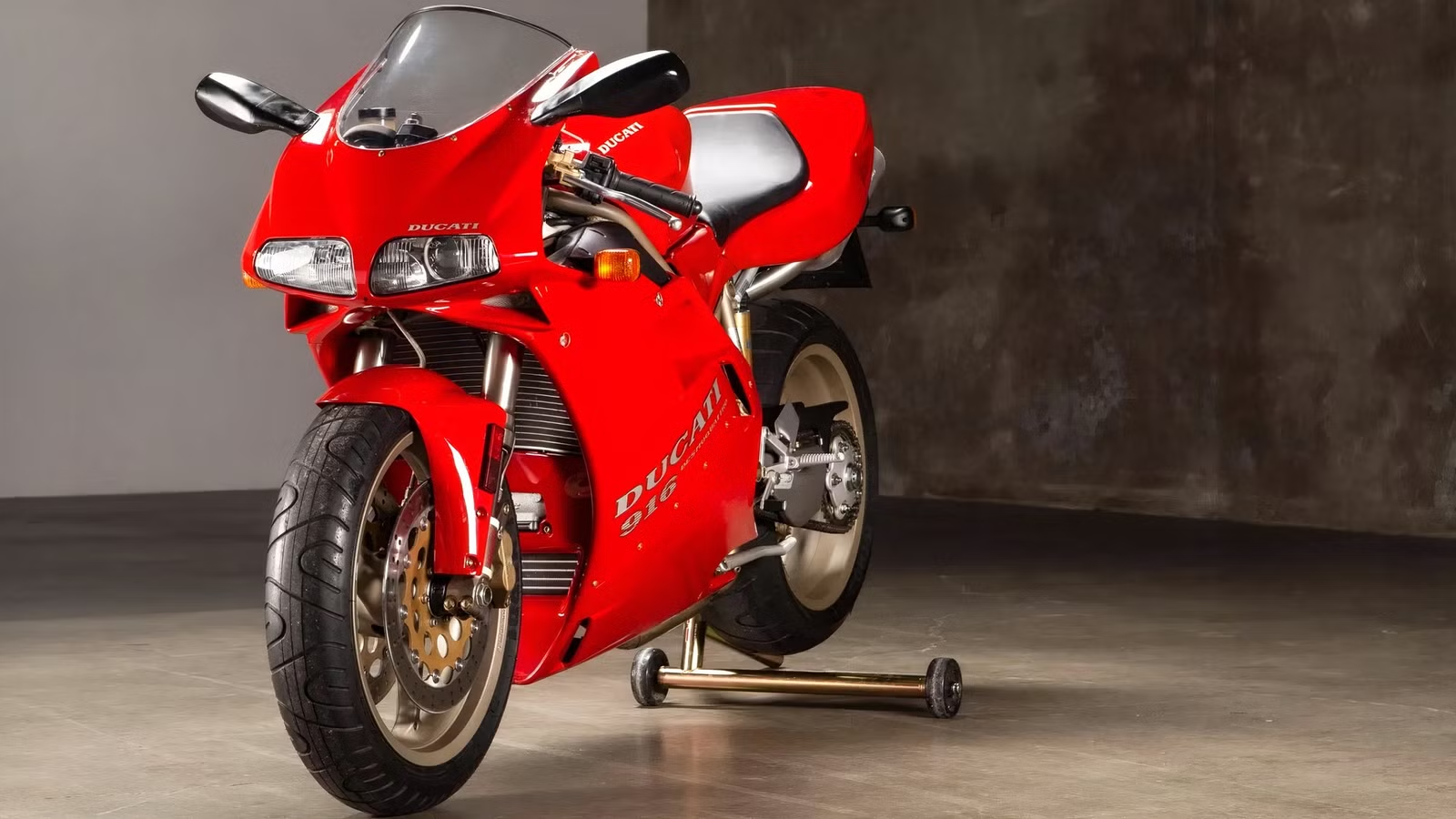
1994 Ducati 916
Price Range: $10,000 – $12,000

Design is always a subjective topic, but the 916 is one of the few objectively beautiful motorcycles. Surprisingly, famed designer Massimo Tamburini drew much of his inspiration for his masterpiece from a Japanese bike in the form of the Honda NR750. Its flowing lines were kept intact largely thanks to its under tail exhaust and single-sided swingarm.

These two key design elements were lifted straight from that model, but it is fair to say that 916 is no imitation. It looks entirely different, and would go on to serve as an inspiration to motorcycle designers from all over the world, and its influence can still be seen today on several modern bikes. While this is a lot of money for an old sport bike, it is an attainable classic which can also be rewarding to ride.
7
1999 MV Agusta F4 750 Serie Oro
Price Range: $30,000 – $40,000

Tamburini had by this time moved to MV Agusta. While Ducati’s follow-up to the 916/996/998 fell flat, the F4 won praise from all corners. A quarter of a century after this bike was penned, it still looks modern. You can, in fact, still go out and buy an F3 which shares its design, albeit with a few modern aerodynamic adjustments.

Unfortunately, while both light and powerful, these early F4s were frightfully unreliable. So, a certain level of discernment, and restraint, will be required if you were to try and purchase one. Like pretty much any older Italian bike, wiring can become a nightmare, and Ferrari helped develop these engines, so, in terms of parts, nothing will ever be remotely affordable. While the Serie Oro pictured here is rare and highly collectible, the regular 750cc F4 which came out the following year is more attainable.
6
2009 Ducati 1198
Price Range: $7,000 – $9,000

After the 999 fell flat, the 1098 got Ducati back on track, and the 1198 built on that success. Its flowing lines make it look fast even while it is standing still, and, unfortunately, it is the kind of motorcycle that might be standing still for long periods of time without any good explanation. One potential cause can be the heat generated by these twins, which tends to make the wiring go hard and brittle, and aside from replacing an entire wiring harness, there is no easy fix for that.
On the upside, owners generally take good care of these machines. Missing a desmo service is a crime punishable by catastrophic engine failure, so it is pretty easy to see why owners take good care of these bikes. Keeping them in good shape will require a sizable budget, yet, in most cases, the pain really is worth the pleasure.
5
2012 Aprilia RSV4 Factory
Price Range: $8,000 – $10,000

After several years of relying on Rotax for V-twin engines, Aprilia, and by extension, the Piaggio Group finally developed their own engine. Although this V4 has since gone from strength to strength, these early models were drought with teething issues. So, there is no denying the fact that purchasing one of these comes with a fair amount of risk.

But, it looks striking. Before winglets captured Aprilia’s imagination, the RSV4 was a design masterclass. Underneath its beautiful exterior lay an exceptional, lightweight chassis to go along with its potent V4. It was, and in many ways still is, the complete superbike. When it runs…
4
Aprilia RS 660
MSRP: $11,849

Yes, it has a wing, and yes, that wing has Aprilia printed on it like some sort of rolling billboard, but it is still well integrated. Unlike the massive wing on the RSV4, it blends seamlessly with the overall design of the bike. Which, in our opinion, is timeless, and will be looked back on with a degree of fondness not afforded to it now while it is still a new motorcycle.

It also proves that you don’t need to be a one-percenter to own a gorgeous Italian motorcycle. At this price point it is genuinely affordable. Its parallel-twin, which makes over 100 horsepower, has proven to be reliable, and with a wet weight of just 403 pounds, it is one of the lightest middleweight bikes on the market.
3
Ducati Panigale V2
MSRP: $16,995

Just like the RSV4, the latest Panigale V4 is basically more wing than motorcycle. The latest V2 simply doesn’t need that sort of downforce (although we are not entirely sure any production motorcycle does), and there is a clear resemblance between it and the aforementioned 1198. Which is not a bad thing at all.
Mercifully, that is more or less where the resemblance ends. Its V-twin is a thoroughly modern lump which promises to be as, if not more reliable than any Ducati engine. The desmodromic valvetrain of the previous model has been ditched in favor of conventional valve springs and modern variable valve timing.
2
MV Agusta Superveloce 1000 Serie Oro
MSRP: $70,098

While the middleweight Superveloce 800 offers a similar design, the limited-edition Superveloce 1000 Serie Oro just offers something a little different. Unlike some other modern creations with wings that seem to be an afterthought, this bike looks like its wings were part of the whole neo-retro design philosophy from the outset.
It is a bold design choice, and while we love it, it is not the kind of motorcycle that will leave anyone on the fence. Underneath lies the beating heart of the old F4, and the same exceptional chassis. A long list of high-end components helps justify its price tag, but unlike most of the other bikes on this list which are all attainable, this is pure Italian exotica.
1
Bimota KB998 Rimini
MSRP: N/A

While the aforementioned Superveloce might be “exotica”, the KB998 Rimini amounts to unobtainium for US buyers. In Europe, it can be had for the equivalent of around $45k (as stipulated by WorldSBK rules), and in our opinion, is worth every cent. It combines the best of Japan with the best of Italy to deliver a homologation special of the highest order.

Kawasaki bought Bimota some years ago, and after a string of exceptional street bikes, this is the first real track-oriented machine Bimota has built under Japanese ownership. This is very much within the scope of the famed frame builder. Even though the KB998 has competition-spec wings, just like Aprilia and MV, Bimota found a way to integrate them into the overall design.
Sources: Various manufacturer websites

Related posts

Latest Post


No Comments