
This Motorcycle Started A Superbike Electronics Arms Race Nobody Saw Coming
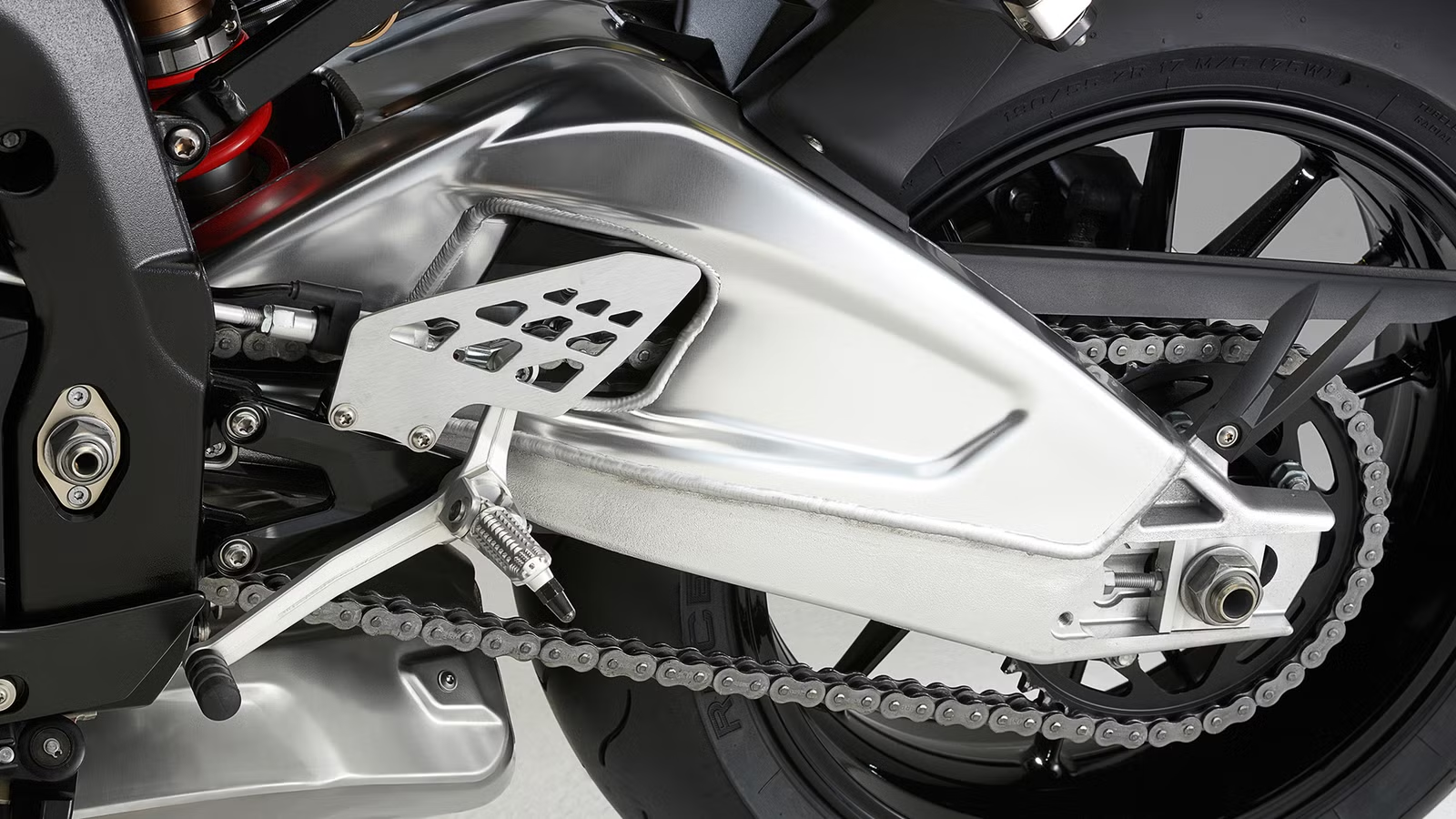
Modern motorcycles owe much of their incredible performance and safety to electronic rider aids, transforming riding from a discipline based almost entirely on skill into one enhanced by intelligent technology.

The 1988 BMW K100 pioneered production motorcycle ABS, while Honda’s ST1100 Pan European introduced one of the first production traction control systems in 1992. Yet these innovations remained largely separate until one ground-breaking superbike combined multiple electronic rider aids into a single, integrated package, forever changing riders’ expectations of what a high-performance motorcycle could deliver on both road and track.
Electronic Rider Aids Existed Long Before They Became Mainstream
The introduction of anti-lock braking systems marked the first real step towards electronically assisted motorcycling. Rather than replacing rider skill, ABS was designed to prevent wheel lock under heavy braking, helping riders maintain steering control and stability during emergency stops or on slippery surfaces. Although many enthusiasts were initially skeptical, real world testing soon demonstrated that the technology could significantly reduce the likelihood of crashes caused by locked wheels.

Traction control followed a few years later, but its early applications were far less sophisticated than the systems riders know today. Designed primarily for large capacity touring motorcycles, these first-generation systems monitored rear wheel slip and reduced engine output when grip was lost. They lacked the speed, precision and multiple intervention strategies of modern electronics, but they proved that electronic rider aids could improve confidence and safety without compromising everyday usability.
The BMW S1000RR Changed What Riders Expected From A Superbike

When the BMW S1000RR arrived for the 2010 model year after its 2009 launch, it marked the German manufacturer’s first production superbike and its most ambitious performance motorcycle to date. Rather than simply chasing outright power, BMW focused on making nearly 200 bhp more accessible through an unprecedented suite of rider aids developed specifically for a liter-class sport bike.
At launch, the S1000RR combined Race ABS, Dynamic Traction Control (DTC), ride by wire throttle and four selectable riding modes: Rain, Sport, Race and Slick. These systems were fully integrated, allowing the motorcycle’s braking, engine response and traction management to work together rather than as separate technologies. BMW described it as the only supersport motorcycle at the time to offer both Race ABS and DTC, establishing a new benchmark that competitors would soon follow.
It Was Designed To Make Nearly 200 HBP Accessible

When the BMW S1000RR arrived, its 999-cc inline four-cylinder engine produced 193 bhp at 13,000 rpm and 82.5 lb-ft at 9,750 rpm, placing it among the most powerful production motorcycles available. However, extracting that level of performance from a lightweight superbike could easily overwhelm less experienced riders, particularly when accelerating hard out of corners or riding in changing conditions.
BMW’s approach was to use electronics as performance enhancers rather than safety nets alone. Dynamic Traction Control monitored rear wheel slip and intervened, when necessary, while different riding modes adjusted power delivery and system sensitivity depending on the environment. This allowed riders to access more of the motorcycle’s capability with greater confidence and consistency. Instead of reducing the excitement of a high-performance motorcycle, the electronics helped make its extreme performance more usable for a wider range of riders.
Every Riding Mode Changed The Motorcycle’s Personality

The BMW S1000RR’s electronics package was designed to adapt the motorcycle’s behavior to different riding conditions through four selectable modes: Rain, Sport, Race and Slick. Rain mode reduced engine response and increased electronic intervention, helping riders manage the motorcycle in wet or low grip conditions. Sport provided a more direct throttle response while maintaining a safety margin for road riding, whereas Race sharpened the bike’s responses for track use with reduced intervention.
Slick mode unlocked the motorcycle’s full potential for experienced riders by allowing higher levels of rear wheel slip and more aggressive performance. The modes adjusted throttle response, Dynamic Traction Control sensitivity and Race ABS characteristics, creating four distinctly different riding experiences on the same machine. This approach was revolutionary because electronics no longer simply reacted to problems; they actively shaped the motorcycle’s performance.
Race ABS Was Unlike Anything Most Riders Had Experienced

Traditional motorcycle ABS systems were designed primarily around safety, but BMW developed Race ABS specifically to meet the demands of high-performance riding. The challenge was creating a system that could prevent dangerous wheel lock during emergency braking while still allowing experienced riders to brake aggressively on a racetrack.
Unlike earlier touring focused systems, the S1000RR’s Race ABS was lightweight and integrated with the motorcycle’s riding modes, allowing different levels of intervention depending on the situation. The system used information from wheel speed sensors and engine management to adjust braking performance, helping riders maximize stopping power without sacrificing control.
On the road, it provided reassurance during unexpected situations, while on track it allowed riders to brake later and harder with greater confidence. It demonstrated that electronic assistance could enhance performance rather than simply compensate for mistakes.
Dynamic Traction Control Became The New Performance Standard

BMW’s Dynamic Traction Control (DTC) represented one of the S1000RR’s most significant technological advances because it allowed riders to use more of the motorcycle’s performance with greater confidence. Unlike earlier traction control systems that simply reduced power after detecting wheel spin, DTC continuously monitored rear wheel slip and adjusted engine output to maintain traction.
The system worked alongside the riding modes, allowing different levels of intervention depending on whether the motorcycle was being ridden on the road or pushed on a racetrack. The arrival of the S1000RR changed expectations in the superbike market, with competitors quickly responding by developing their own advanced electronic packages.
Ducati, Kawasaki, Yamaha and Aprilia introduced increasingly sophisticated traction control systems, eventually incorporating lean angle sensors and inertial measurement units. BMW’s approach helped transform traction control from a premium feature into an expected component of modern liter class superbikes.
The Electronics Package Started A Superbike Arms Race

The arrival of the BMW S1000RR forced other manufacturers to rethink what riders expected from a modern superbike. Ducati responded with increasingly advanced systems on models such as the 1199 Panigale, while Aprilia, Kawasaki, Yamaha and Honda developed their own electronic packages for flagship performance motorcycles.
The competition quickly moved beyond basic traction control, with manufacturers introducing systems capable of adapting to changing riding conditions in real time. A major breakthrough came with the adoption of six-axis inertial measurement units (IMUs), which allowed motorcycles to measure lean angle, acceleration and movement while cornering.
This technology enabled features such as cornering ABS, lean sensitive traction control, launch control and electronic wheelie management. Within a few years, electronic rider aids evolved from optional technology into a defining part of superbike development, permanently changing the performance motorcycle landscape.
The S1000RR Proved Electronics Could Make Superbikes Faster, Not Just Safer

When the BMW S1000RR reached riders and professional testers, one of the biggest revelations was that its electronics did not dilute the experience of riding a superbike. Instead, racers and journalists discovered that systems such as Dynamic Traction Control allowed them to apply power earlier when exiting corners and ride closer to the motorcycle’s limits with greater consistency.
BMW’s own development riders demonstrated that electronic assistance could improve lap times by helping maintain traction and reducing mistakes under extreme conditions. Road testers also praised how the technology expanded the bike’s performance envelope without making it feel artificial.
The S1000RR changed the direction of superbike development by proving that advanced electronics were not merely safety equipment, but genuine performance tools. Today, features such as traction control, cornering ABS and riding modes are expected on flagship motorcycles, largely because BMW showed their potential.
Sources: Cycle World, BMW, Motorcycle News

Related posts

Latest Post


No Comments