
This Is The Most Powerful Japanese Cruiser Harley-Davidson Never Wanted To Fight
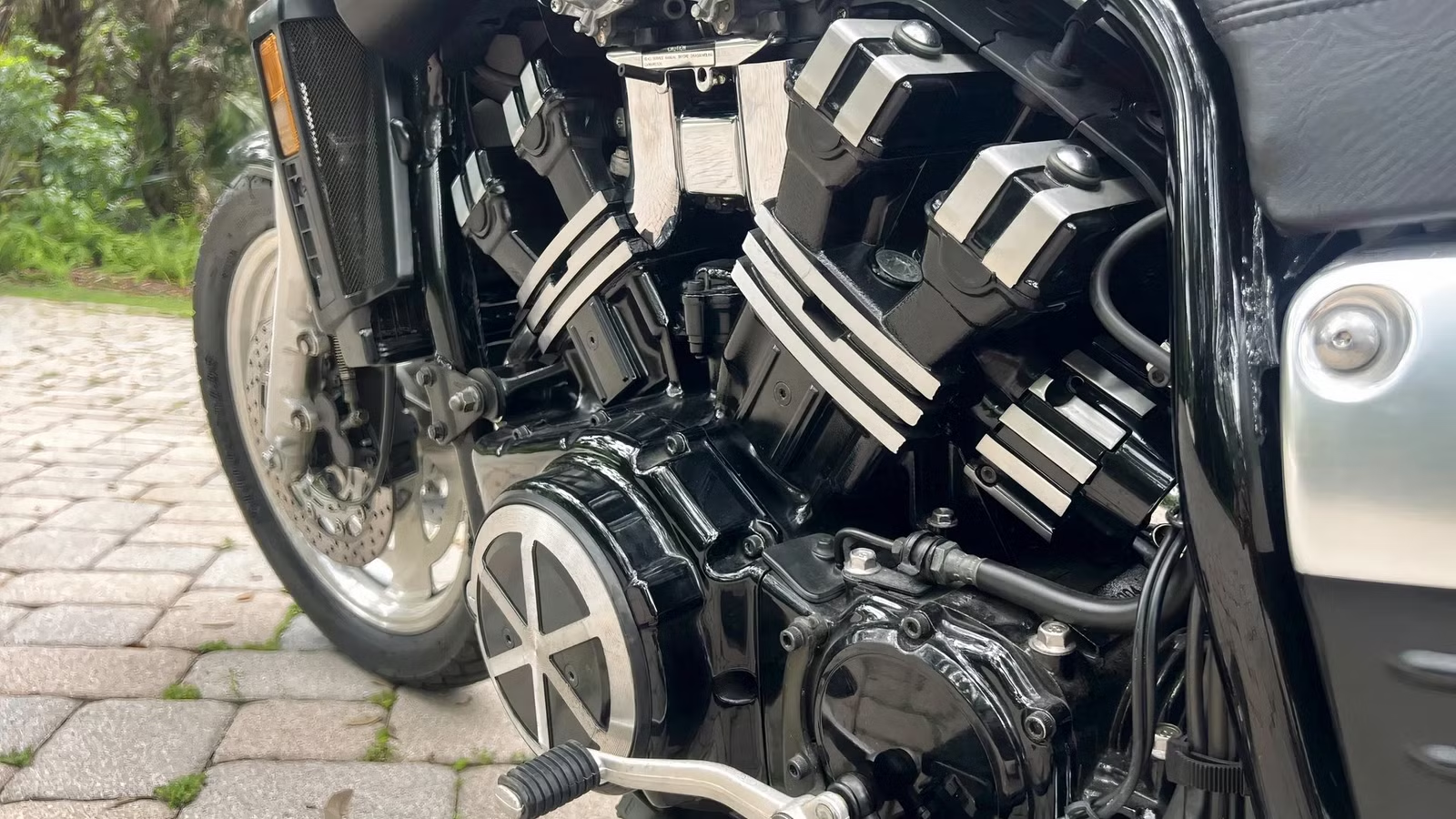
The classic muscle cruiser recipe is pretty simple: big air-cooled V-twin, fat low-rpm torque, and enough exhaust thrum to shake your mirrors loose, isn’t it? Frankly, if you mention one, most people will think of a Milwaukee heavy. But Yamaha blew up that template back in 1985.

Instead of going in line with the tradition or stacking displacement, Yamaha manufactured something purely for the love of speed. They shoved a liquid-cooled V4 into a cruiser’s chassis, claimed over 140 mad horsepower, and laid down quarter-mile numbers that embarrassed standard superbikes.
Japan Had A Very Different Idea Of A Muscle Cruiser
The VMAX was born from engineer Akira Araki’s obsession with American drag racing and V8 hot rods. After a Yamaha research trip to the States in the early 1980s, he returned with one goal: build the most outrageous V4 motorcycle imaginable. Araki teamed up with engineers and designers at GKDI in Santa Monica to bring his vision to life. While Japanese rivals experimented with turbos, Yamaha wanted raw, naturally aspirated muscle.

Traditional cruisers did things one way, but Yamaha was ready to break the mold.
The Yamaha VMAX Was In A League Of Its Own

By the time the bike hit showrooms for 1985, the styling was just as wild as the powertrain. It featured a dummy gas tank, oversized side scoops, and a bare-bones frame designed specifically to showcase the engine. Yamaha hid the actual gas tank under the rider seat and hooked the rear wheel up to a heavy-duty shaft drive.
That was a serious gamble, especially after the concept drawings failed to generate much excitement inside Yamaha HQ. But the public’s response was a completely different story. Yamaha ended up running with that exact same formula for over twenty years. From 1985 to 2007, it stood pretty much uncontested in the power-cruiser market it invented.
That V4 Engine Was The VMAX’s Secret Weapon

The Yamaha VMAX borrowed its 1,198cc V4 from the 1983 Venture Royale, where it made roughly 90 horsepower. But Araki wanted more. Bigger valves, aggressive cams, lighter pistons, higher compression, and four 35 mm Mikuni carbs helped push output toward the 145-horsepower target.
Then came V-Boost. Instead of using a turbo, Yamaha connected the intake passages between cylinder pairs. At 6,000 RPM, computer-controlled valves opened, allowing each cylinder to draw from two carburetors. The result was a savage surge of power that turned the VMAX into an absolute lunatic.
Yamaha Built A Cruiser That Could Humiliate Bigger American V-Twins

The math was almost comical. Harley’s new 1,340cc air-cooled Evolution V-twin, brought in for 1984 to rescue the brand from bankruptcy, unleashed roughly 70 ponies at 5,000 RPM. It was a classic 45-degree pushrod setup doing honest work. Yamaha’s smaller engine, meanwhile, claimed more than double that power from a high-revving, liquid-cooled, 16-valve V4. Per liter, that was roughly 119 horsepower for Japan against 53 for Milwaukee.
Regular riders could run quarter-miles in the ten-second bracket. On a chassis dyno, real-world rear-wheel figures hovered between 112 and 120 horsepower, comfortably outpacing the Harley’s flywheel numbers.
It also wasn’t really a fair fight. Harley’s Evolution was designed to give the company a dependable platform and help pull it out of a very difficult period. The Evo’s job was to save the company. The V-Max’s job was to hunt down sports bikes.
The VMAX Kept Getting Bigger And More Powerful

The original Yamaha changed little over the years, though 1993 brought beefier forks to reduce high-speed wobbles and four-piston brakes for better stopping power. Performance varied by market, with UK models sold from 1991 to 1995 losing V-Boost and dropping to around 95 horsepower. Later versions produced a claimed 133 horsepower at the crank, or roughly 112 at the rear wheel. Then Yamaha finally dropped the hammer.
Yamaha officially unleashed the second-generation VMAX in June 2008 for the 2009 model year, and the specs were unreal. The V4 expanded to 1,679cc, swapping the old 70-degree layout for a tighter 65-degree setup. Claimed output jumped from 133 to 197 horsepower, paired with 122 lb-ft of torque.
To handle that kind of punch, Yamaha mounted the engine inside a rigid aluminum frame as a structural stressed member. The old carburetors made way for fuel injection, while electronic ride-by-wire throttle control paired with variable intake trumpets to deliver the same sudden top-end surge. It picked up some extra mass, settling at 685 pounds wet with a long 66.9-inch wheelbase, but brought modern stopping power with ABS, a slipper clutch, and fully adjustable suspension.
One dyno test recorded 166.4 hp at the rear wheel. The second-generation bike, now styled as VMAX rather than V-Max, stayed in production until after 2020.
The VMAX Was Never Just About Straight-Line Speed

For all the drag-strip fireworks, the original V-Max was never a corner-carving hero. Soft suspension, heavy brake dive, and high-speed wobbles plagued the first generation until beefier forks arrived in 1993. The 2009 redesign fixed the chassis flex, but the bike blew up to 685 pounds with a stretched 66.9-inch wheelbase. It remained a muscle cruiser first and everything else a distant second.
Fuel range was the other massive trade-off. With a tiny 3.96-gallon tank tucked under the seat, the low-fuel light on the 2009 model usually flickered on around the 60-mile mark.
Why Harley-Davidson Never Had A Direct Answer To The VMAX

Interestingly, Harley almost built a V-Max killer first. In 1976, Harley partnered with Porsche on “Project Nova,” developing a liquid-cooled, DOHC V4. The project was shelved right before its planned 1981 launch so Harley could focus all its cash on the air-cooled Evolution engine. Harley’s liquid-cooled performance cruiser didn’t arrive until the 2002 V-Rod, which packed a Porsche-developed, 115-horsepower Revolution V-twin.
The V-Max was not built to take on Harley-Davidson. It was an engineer’s take on the American hot rod, with four cylinders, liquid cooling and a lot of power. When it came to straight-line performance, Harley never really had an answer.

Related posts
Latest Post


No Comments